

Open MRI vs Closed MRI on Cost Accuracy and Comfort
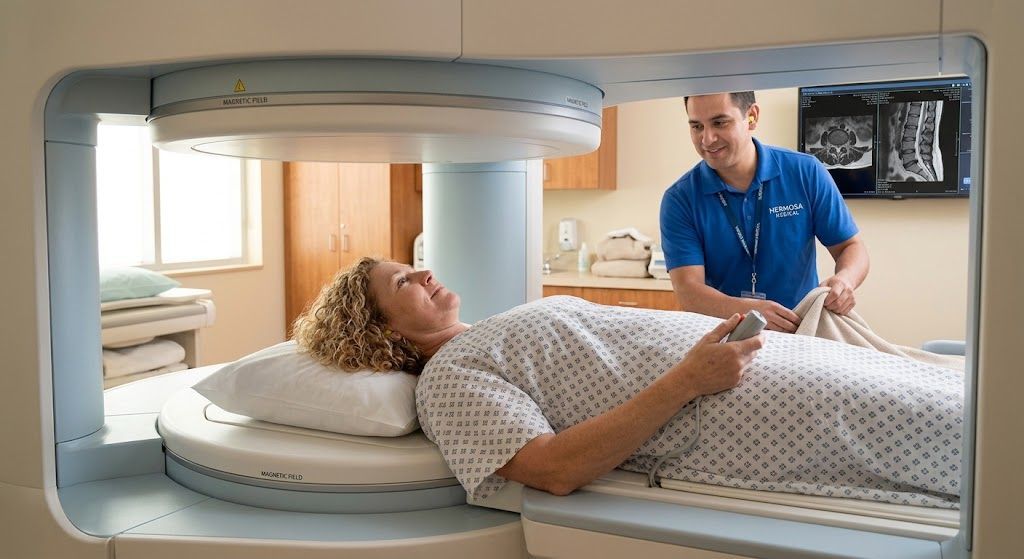
Open MRI vs Closed MRI on Cost Accuracy and Comfort
Reviewed by Otto R. Garcia MD Internist at Hermosa Medical and Diagnostic Center
Last updated: September 2026
Key takeaways
- The common mistake is booking a closed scan you cannot finish rather than an open one you can.
- Closed MRI uses 1.5 or 3 tesla. Open MRI runs 0.3 to 1.2 tesla which is the whole trade.
- Open MRI is adequate for spine and large joints. Brain small joints and vessels need closed.
- Open units commonly take 450 to 500 pounds against 350 for a standard closed table.
- Price is driven by body region and contrast rather than machine type. Insurance treats both the same.
The commonest mistake with MRI is booking the scan you are supposed to have rather than the scan you can actually complete.
Claustrophobia is the leading reason an MRI gets abandoned partway through. An incomplete scan wastes the appointment delays the diagnosis and often leads to sedation being added which brings its own risks monitoring requirements and the need for someone to drive you home.
A completed open scan is more useful than an abandoned closed one. That sounds obvious and it is routinely ignored because the referral says MRI and nobody asks which kind.
Open MRI in Chicago accommodates patients who cannot complete a closed scan at all. That includes people with claustrophobia higher body weight limited mobility and children who need a parent beside them.
Open vs closed vs wide bore compared
|
Feature |
Open MRI |
Standard closed MRI |
Wide bore closed MRI |
|
Field strength |
0.3 to 1.2 tesla |
1.5 or 3 tesla |
1.5 or 3 tesla |
|
Design |
Two magnet plates. Open sides |
Enclosed tube about 60 cm |
Enclosed tube about 70 cm |
|
Weight limit |
Commonly 450 to 500 lb |
Around 350 lb |
450 to 550 lb |
|
Scan time per region |
20 to 45 minutes |
15 to 30 minutes |
15 to 30 minutes |
|
Companion in room |
Usually yes |
Limited |
Limited |
|
Best for |
Spine. Large joints. Abdomen. Follow up |
Brain. Small joints. Vessels. Cancer staging |
Anyone needing high field plus more room |
|
Typical cost before insurance |
400 to 1200 dollars per region |
400 to 1200 dollars per region |
400 to 1200 dollars per region |
Failed or abandoned an MRI before because of the tube? Say so when booking and an open appointment gets scheduled instead. Call 773 772 8876 or book an appointment online.
What the two machines actually are
Closed MRI is a cylindrical tube called a bore and the patient slides into it on a table. Open MRI replaces the tube with two magnet plates above and below leaving the sides open. Field strength is the difference that matters. Closed units run 1.5 or 3 tesla. Open units typically run 0.3 to 1.2 tesla.
Tesla measures magnetic field strength and it drives signal. More signal means either better image detail or shorter scan time. That is the entire trade at the centre of this comparison.
There is a third category worth knowing. Wide bore closed MRI keeps the tube but widens it to about seventy centimetres while retaining 1.5 or 3 tesla. It solves part of the comfort problem without sacrificing field strength and many patients who fear a standard closed scanner tolerate a wide bore unit comfortably.
Image quality also depends on more than tesla. Coil design software reconstruction and patient stillness all matter. A modern 1.2 tesla open unit with current coils outperforms a twenty year old 1.5 tesla closed machine on many studies. Ask about the specific equipment rather than only the number.
Is an open MRI as accurate as a closed MRI
The honest answer depends on what is being looked for. Open MRI is generally adequate for lumbar and cervical spine large joint imaging routine abdominal and pelvic studies and follow up of a previously characterized finding. A high field closed scanner is usually preferred for brain small joints blood vessels and cancer staging.
Open MRI is generally adequate for. Lumbar and cervical spine for disc disease and stenosis. Knee shoulder and hip for large structural tears. Routine abdominal and pelvic imaging. Follow up where the question is has this changed. Screening studies where the question is broad.
A closed scanner is usually preferred for. Brain imaging particularly for multiple sclerosis small strokes seizure workup and pituitary lesions. Small joint detail such as wrist ankle and temporomandibular joint. MR angiography of blood vessels. Cancer staging where lesion size and margin matter. Cardiac MRI. Functional and spectroscopic studies.
The ordering physician chooses based on the clinical question. When a scan is ordered as open MRI acceptable that decision has already been made. When a report from an open scan comes back saying limited by field strength that is the trade showing itself and a closed scan may then be requested.
Comfort claustrophobia and completion rates
Claustrophobia is the single most common reason an MRI is abandoned. Published estimates of scan failure due to anxiety in closed scanners commonly run between one and fifteen percent depending on the population and the body region being imaged.
An incomplete scan has real costs beyond the wasted appointment. The diagnosis is delayed. Sedation may then be required which adds risk monitoring requirements and the need for someone to drive the patient home.
Open MRI removes the trigger rather than medicating it. The patient can see the room the whole time. A family member can stand beside the table and hold a hand. For paediatric imaging this often eliminates the need for sedation entirely which is a meaningful safety benefit rather than just a comfort one.
Noise differs too. All MRI scanners are loud because the gradient coils vibrate. Open units are generally somewhat quieter than high field closed units though ear protection is provided either way.
Weight limits and body size
Standard closed MRI tables typically support around 350 pounds with a bore of sixty centimetres. Wide bore units typically support 450 to 550 pounds with a seventy centimetre opening. Open MRI systems commonly support 450 to 500 pounds and the open sides accommodate broader shoulders and hips without contact against a magnet wall.
Weight limits are not only about the table. The aperture matters as much because a patient whose body contacts the bore wall cannot be scanned safely or comfortably. Open geometry solves both constraints at once.
Patients who cannot lie flat also do better in an open unit. Severe kyphosis heart failure that prevents lying flat advanced pregnancy and significant back pain all become easier when the body is not constrained by a tube.
Confirm the specific limit when booking because it varies by manufacturer and by model rather than following a single industry standard.
Cost and insurance in Chicago
Machine type has little effect on price. Cost is driven by body region whether contrast is used and whether the facility is hospital based or an independent imaging centre. Insurance treats open and closed MRI identically in nearly all plans.
Typical Chicago ranges before insurance run roughly 400 to 1200 dollars for a single region without contrast and 600 to 1800 dollars with contrast. Hospital outpatient departments sit at the higher end and independent imaging centres lower.
Prior authorization is commonly required for MRI of any type and it is the most frequent cause of delay. Start it as soon as the scan is ordered rather than when you call to book.
Two practical cost notes. Ask whether the quoted price is global or whether the radiologist reading fee bills separately because a separate professional fee surprises people. Ask about self pay rates if you are uninsured since many centres including ours offer a discount for payment at time of service. Call 773 227 9777 for current pricing.
A typical case we see
A woman in her sixties from Belmont Cragin needed a lumbar spine MRI and had abandoned two previous attempts in a closed scanner. Both times she had made it a few minutes before asking to come out. The second attempt had ended with a discussion about sedation.
She was booked into the open scanner instead. Her daughter stood beside the table for the whole scan. She completed it in about thirty five minutes.
The images answered the clinical question which was whether a nerve root was compressed. It was not. She was referred to physical therapy.
No sedation was needed and no third appointment was wasted. The lesson is that the machine should be chosen around the patient and the question together rather than the question alone.
Illustrative example. Composite of common presentations. Not a specific individual and not a testimonial. replace with a real anonymized case from clinic records.
Talk to someone about booking an open MRI
Walk ins are welcome at 2004 N Pulaski Rd in Chicago. No appointment needed.
Call 773 772 8876 or book an appointment online
See our Radiology and imaging services page for what the visit covers
Hablamos español. Llame al 773 772 8876 para programar su cita.
Which one should you choose
Choose open MRI when any of these applies. Known claustrophobia or a previous failed scan. Weight or body dimensions exceeding closed scanner limits. Inability to lie flat comfortably. A need for a caregiver or parent beside you. A routine spine or large joint examination.
Choose closed MRI when any of these applies. The study is of the brain the small joints or the blood vessels. Cancer staging or surgical planning is the purpose. Fine detail is the clinical question. You need the shortest possible scan because pain or tremor makes stillness hard.
That last point is worth expanding. Longer scan time has a downside people miss. Motion blurs images and staying still for forty minutes is harder than staying still for twenty. For patients with tremor severe pain or difficulty holding position the shorter closed scan sometimes produces the better image despite the discomfort.
Ask your ordering physician directly which is appropriate for your specific question. That single question saves more trouble than any amount of independent research.
Preparing for either scan
Eight steps cover preparation and none of them are complicated.
Arrive fifteen minutes early for paperwork and metal screening.
Leave jewellery watches and hair accessories at home. Metal in clothing including underwire and zippers usually means changing into a gown.
Bring a list of implants surgeries and any implant identification cards. Many modern implants are MRI conditional meaning safe under specified conditions.
Tell the technologist if you are or might be pregnant.
Say at booking rather than on arrival if you struggle with enclosed spaces. An open appointment can be scheduled instead or a mild anxiolytic arranged in advance with your physician.
Eat and take medication normally unless told otherwise. Abdominal studies sometimes require fasting.
Bring something to occupy the wait if contrast is involved.
Plan for results in one to three days. Our guides to MRI results and what impression means cover the report language.
Safety rules that apply to both machines
Metal safety rules are identical between open and closed scanners because both use a powerful magnet. Pacemakers defibrillators cochlear implants aneurysm clips insulin pumps and metal fragments in the eye all require screening before entry.
Many modern implants are MRI conditional which means they are safe under specified conditions such as a maximum field strength or a specific scanning protocol. Bring the implant card because it names those conditions.
Contrast agents work identically in both machines. Gadolinium based contrast is given intravenously when tissue characterization requires it and kidney function is checked first because severely reduced function changes which agents can be used.
Tattoo pigments occasionally contain metallic compounds and can warm slightly. Tell the technologist about large or recent tattoos.
The screening form is long for a reason. Complete it honestly rather than quickly.
What happens at your appointment
Expect about 60 minutes at the imaging centre for a single region scan including preparation.
Prior authorization first. Most insurers require it for MRI and it is the commonest cause of delay. Start as soon as the scan is ordered.
Booking. Say at this point if you have claustrophobia a weight concern difficulty lying flat or a previous abandoned scan. That is when the open scanner gets selected rather than after a failed attempt.
Check in. Photo identification insurance card and implant cards. Arrive fifteen minutes early. Staff speak English Spanish and Arabic.
Metal screening. A detailed form plus a conversation. Implants surgeries metal fragments and tattoos all come up.
Changing. Into a gown in most cases. Lockers provided for belongings.
Positioning. The technologist positions you and explains how long each sequence runs. You hold a call button throughout and can speak to the technologist between sequences.
The scan. 20 to 45 minutes on the open unit depending on region. A companion can usually stay in the room after completing their own metal screening.
Contrast if ordered. An intravenous line is placed and contrast given partway through.
After. Normal activity immediately unless sedation was used. Report to your ordering physician within 24 to 72 hours.
What Medicaid and Medicare cover for MRI scans in Chicago
Coverage depends on whether a service is medically necessary or cosmetic and it varies by plan. The summary below reflects how Illinois Medicaid and Medicare generally treat these services. Confirm your own plan before the visit because benefits differ between managed care plans.
Generally covered
- MRI ordered by a treating physician for a documented clinical indication
- Open or closed MRI treated identically for coverage purposes
- Contrast where clinically indicated
- Radiologist interpretation and report
- Medicare Part B and Illinois Medicaid both cover medically necessary MRI
Generally not covered
- Screening MRI without a clinical indication
- Sedation in some plans unless documented as medically necessary
- Choice of facility outside the plan network in many cases
Worth bundling into the same visit
- Office visit with the ordering physician at the same trip
- X ray or ultrasound where both are clinically indicated
- Blood work including kidney function before contrast
- Prescription pickup at the on site pharmacy
We accept Medicaid and Medicare. Call 773 772 8876 to confirm your plan before the visit. Coverage varies by plan so call to confirm rather than assuming.
Frequently asked questions
Is an open MRI as accurate as a closed MRI?
For routine spine and large joint imaging open MRI is generally adequate. For brain small joint vascular and cancer staging studies a high field closed scanner gives better detail because of stronger field strength.
Does an open MRI cost more?
Usually not. Price is driven by body region contrast use and facility type rather than machine design and insurance treats both the same.
What is the weight limit for an open MRI?
Open units commonly support 450 to 500 pounds. Standard closed tables support around 350 pounds and wide bore units 450 to 550 pounds. Confirm the specific limit when booking.
Can someone stay in the room during an open MRI?
Yes in most cases after the companion completes metal screening. This often removes the need for sedation in children and anxious patients.
How long does an open MRI take?
Roughly 20 to 45 minutes per body region compared with 15 to 30 minutes on a high field closed scanner because lower field strength needs more signal averaging.
What does open MRI mean?
An open MRI uses two magnet plates above and below the patient with open sides instead of an enclosed cylindrical tube.
Can I have an MRI with a pacemaker?
Many modern devices are MRI conditional and can be scanned under specific protocols. Bring the device card and expect additional screening.
Does Medicaid cover MRI in Illinois?
Yes for medically necessary imaging ordered by a treating physician. Prior authorization is commonly required. Call 773 227 9777 for our imaging centre.
About the reviewer
Otto R. Garcia MD | Internist | Hermosa Medical and Diagnostic Center
Dr Garcia is a board certified internal medicine specialist at Hermosa Medical Center. He cares for adults across the full range of chronic and acute conditions with a focus on long term disease management. He sees patients in English and Spanish.
Imaging at Hermosa Medical and Diagnostic Center is performed at the on site radiology centre and scans are interpreted by a reporting radiologist. This article was medically reviewed by a board certified physician on staff who orders and acts on these scans. A radiologist byline will replace this line once the clinic supplies the reporting radiologist name and credential.
Next step
If you have previously abandoned a scan or you know enclosed spaces are a problem say so at booking rather than on the day. That one sentence changes which scanner is reserved for you.
Go to Radiology and imaging services to see what we offer and how to book.