

What Does Impression Mean on an MRI Report
What Does Impression Mean on an MRI Report
Reviewed by Otto R. Garcia MD Internist at Hermosa Medical and Diagnostic Center
Last updated: September 2026
Key takeaways
- The impression is the radiologist conclusion. Everything above it is raw inventory.
- A finding listed in the findings section but not the impression was judged unimportant.
- Radiologists grade certainty deliberately across 5 levels of wording.
- Consistent with means high certainty. Cannot exclude means low certainty and usually thoroughness.
- Follow up timing signals concern better than wording does. No follow up means low concern.
Start with the certainty ladder because it decodes most of the report in one table.
Radiologists grade confidence deliberately through their word choice. Consistent with means one thing. Cannot exclude means something quite different. Patients read both as equally alarming and they are not remotely equivalent.
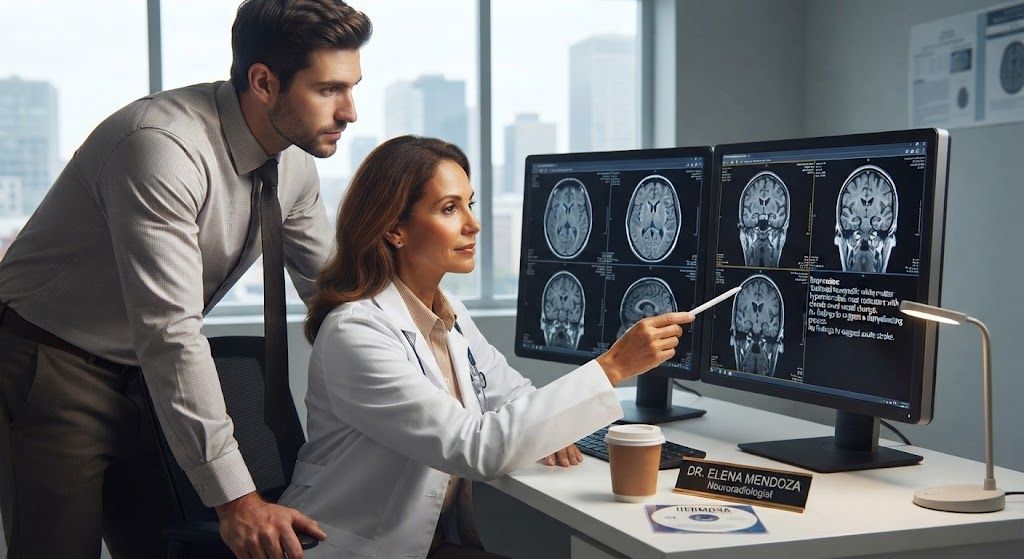
The impression is the radiologist conclusion on your MRI scan. It is where the radiologist stops describing and starts interpreting. Everything above it in the findings section is an exhaustive inventory written for physicians.
If a finding appears in the findings section and does not appear in the impression the radiologist judged it unimportant. That single fact prevents most unnecessary worry about radiology reports.
The certainty ladder
|
Wording |
Certainty level |
What the radiologist means |
Usual next step |
|
Consistent with. Diagnostic of. Represents |
Highest |
This is what it is |
Treat or refer for that diagnosis |
|
Compatible with. Typical of. Characteristic appearance |
High |
Very likely this |
Proceed on that basis |
|
Suggestive of. Favoured to represent. Probable |
Moderate |
Most likely this but not certain |
Correlate clinically or follow up |
|
Possible. May represent. Consider |
Low |
One of several options |
Watch or further imaging |
|
Cannot exclude. Not excluded |
Lowest |
Unlikely but being thorough |
Usually nothing |
|
Differential considerations include |
Undecided |
Images cannot distinguish between these |
Clinical correlation decides |
Stuck on one phrase in your report? A short review visit with the doctor who ordered the scan translates it faster than any search. Call 773 772 8876 or book an appointment online.
Where the impression sits in the report
Every radiology report follows the same structure regardless of which hospital or imaging centre produced it. Exam and clinical history. Comparison. Technique. Findings. Impression. The findings section is data and the impression is judgement.
Exam and clinical history. What was scanned and why. A single line such as low back pain radiating to the left leg.
Comparison. Which prior imaging was available. This line matters more than people realize because stability over time is powerful evidence against an aggressive process.
Technique. Which sequences were acquired and whether contrast was given.
Findings. A systematic description of every structure in the field of view. Written for physicians and deliberately exhaustive. It mentions normal variants incidental findings and technical limitations.
Impression. The conclusion. Usually numbered when there are several points and ordered by importance.
Patients who read the findings section first almost always encounter a phrase that sounds alarming and is completely routine. Reading the impression first solves that.
Three conventions that govern every impression
Knowing three conventions changes how you read any radiology report. Order signals priority. Certainty is graded through word choice. Recommendations appear explicitly when action is needed.
Order signals priority. The first numbered point is the most clinically significant finding. Later points descend in importance. A finding listed fourth is rarely the reason your doctor called.
Certainty is graded deliberately. The table above sets out the ladder. This is not vague writing. It is calibrated writing and each phrase carries a specific confidence level.
Recommendations are explicit. If a follow up scan biopsy or clinical correlation is advised it is stated directly. Absence of a recommendation generally means no further imaging is required.
There is a fourth convention worth knowing. The phrase clinical correlation is recommended appears constantly and frightens patients. It simply means the image alone cannot decide and the treating physician must weigh it against symptoms and examination. It is routine and not a warning.
A worked example
Consider a lumbar spine impression reading as follows.
One. Mild multilevel degenerative disc disease most pronounced at L4 to L5 with a small central disc protrusion. No nerve root compression.
Two. Mild facet arthropathy at L4 to L5 and L5 to S1.
Three. Incidental simple renal cyst in the right kidney measuring 2.1 centimetres. No follow up required.
Here is how to read it. Point one is the primary finding and the phrase no nerve root compression is the key reassurance. A disc protrusion without nerve compression frequently causes no symptoms at all. Point two describes normal wear of the small joints in the spine. Point three is an accidental discovery in an organ nobody was looking at and the radiologist has already stated no follow up is needed.
Nothing in this impression is urgent. A patient reading only the findings section might have encountered protrusion arthropathy and cyst and concluded the opposite. Our guide to when to worry about MRI results covers the findings that genuinely do warrant concern.
The seven phrases that warrant a prompt call
Seven items in an impression mean contact the ordering physician promptly rather than waiting for a routine appointment.
A mass or lesion described as enhancing ill defined or infiltrative.
The words suspicious for malignancy or concerning for neoplasm.
Cord compression or severe canal stenosis with cord signal change.
Acute infarct or acute ischaemia.
Abscess collection or osteomyelitis.
Acute fracture.
Any explicit recommendation for biopsy or urgent specialist referral.
Seek emergency care rather than an appointment if those findings occur alongside new weakness loss of bladder or bowel control saddle numbness sudden severe headache new confusion or difficulty speaking.
Why the impression sometimes disagrees with how you feel
Two mismatches are common and both are normal. A serious sounding impression with no symptoms. Severe symptoms with a clean impression. Neither means anything went wrong with the scan or the report.
Degenerative findings accumulate silently with age. Large studies of people with no back pain find disc bulges and degeneration at high rates increasing decade by decade. The image records structure and structure does not equal pain.
The reverse is equally real. MRI visualizes anatomy and not function. Nerve irritation without structural compression muscular pain central pain sensitization and early inflammatory disease all produce genuine severe symptoms with an unremarkable scan. A normal MRI is not a statement that your pain is imagined.
Your physician reconciles the two and that reconciliation is the actual diagnosis. The report is one input into it.
A typical case we see
A woman in her fifties from Logan Square brought in a brain MRI report she had been carrying for three weeks. The findings section mentioned nonspecific white matter changes and she had read extensively about multiple sclerosis.
The impression read as follows. Scattered nonspecific white matter hyperintensities most consistent with chronic small vessel change. No findings to suggest a demyelinating process.
The second sentence was the answer and she had not noticed it because the first phrase had sent her elsewhere three weeks earlier. The finding related to her long standing blood pressure and it changed her management in one way only. It reinforced the case for tighter blood pressure control.
Three weeks of fear could have been ten minutes of explanation.
Illustrative example. Composite of common presentations. Not a specific individual and not a testimonial. replace with a real anonymized case from clinic records.
Walk ins are welcome at 2004 N Pulaski Rd in Chicago. No appointment needed.
Call 773 772 8876 or book an appointment online
See our Radiology and imaging services page for what the visit covers
Hablamos español. Llame al 773 772 8876 para programar su cita.
How the impression differs across imaging types
The structure is identical across MRI CT ultrasound and X ray reports which makes this a transferable skill rather than an MRI specific one.
Where they differ is in what each test can conclude. An X ray impression is usually short because plain radiography answers a narrow question. A CT impression covers more organs because the scan covers more anatomy. An ultrasound impression frequently notes limitations from body habitus or bowel gas because sound waves do not penetrate everything.
An MRI impression is often the longest because MRI is the most sensitive modality and detects more incidental findings than any other.
That last point is worth holding onto. A longer MRI impression does not mean worse health. It means the test saw more. Our imaging centre runs X ray ultrasound and open MRI so the right test can be chosen for the question rather than defaulting to the most sensitive one.
Questions to bring to the follow up visit
Seven questions turn a rushed appointment into a useful one.
Which numbered point in the impression matters most for me.
Does that finding explain my symptoms or is it incidental.
Was a prior study available for comparison and did anything change.
What did the radiologist mean by the specific hedging phrase used.
What is the plan and what is the timeline.
If we watch rather than treat what are we watching for and when is the next scan.
Which symptoms should prompt a call before then.
Request the images as well as the report. If you pursue a second opinion another radiologist needs the images themselves rather than a description of them.
What happens at your appointment
Expect 20 to 30 minutes for a results review visit. Book it with the physician who ordered the scan rather than a new provider because they have the clinical context.
Bring the report and the images. Both. The disc or portal access matters if any second opinion follows.
Bring your list of prior imaging. Where and roughly when. Retrieving prior studies changes interpretation more than almost anything else and reports frequently say no priors available simply because nobody requested them.
Bring written questions. The seven above cover most situations.
The review. The physician walks through the impression point by point and states which findings are relevant to your symptoms and which are background.
The plan. Treatment watchful waiting further imaging or referral. With a timeline and with the specific symptoms that should prompt an earlier call.
Written summary. You leave with the plan on paper rather than relying on memory.
Referrals or further imaging arranged before you leave. Our imaging centre is on site so a follow up scan can usually be booked in the same visit rather than through a separate referral chain.
What Medicaid and Medicare cover for MRI reports and imaging review in Chicago
Coverage depends on whether a service is medically necessary or cosmetic and it varies by plan. The summary below reflects how Illinois Medicaid and Medicare generally treat these services. Confirm your own plan before the visit because benefits differ between managed care plans.
Generally covered
- Office visit to review imaging results with the ordering physician
- The MRI itself when ordered for a documented clinical indication
- Radiologist interpretation and report
- Follow up imaging recommended by the radiologist
- Specialist referral arising from the findings
Generally not covered
- Second opinion re reads at an outside facility in many plans
- Imaging performed without a physician order
- Copies of images on disc in some plans where an administrative fee applies
Worth bundling into the same visit
- Blood work drawn at the same visit
- Blood pressure and metabolic screening where white matter change is found
- Other indicated imaging at the same appointment
- Prescription pickup at the on site pharmacy
We accept Medicaid and Medicare. Call 773 772 8876 to confirm your plan before the visit. Coverage varies by plan so call to confirm rather than assuming.
Frequently asked questions
What does impression mean on an MRI report?
The impression is the radiologist conclusion. It names the most significant findings ranks them by importance and states what should happen next. Findings not repeated in the impression were judged unimportant.
Is the impression the same as a diagnosis?
No. It is an interpretation of images only. A diagnosis combines it with symptoms examination history and often laboratory results.
What does clinical correlation recommended mean?
The images alone cannot decide significance so your treating physician must weigh them against your symptoms and examination. It is routine and not a warning.
Why is my MRI impression so long?
Length reflects how much was visible rather than severity. Spine studies in older adults routinely produce long impressions full of ordinary age related change.
Which impression wording means high certainty?
Consistent with indicates high certainty. Compatible with and suggestive of indicate moderate certainty. Cannot exclude and may represent indicate low certainty and usually reflect thoroughness.
Does cannot exclude mean they think I have it?
Usually the opposite. It appears for completeness about a possibility the radiologist considers unlikely. Judge concern by whether a follow up is recommended and how soon.
Can I get my impression explained without a full appointment?
Many practices will clarify one phrase by phone or secure message. A short call about a single term is reasonable to request.
Does the radiologist speak to me directly?
Usually not for routine outpatient imaging. The radiologist reports to the ordering physician who discusses it with you. Some centres offer direct radiologist consultation on request.
About the reviewer
Otto R. Garcia MD | Internist | Hermosa Medical and Diagnostic Center
Dr Garcia is a board certified internal medicine specialist at Hermosa Medical Center. He cares for adults across the full range of chronic and acute conditions with a focus on long term disease management. He sees patients in English and Spanish.
*Imaging at Hermosa Medical and Diagnostic Center is performed at the on site radiology centre and scans are interpreted by a reporting radiologist. This article was medically reviewed by a board certified physician on staff who orders and acts on these scans. A radiologist byline will replace this line once the clinic supplies the reporting radiologist name and credential.*
Next step
If a phrase in your report is keeping you awake book a short review rather than reading more. The impression usually contains the reassurance and it takes ten minutes to find it with someone who reads these daily.
Go to Radiology and imaging services to see what we offer and how to book.
Visit Hermosa Medical and Diagnostic Center
Hermosa Medical and Diagnostic Center has served the Chicago West Side for 33 years. Primary care specialty care laboratory services imaging and an on site pharmacy sit in one building so most visits finish in one trip.
Address 2004 N Pulaski Rd Chicago IL 60639
Phone 773 772 8876
Advantage MRI 773 227 9777
Hours Call 773 772 8876 to confirm current hours
Walk ins Welcome. No appointment needed.
Insurance Medicaid Medicare and most major plans accepted
Languages English Spanish and Arabic
We serve Hermosa Belmont Cragin Humboldt Park Logan Square and Austin.
Hablamos español. Llame al 773 772 8876 para programar su cita. Se habla español.
Getting here
We are at 2004 N Pulaski Rd in the Hermosa neighborhood just north of Armitage Ave. Street parking is available on Pulaski Rd and on the surrounding side streets. The CTA 53 Pulaski bus stops directly outside and the 73 Armitage bus runs east from the corner toward the Blue Line.
Embedded Google Map of 2004 N Pulaski Rd Chicago IL 60639. Open in Google Maps (the map embed code is in the markdown version of this file).