


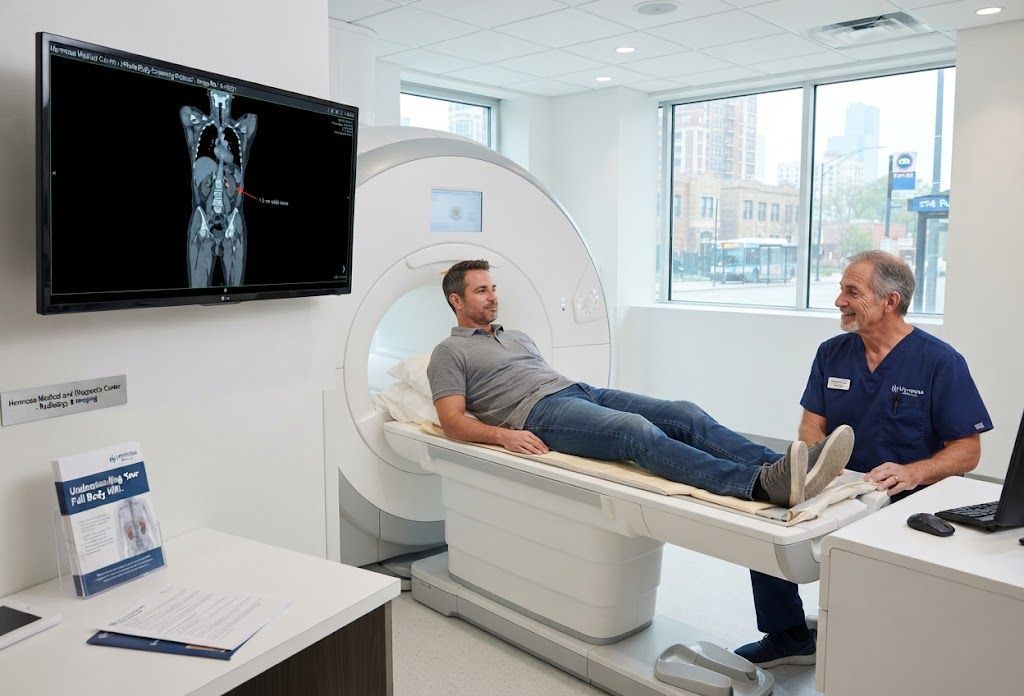
Full Body MRI Scan in Chicago and What It Can Actually Find
Full Body MRI Scan in Chicago and What It Can Actually Find
Reviewed by Otto R. Garcia MD Internist at Hermosa Medical and Diagnostic Center
Last updated: September 2026
Key takeaways
- A full body MRI detects solid masses above roughly 1 centimetre and uses no radiation.
- It misses most early cancers colon and stomach lesions small lung nodules and coronary disease.
- Incidental findings appear in a majority of healthy people scanned.
- No major medical society recommends it for general population screening.
- Self pay pricing commonly runs 1500 to 3000 dollars because insurance rarely covers screening.
A full body MRI scan covers the head neck chest abdomen pelvis and spine in a single session. It uses no radiation and typically takes 60 to 90 minutes.
It finds solid masses larger than roughly one centimetre aneurysms structural brain abnormalities spine disease large joint damage and organ enlargement.
It misses most early cancers flat lesions in hollow organs such as the colon and stomach small lung nodules coronary artery disease and anything below its resolution limit. It is not a substitute for colonoscopy mammography low dose CT lung screening cervical screening or a lipid panel.
The most important thing to understand before booking is that a full body MRI finds something in a majority of healthy people. Most of those findings are harmless. Some lead to further scans biopsies and anxiety that ultimately change nothing. That cascade is the main cost of the test and it is rarely discussed in the marketing.
What a full body MRI finds and what it misses
|
Target |
Detected well |
Detected poorly or not at all |
Better test |
|
Solid organ masses |
Yes above about 1 cm |
Below 1 cm |
Targeted imaging of the organ |
|
Brain abnormalities |
Aneurysms tumours old strokes |
Very small lesions |
Dedicated brain MRI with contrast |
|
Spine disease |
Yes. MRI is the best available test |
Nothing significant missed |
None needed |
|
Colon and stomach lesions |
No. Hollow organs collapse |
Flat and early lesions invisible |
Colonoscopy or stool based testing |
|
Lung nodules |
Large nodules only |
Small nodules. Lung is mostly air |
Low dose CT for eligible smokers |
|
Coronary artery disease |
Not assessed in a standard protocol |
Largely invisible |
Lipid panel. Stress testing. Calcium score |
|
Breast and cervical cancer |
Not a screening protocol |
Not reliable |
Mammography and cervical screening |
|
Diabetes thyroid kidney anaemia |
Not detected |
These are blood findings |
A basic blood panel costing a fraction |
Wondering whether a scan is the right next step? A conversation about your family history usually answers it better than imaging would. Call 773 772 8876 or book an appointment online.
What a whole body protocol actually scans
A whole body protocol acquires several sequences covering brain and skull base neck soft tissues chest including the mediastinum abdomen covering liver kidneys pancreas spleen and adrenal glands pelvis including bladder and reproductive organs and the entire spine.
Most screening protocols use non contrast sequences. Diffusion weighted imaging is often included because it highlights densely cellular tissue which raises sensitivity for some tumours.
Some centres add MR angiography to assess major blood vessels and that addition is where aneurysm detection comes from. Ask whether it is included because it changes both the price and what the scan can find.
Large joints are included in some protocols and not others. Confirm the coverage list before booking rather than assuming everything is scanned.
What it detects well
Seven categories show up reliably on a whole body MRI and each represents a genuine strength of the modality.
Solid organ masses. Tumours in the liver kidney pancreas adrenal gland ovary and uterus show reliably once they reach about one centimetre.
Brain abnormalities. Aneurysms tumours old strokes structural malformations and significant white matter disease.
Spine disease. Disc herniation stenosis vertebral fractures and bone marrow lesions. MRI is the best available test for the spine by a wide margin.
Aortic aneurysm. When angiographic sequences are included in the protocol.
Lymph node enlargement. Which can be the first sign of lymphoma or metastatic disease.
Bone metastases. MRI detects marrow involvement earlier than plain radiography.
Organ enlargement and fatty liver. Useful metabolic information that frequently changes management.
What it misses and why that matters more
Six important categories are missed or poorly detected and this list deserves more attention than the strengths list because it determines what the scan cannot reassure you about.
Most early cancers. Resolution limits detection to roughly one centimetre. Many cancers are curable well below that size and several are not visible on MRI at any size until advanced.
Colon and stomach lesions. These organs are hollow and collapse on imaging so flat and early lesions are invisible. Colonoscopy remains the standard.
Small lung nodules. Lung tissue is mostly air which gives poor MRI signal. Low dose CT is the validated lung cancer screening tool for eligible smokers.
Coronary artery disease. A standard whole body protocol does not assess coronary arteries. The commonest cause of death in adults is largely invisible on this test.
Breast and cervical cancer screening. Mammography and cervical screening are the validated pathways. Breast MRI is a separate dedicated protocol used for high risk patients.
Metabolic and blood disease. Diabetes thyroid disease anaemia kidney function and cholesterol are laboratory findings and not imaging findings. A basic blood panel costs a fraction and changes management far more often.
The honest summary is that a full body MRI is strong at structure and blind to chemistry.
The incidental finding problem
Published series of whole body screening MRI in asymptomatic adults consistently report incidental findings in a large majority of participants. Reported rates of clinically significant findings are far lower and often fall in the low single digit percentage range.
The gap between those two numbers is the problem. Each incidental finding creates a decision. Watch it or investigate it.
Investigation means follow up imaging in three or six months sometimes a biopsy and occasionally surgery. Every one of those steps carries its own risk cost and anxiety. Benign renal cysts liver haemangiomas thyroid nodules adrenal adenomas and simple ovarian cysts are found constantly and almost never matter.
There is a psychological cost that is real and measurable. People who learn they have a nodule under observation carry that knowledge continuously and some describe it as a permanent low grade worry that the original scan was supposed to relieve.
None of this makes the test worthless. It means the test should be chosen deliberately with an understanding of what happens after an unexpected finding. Ask before booking who manages incidental findings and whether that follow up is included.
Who actually benefits
Four groups have reasonable justification for whole body MRI and none of them is the average adult with no symptoms.
People with a genetic cancer predisposition syndrome. Li Fraumeni syndrome and certain hereditary cancer syndromes have published surveillance protocols that include whole body MRI. This is evidence based and supervised.
People with a strong multi cancer family history after genetic counselling determines that broad surveillance is appropriate.
Cancer survivors under a specialist surveillance plan.
People with unexplained symptoms where a broad search is clinically justified. This is diagnostic imaging rather than screening and it is usually covered by insurance.
For an average risk adult with no symptoms the evidence supporting whole body MRI screening for reducing mortality is not established. No major medical society currently recommends it for general population screening and that absence reflects the lack of trial evidence rather than an oversight.
A typical case we see
A man in his forties from Logan Square booked a whole body screening scan at an outside provider after a colleague was diagnosed with cancer. He had no symptoms and no family history of note.
The scan found a small renal cyst a thyroid nodule and a liver haemangioma. All three were described as almost certainly benign and all three came with a recommendation for follow up imaging in six months.
He spent the next six months worrying about three findings that have essentially never caused harm in anyone. The follow up scans confirmed all three were unchanged.
What he had not had was a lipid panel a blood pressure check or a colonoscopy. He was 46 and due for the last of those. The scan had answered a question nobody had asked while leaving the validated screening undone.
Illustrative example. Composite of common presentations. Not a specific individual and not a testimonial. replace with a real anonymized case from clinic records.
### Talk to someone about whether a scan is the right next step
Walk ins are welcome at 2004 N Pulaski Rd in Chicago. No appointment needed.
Call 773 772 8876 or book an appointment online
See our Radiology and imaging services page for what the visit covers
*Hablamos español. Llame al 773 772 8876 para programar su cita.*
A better sequence for most people
If your goal is catching serious disease early four steps deliver more per dollar than a whole body scan for the average adult.
Start with a comprehensive physical and a family history conversation. Family history changes screening recommendations more than any test does.
Complete age appropriate validated screening. Colonoscopy or stool based testing from the recommended age. Mammography on schedule. Cervical screening on schedule. Low dose chest CT if you meet smoking criteria. Bone density when indicated.
Get laboratory work. Lipid panel fasting glucose or hemoglobin A1c kidney function liver function thyroid and complete blood count. These identify the metabolic diseases that actually shorten most lives.
Check blood pressure properly and repeatedly. Hypertension is silent common and treatable and it does not appear on an MRI at all. Our guide to chronic condition monitoring at home covers how to do that correctly.
Then if a specific concern remains or your family history warrants broader surveillance discuss targeted imaging with your physician. This is not an argument against imaging. It is an argument for ordering it in the right sequence.
Questions to ask before you book
Seven questions separate a supervised medical service from a scan sold as a product.
Who reads the scan and are they a board certified radiologist with relevant subspecialty experience.
Is a physician consultation included to explain the report or do you receive the document alone.
Which body regions and which sequences are covered because protocols vary widely between providers.
Is contrast used and if so is kidney function checked first.
Who manages incidental findings and is that follow up imaging included in the quoted price.
Will the images be released to you on disc or through a portal so another physician can review them.
Will a copy of the report be sent to your own doctor.
Ask these before paying rather than afterwards. The answers vary considerably between providers and they determine the true cost.
Cost and insurance in Chicago
Full body MRI screening is almost always self pay because insurance covers imaging ordered for a clinical indication rather than for general screening.
Typical United States self pay pricing for whole body screening MRI runs roughly 1500 to 3000 dollars depending on protocol length and whether angiography and cardiac sequences are added. Chicago pricing sits within that range.
Diagnostic MRI of a single region ordered by a physician for a specific problem is a different matter entirely. That is typically covered subject to prior authorization and generally runs 400 to 1800 dollars before insurance.
The practical implication for most people is that a targeted scan of the region that actually hurts is both cheaper and more likely to be covered than a whole body scan looking for anything.
Call 773 227 9777 for imaging pricing at our centre. We do not publish figures here because they change.
What happens at your appointment
Expect 60 to 90 minutes inside the scanner for a whole body protocol and sometimes longer.
Physician conversation first. Ideally before booking. This is where family history gets reviewed and where a targeted scan or blood work often turns out to be the better answer.
Metal screening. Pacemakers defibrillators cochlear implants aneurysm clips insulin pumps and metal fragments in the eye all require review. Bring implant cards.
Fasting if required. Some abdominal protocols require it. Confirm when booking.
Changing. Into a gown. No metal at all including underwire and zippers.
Positioning. The scan runs in stages covering each body region in turn. You will be moved between stages and told how long each one runs.
Contrast if included. Intravenous line placed and kidney function checked beforehand where indicated.
The scan. 60 to 90 minutes. Ear protection provided. Our open unit means you are not enclosed which matters over a scan this long.
Results conversation arranged in advance. Reading a whole body report without a clinician is the fastest route to unnecessary distress. Our guides to MRI results and the impression section help in the meantime.
What Medicaid and Medicare cover for full body and diagnostic MRI in Chicago
Coverage depends on whether a service is medically necessary or cosmetic and it varies by plan. The summary below reflects how Illinois Medicaid and Medicare generally treat these services. Confirm your own plan before the visit because benefits differ between managed care plans.
Generally covered
- Diagnostic MRI ordered for a documented clinical indication
- Targeted imaging of a specific region where symptoms justify it
- Radiologist interpretation and report
- Follow up imaging recommended by the radiologist
- Age appropriate validated screening such as colonoscopy and mammography
Generally not covered
- Whole body MRI performed as screening with no clinical indication
- Self referred imaging without a physician order in most plans
- Follow up imaging for incidental findings in some plans where the original scan was not covered
Worth bundling into the same visit
- Annual physical and full blood panel in the same trip
- Blood pressure check and cardiovascular risk assessment
- Referral for age appropriate cancer screening
- Prescription pickup at the on site pharmacy
We accept Medicaid and Medicare. Call 773 772 8876 to confirm your plan before the visit. Coverage varies by plan so call to confirm rather than assuming.
Frequently asked questions
Does a full body MRI detect all cancers?
No. It detects solid masses above roughly 1 centimetre. It misses most early cancers flat lesions in hollow organs such as the colon and small lung nodules.
Is a full body MRI worth it for a healthy person?
No major medical society recommends whole body MRI for general population screening because mortality benefit is not established. It has a clearer role in genetic cancer predisposition syndromes.
Does insurance cover a full body MRI in Chicago?
Generally no when performed as screening. Self pay pricing commonly runs 1500 to 3000 dollars. Diagnostic MRI ordered for a specific problem is usually covered subject to prior authorization.
How long does a full body MRI take?
Typically 60 to 90 minutes and longer for extended protocols that add angiography.
Is there radiation in a full body MRI?
No. MRI uses a magnetic field and radio waves rather than ionizing radiation which is a genuine advantage over CT based whole body screening.
What happens if they find something?
Usually follow up imaging in three to six months and occasionally biopsy. Ask before booking whether that follow up is included in the price.
Can I get a full body MRI without a doctor order?
Some self pay screening centres allow it. Having a physician involved is strongly advisable because somebody needs to manage whatever the scan finds.
What should I do instead?
A comprehensive physical age appropriate validated screening a full blood panel and proper blood pressure measurement. That sequence catches more actionable disease per dollar for an average risk adult.
About the reviewer
Otto R. Garcia MD | Internist | Hermosa Medical and Diagnostic Center
Dr Garcia is a board certified internal medicine specialist at Hermosa Medical Center. He cares for adults across the full range of chronic and acute conditions with a focus on long term disease management. He sees patients in English and Spanish.
*Imaging at Hermosa Medical and Diagnostic Center is performed at the on site radiology centre and scans are interpreted by a reporting radiologist. This article was medically reviewed by a board certified physician on staff who orders and acts on these scans. A radiologist byline will replace this line once the clinic supplies the reporting radiologist name and credential.*
Next step
Before booking a whole body scan have the family history conversation and get the blood work. For most people that combination answers more than the scan would and it costs a fraction.
**Go to Radiology and imaging services** to see what we offer and how to book.
Visit Hermosa Medical and Diagnostic Center
Hermosa Medical and Diagnostic Center has served the Chicago West Side for 33 years. Primary care specialty care laboratory services imaging and an on site pharmacy sit in one building so most visits finish in one trip.
Address 2004 N Pulaski Rd Chicago IL 60639
Phone 773 772 8876
Advantage MRI 773 227 9777
Hours Call 773 772 8876 to confirm current hours
Walk ins Welcome. No appointment needed.
Insurance Medicaid Medicare and most major plans accepted
Languages English Spanish and Arabic
We serve Hermosa Belmont Cragin Humboldt Park Logan Square and Austin.
*Hablamos español. Llame al 773 772 8876 para programar su cita. Se habla español.*
Getting here
We are at 2004 N Pulaski Rd in the Hermosa neighborhood just north of Armitage Ave. Street parking is available on Pulaski Rd and on the surrounding side streets. The CTA 53 Pulaski bus stops directly outside and the 73 Armitage bus runs east from the corner toward the Blue Line.
Embedded Google Map of 2004 N Pulaski Rd Chicago IL 60639. Open in Google Maps (the map embed code is in the markdown version of this file).
Sources
- American College of Radiology | Appropriateness Criteria
- US Preventive Services Task Force | Screening Recommendations
- National Cancer Institute | Cancer Screening