

Dental Emergency Chicago | What To Do in the First Hour
Dental Emergency Chicago | What To Do in the First Hour
Reviewed by Otto R. Garcia MD Internist at Hermosa Medical and Diagnostic Center
Last updated: September 2026
Key takeaways
- The commonest mistake is going to a hospital ER for toothache. Most have no dentist on site.
- A knocked out tooth has roughly 30 minutes before the odds of saving it fall sharply.
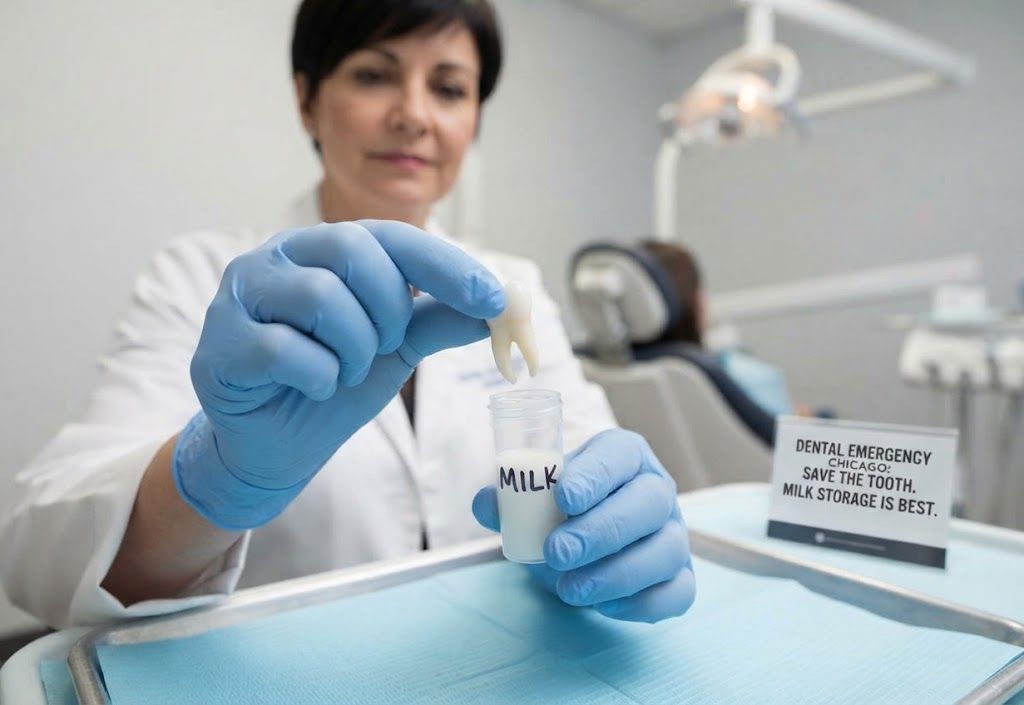
- Hold a knocked out tooth by the crown only. Store it in milk and never in water or tissue.
- 6 situations are true emergencies. 4 more feel urgent and can wait a few days.
- Ibuprofen combined with acetaminophen outperforms either alone for dental pain.
The commonest mistake in a dental emergency is choosing the wrong building.
Large numbers of people go to a hospital emergency room with toothache. Emergency departments rarely have a dentist on site. They can prescribe antibiotics and pain relief and they cannot drain an abscess through the tooth extract it or place a filling. Patients typically leave with a prescription and a referral which means paying twice and waiting longer.
Go to a hospital emergency room only for facial swelling reaching the eye or neck difficulty breathing difficulty swallowing uncontrolled bleeding or a suspected jaw fracture. Those are medical emergencies rather than dental ones.
Everything else including severe toothache broken teeth lost fillings and abscesses is handled faster and far cheaper at a dental office in Chicago or an urgent care clinic with dental services on site.
Where to go and how fast
|
Situation |
Urgency |
Where to go |
First aid |
Why timing matters |
|
Tooth knocked completely out |
Within 30 minutes |
Dental office. Call ahead |
Hold by crown. Replant or store in milk |
Root ligament cells die from drying in about 30 minutes |
|
Facial swelling reaching eye or neck |
Immediate |
Hospital emergency department |
Nothing by mouth. Go now |
Airway compromise is possible |
|
Severe pain with swelling and fever |
Same day |
Dental office |
Cold compress outside cheek. Ibuprofen |
Infection spreads through facial tissue spaces |
|
Fracture exposing pink or red pulp |
Same day |
Dental office |
Save fragments in milk. Cover sharp edge |
Bacteria reach the nerve within hours |
|
Tooth loose or pushed out of position |
Same day |
Dental office |
Do not force it. Bite on gauze |
Ligament damage needs early repositioning |
|
Bleeding not stopping after 20 minutes pressure |
Same day |
Dental office or ER |
Firm continuous gauze pressure |
Blood loss and possible clotting problem |
|
Lost filling. Chipped tooth. Broken wire |
Within a few days |
Dental office |
Temporary cement. Dental wax |
Uncomfortable but not time critical |
Not sure whether what you have is an emergency? Call and describe it. That call costs nothing and often saves a wasted ER trip. Call 773 772 8876 or book an appointment online.
The knocked out tooth and its 30 minute window
This is the only dental situation where the clock genuinely controls the outcome. The ligament fibres attached to the root surface are living tissue and they die from drying within about thirty minutes of air exposure. Replanted within thirty minutes the tooth has a good chance. At sixty minutes the odds drop substantially. Past two hours replantation rarely succeeds.
Do this in order.
Find the tooth and pick it up by the crown which is the white chewing part. Touching the root damages exactly the fibres you need alive.
Do not scrub it. Do not use soap. Do not wrap it in tissue or cloth which pulls moisture out of the root surface immediately.
If it is dirty rinse for no more than ten seconds in cold milk saline or the person's own saliva. Plain tap water is a last resort because it damages root cells faster than milk does.
Put it back into the socket if the person is conscious and cooperative. Push gently until the crown sits level with the neighbouring teeth then have them bite softly on clean gauze to hold it.
If replanting is not possible store the tooth in cold milk. Milk has an osmolality close to body tissue which is why it preserves root cells far better than water. Saline is next best. Saliva works in a pinch and the tooth can be held inside the cheek where there is no risk of swallowing it.
Get to a dental office immediately and call ahead so the team is ready on arrival.
One important exception. Do not replant a baby tooth. Pushing a primary tooth back into the socket can damage the permanent tooth developing above it. Bring the child in and leave the tooth out.
Severe toothache and telling infection from irritation
Pain intensity alone does not indicate danger. The pattern does. Pain from cold that disappears within seconds usually means exposed dentin or small decay. Pain from heat that lingers or arrives spontaneously and throbs usually means the pulp is irreversibly inflamed. Pain with swelling fever or a bad taste means infection has spread beyond the tooth.
The third pattern needs same day attention. The first needs an appointment. The second needs treatment within days and often means a root canal. Our guide to signs you need a root canal covers that pathway.
Temporary relief while you wait. Rinse with warm salt water made from half a teaspoon of salt in a cup of warm water. Take ibuprofen if you can tolerate it because it targets inflammation directly. Combining ibuprofen with acetaminophen at standard doses gives better dental pain relief than either alone and better than many opioid options according to consistent trial evidence. Apply a cold compress outside the cheek for fifteen minutes at a time.
Three things not to do. Never place an aspirin tablet against the gum because it causes a chemical burn on the tissue. Do not apply heat to a swollen face because heat encourages the infection to spread. Do not ignore swelling that grows because facial space infections can compromise the airway.
Broken chipped and cracked teeth
Treatment depends entirely on how deep the fracture goes. A chip limited to enamel needs smoothing or a small bonded repair and is not urgent. A fracture into dentin exposes the yellow layer beneath and should be covered within days. A fracture exposing the pulp shows a pink or red dot at the centre and is urgent.
A vertical root fracture often produces pain on biting with no visible break and these frequently cannot be saved.
First aid for any broken tooth. Rinse the mouth with warm water rather than cold. Save fragments in milk because some can be bonded back and they look better than composite. Apply gauze with pressure if the gum bleeds. Use a cold compress outside the cheek. Cover a sharp edge with dental wax or sugar free gum to protect the tongue. Avoid chewing on that side entirely.
Read our guide to cracked or broken tooth care for the full repair pathway and what each option costs.
Abscess and why it must not wait
A dental abscess is a pocket of pus from bacterial infection at the root tip or in the gum. Signs include throbbing pain radiating to the jaw ear or neck sensitivity to pressure and temperature facial swelling tender lymph nodes under the jaw fever and a sudden rush of foul tasting fluid if it drains on its own.
That drainage moment feels like relief. It is not resolution. The infection source is still inside the tooth and it will recur.
An untreated dental abscess can spread into the tissue spaces of the face and neck. Ludwig angina is the serious version and it can obstruct the airway. Infection can also reach the sinus the eye socket or the bloodstream.
Go to a hospital emergency room rather than a dental office if swelling reaches the eye or crosses the midline of the neck if you cannot open your mouth more than two finger widths if swallowing is difficult or if you have a fever above 101 degrees Fahrenheit with facial swelling.
Otherwise a dental office resolves this faster by draining the infection and treating the tooth. Antibiotics alone do not cure a dental abscess. They control spread while the actual source gets treated.
Lost fillings crowns and soft tissue injuries
A lost filling or crown is not an emergency but it needs attention within a few days because exposed tooth structure decays rapidly and neighbouring teeth drift into the gap.
Keep the crown if you have it and clean the inside gently. Temporary dental cement from a pharmacy holds it for a few days and denture adhesive works in a pinch. Never use household glue. It is toxic and it prevents the dentist recementing the crown properly which can turn a simple recement into a replacement.
Soft tissue injuries. For a cut lip tongue or cheek clean gently with water then apply firm pressure with clean gauze for fifteen to twenty minutes without lifting to check. Lifting restarts the clot. A cold compress outside reduces swelling.
Bleeding continuing past twenty minutes of continuous pressure needs professional attention. Deep cuts on the tongue or a laceration crossing the lip border usually need sutures.
Bleeding after an extraction is normal for a few hours. Bite on gauze and avoid rinsing spitting or using a straw for twenty four hours because the suction dislodges the clot and causes dry socket.
Chicago winter and the dental emergencies it produces
Cold air causes teeth with existing cracks to flex which is why January and February bring a predictable rise in cracked tooth complaints. Enamel and dentin expand and contract at different rates and a tooth already carrying a crack finds that cycle enough to propagate it.
Two more seasonal patterns show up across Hermosa Belmont Cragin and Austin every winter.
Ice chewing rises when people are indoors with cold drinks and it is one of the leading causes of cracked molars we see.
Holiday food does the rest. Hard candy nuts popcorn kernels and frozen sweets account for a visible cluster of broken teeth between late November and early January.
If you already know you have a cracked or heavily filled tooth the practical move is getting it crowned before winter rather than after it fractures. A crown placed electively costs a fraction of an emergency extraction and implant.
A typical case we see
A man in his thirties from Humboldt Park went to a hospital emergency department at 2am with severe toothache and left with antibiotics and a referral. Three days later the pain returned worse and his cheek had begun to swell.
He arrived at the clinic on day four. The tooth had an abscess at the root tip. Antibiotics had reduced the swelling temporarily which is exactly what they do and they had not touched the source.
Treatment was drainage through the tooth followed by root canal therapy. The lesson is not that the ER did anything wrong. It is that antibiotics manage spread while the tooth itself still needs treating and going to the right building first would have saved him three days of pain and one bill.
Illustrative example. Composite of common presentations. Not a specific individual and not a testimonial. replace with a real anonymized case from clinic records.
Preventing the next emergency
Most dental emergencies are not accidents. They are slow problems that finally arrived. Untreated decay becomes an abscess. A small crack becomes a fracture. Gum disease loosens teeth across years. A six month examination catches all three while they are still small and inexpensive.
Three specific habits prevent a large share of true emergencies.
Wear a mouthguard for any contact sport. This applies to adults in recreational leagues just as much as to children and sports account for a significant share of knocked out teeth.
Stop chewing ice hard candy and popcorn kernels. These cause more cracked molars than anything else.
Treat night grinding with a guard. Grinding fractures teeth quietly across years and most people who do it have no awareness of it. Morning jaw soreness flattened chewing surfaces and headaches on waking are the signs.
What an emergency dental visit actually costs
Cost varies by what is needed and the range is wide enough to matter when deciding where to go. An emergency examination with X ray is the entry point. Treatment then depends on the diagnosis.
A hospital emergency department visit for toothache typically costs several times a dental office visit and usually ends in a prescription plus a referral to a dentist. That is two bills for one problem.
Illinois Medicaid covers emergency dental services for adults and comprehensive dental care for children under 21. Coverage details vary between managed care plans so call to confirm before the visit.
For uninsured patients ask about self pay pricing at the time of booking rather than after treatment. Many practices including ours quote emergency examination pricing on the phone.
Call 773 772 8876 for current emergency pricing. We do not publish figures here because they change and a wrong number is worse than none.
What happens at your appointment
Expect 30 to 60 minutes for an emergency dental visit. Walk ins are welcome and calling ahead helps the team prepare.
Call first if you can. Describe what happened and when. For a knocked out tooth this matters most because the team can prepare the socket and splint materials before you arrive.
Check in. Photo identification and insurance card. If you are in severe pain say so at the desk rather than waiting. Staff speak English Spanish and Arabic.
Triage. Swelling airway fever and bleeding are assessed first. Anything suggesting a spreading facial infection is escalated immediately.
Examination and X ray. Imaging is taken on site. For trauma cases the clinic also has X ray capability for the jaw which matters when a fracture is suspected.
Pain control. Local anaesthetic where treatment is happening that visit. Written guidance on ibuprofen and acetaminophen dosing where you are going home first.
Treatment. Drainage replantation splinting temporary restoration or extraction depending on diagnosis. Definitive treatment is sometimes staged across two visits.
Prescriptions. Filled at the on site pharmacy before you leave so treatment starts immediately rather than after another stop.
Follow up booked before you leave. Emergency treatment is usually the first half of the job.
What Medicaid and Medicare cover for emergency dental care in Chicago
Coverage depends on whether a service is medically necessary or cosmetic and it varies by plan. The summary below reflects how Illinois Medicaid and Medicare generally treat these services. Confirm your own plan before the visit because benefits differ between managed care plans.
Generally covered
- Emergency dental examination and X rays
- Extraction of a tooth that cannot be saved
- Drainage of a dental abscess
- Treatment for uncontrolled bleeding and dental trauma
- Illinois Medicaid covers emergency dental services for adults
- Children under 21 have comprehensive dental coverage including restorative work
Generally not covered
- Cosmetic repair of a chipped tooth where function is unaffected
- Some adult restorative procedures depending on the managed care plan
- Replacement of a lost crown for appearance alone in some plans
Worth bundling into the same visit
- Examination and X rays at the same visit
- Cleaning if you are due one
- Assessment of other teeth that show early decay or cracks
- Prescription pickup at the on site pharmacy
We accept Medicaid and Medicare. Call 773 772 8876 to confirm your plan before the visit. Coverage varies by plan so call to confirm rather than assuming.
Frequently asked questions
Should I go to the ER for a toothache?
Only for facial swelling reaching the eye or neck trouble breathing or swallowing fever with swelling or uncontrolled bleeding. For pain alone a dental office treats the cause and costs far less.
How long can a knocked out tooth survive outside the mouth?
Aim to replant within 30 minutes. Success falls sharply after 60 minutes. Store the tooth in cold milk if you cannot replant it and never in water or tissue.
Can a dental abscess heal on its own?
No. It may drain and feel better but the infection source stays inside the tooth and recurs. Antibiotics control spread and do not cure it.
What is the best painkiller for dental pain?
Ibuprofen combined with acetaminophen at standard doses outperforms either alone for dental pain. Confirm with a pharmacist if you take blood thinners or have kidney or stomach conditions.
Should I put a knocked out baby tooth back in?
No. Replanting a primary tooth can damage the developing permanent tooth above it. Bring the child in and leave the tooth out.
Does Medicaid cover emergency dental care in Illinois?
Illinois Medicaid covers emergency dental services for adults and comprehensive dental care for children under 21. Plan details vary so call 773 772 8876 to confirm before the visit.
What if the emergency happens at night or on a weekend?
Apply the first aid above and call as early as possible the next morning. For a knocked out tooth seek urgent or hospital care that night because the window is measured in minutes.
Why does my cracked tooth hurt more in winter?
Cold causes enamel and dentin to contract at different rates which flexes an existing crack. Chicago winters produce a predictable seasonal rise in cracked tooth complaints.
About the reviewer
Otto R. Garcia MD | Internist | Hermosa Medical and Diagnostic Center
Dr Garcia is a board certified internal medicine specialist at Hermosa Medical Center. He cares for adults across the full range of chronic and acute conditions with a focus on long term disease management. He sees patients in English and Spanish.
*Dental procedures at Hermosa Medical and Diagnostic Center are performed by the clinic dental team. This article was medically reviewed by a board certified physician on staff. A dentist byline will replace this line once the clinic supplies the treating dentist name and credential.*
Next step
If you are in pain right now call rather than reading further. If you are reading this after the fact the useful move is getting any cracked or heavily filled teeth assessed before they become the next emergency.
**Go to Dentistry services** to see what we offer and how to book.
Visit Hermosa Medical and Diagnostic Center
Hermosa Medical and Diagnostic Center has served the Chicago West Side for 33 years. Primary care specialty care laboratory services imaging and an on site pharmacy sit in one building so most visits finish in one trip.
Address 2004 N Pulaski Rd Chicago IL 60639
Phone 773 772 8876
Hours Call 773 772 8876 to confirm current hours
Walk ins Welcome. No appointment needed.
Insurance Medicaid Medicare and most major plans accepted
Languages English Spanish and Arabic
We serve Hermosa Belmont Cragin Humboldt Park Logan Square and Austin.
Hablamos español. Llame al 773 772 8876 para programar su cita. Se habla español.
Getting here
We are at 2004 N Pulaski Rd in the Hermosa neighborhood just north of Armitage Ave. Street parking is available on Pulaski Rd and on the surrounding side streets. The CTA 53 Pulaski bus stops directly outside and the 73 Armitage bus runs east from the corner toward the Blue Line.
Embedded Google Map of 2004 N Pulaski Rd Chicago IL 60639. Open in Google Maps (the map embed code is in the markdown version of this file).