

Teeth Whitening Chicago | Costs Results and Safety 60639
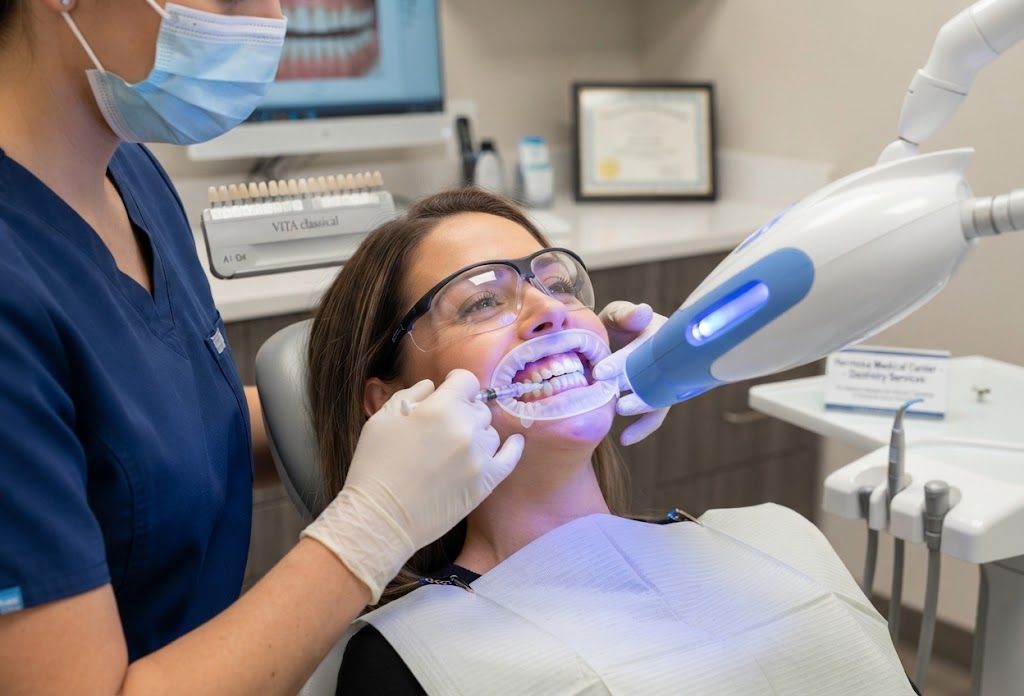
Best Teeth Whitening in Chicago and Which One Actually Works
Reviewed by Otto R. Garcia MD Internist at Hermosa Medical and Diagnostic Center
*Last updated: September 2026*
Key takeaways
- In office whitening lifts teeth 3 to 8 shades in a single 90 minute visit.
- Custom take home trays lift 2 to 6 shades across 10 to 14 days and cost less.
- Pharmacy strips lift 1 to 2 shades and often leave the back teeth darker.
- Whitening does nothing at all to crowns veneers bridges or tooth coloured fillings.
- Dental insurance including Medicaid treats whitening as cosmetic and does not cover it.
In office whitening at a dental office in Chicago lifts teeth by three to eight shades in one visit. Custom take home trays lift two to six shades over ten to fourteen days. Pharmacy strips lift one to two shades. Whitening toothpaste removes surface film only and does not change the natural colour of the tooth underneath.
Choose in office whitening for the fastest visible change before a fixed date. Choose custom trays for the best value and the longest lasting result. If your teeth are sensitive start with a low concentration tray gel and build up slowly.
That is the decision in four sentences. What follows explains why each option behaves the way it does and how to pick correctly for your own teeth.
Whitening options compared
|
Option |
Cost in Chicago |
Time to result |
How long it lasts |
Best for |
Downside |
|
In office professional whitening |
Typically 350 to 700 dollars |
One 90 minute visit |
1 to 3 years |
A fixed date such as a wedding or interview |
Highest cost. More sensitivity |
|
Custom take home trays |
Typically 250 to 450 dollars |
10 to 14 days |
2 to 3 years with touch ups |
Best overall value. Almost everyone |
Requires daily wear for two weeks |
|
Pharmacy whitening strips |
30 to 60 dollars per box |
1 to 2 weeks |
4 to 6 months |
Mild surface stain. Testing tolerance |
Patchy. Misses curved back teeth |
|
Whitening toothpaste |
5 to 15 dollars |
Ongoing |
Maintenance only |
Holding a result you already have |
No true shade change. Some are abrasive |
|
Charcoal and home remedies |
Low |
None |
None |
Nothing |
Abrasive or acidic. Can permanently thin enamel |
Prices are typical Chicago market ranges and not a quote from this clinic. Call 773 772 8876 for current pricing.
Not sure whether your stain will even respond to whitening? A five minute exam tells you before you spend anything. Call 773 772 8876 or book an appointment online.Why your teeth changed colour in the first place
Teeth have two layers that matter here. Enamel on the outside is hard and slightly porous. Dentin underneath is naturally yellow. Stain lands either on the enamel surface where whitening works well or inside the dentin where it responds slowly or not at all.
Extrinsic stain sits on and just inside the enamel. Coffee tea red wine dark soda curry tomato sauce and tobacco all cause it. This type responds well to peroxide.
Intrinsic stain sits deeper in the dentin. Ageing causes it. So does trauma to a tooth. So do certain antibiotics taken during childhood including tetracycline. This type responds slowly and sometimes barely at all.
A dentist can tell the difference in under a minute by looking at where the discolouration sits and how evenly it covers the tooth. That single observation decides whether whitening is worth your money.
Enamel also thins with age which lets more yellow dentin show through. This is why the same treatment gives a smaller change at sixty than at twenty five.
How each option actually works
In office whitening uses hydrogen peroxide at 25 to 40 percent applied under a protective barrier over the gums. Take home trays use carbamide peroxide at 10 to 22 percent which breaks down slowly. Strips use 5 to 14 percent. Concentration drives speed and it also drives sensitivity.
In office. Gel sits for fifteen to twenty minutes then gets removed and reapplied across two or three cycles. The barrier over your gums is not optional. Peroxide at that strength causes chemical burns on soft tissue within minutes which is exactly why this belongs in a clinical setting.
Custom trays. A dentist takes an impression or digital scan and a lab builds trays that fit your arch exactly. Fit is the entire point. A custom tray holds gel against the tooth and keeps it off the gum. A generic tray leaks gel onto tissue and leaves gaps where no gel touches the tooth which is why store bought trays produce patchy results.
Strips. Thin flexible strips coated with low concentration gel. Their weakness is geometry. A strip is flat and your teeth are not. It contacts the six front teeth well and the curved back teeth poorly which is how people end up with six bright teeth and visibly darker ones beside them.
Toothpaste. Mild abrasives scrub surface film. Nothing penetrates enamel. It is a maintenance product and not a treatment and marketing rarely says so.
Who is a good candidate and who is not
Whitening works predictably on natural teeth with yellow or light brown extrinsic stain. It works less predictably on grey teeth because grey discolouration usually comes from inside. It does nothing at all to dental work.
Crowns veneers bridges bonding and tooth coloured fillings hold their original shade permanently. Whiten the natural teeth beside a crown and the crown suddenly looks darker by comparison. This surprises people constantly. Plan restorations after whitening so the new shade can be matched.
Postpone whitening if you have untreated decay an active gum infection a cracked tooth or exposed root surfaces. Peroxide entering a cavity or reaching exposed dentin causes sharp pain and can inflame the nerve. Treat the underlying problem first. Our guide to signs you need a root canal covers one of the commonest.
Whitening is not recommended during pregnancy or breastfeeding. There is no strong evidence of harm and no strong evidence of safety which is reason enough to wait.
Children under sixteen generally should not whiten. The pulp chamber in a young tooth is larger and closer to the surface which raises sensitivity risk considerably.
Sensitivity and how to prevent it
Peroxide travels through microscopic tubules in dentin toward the nerve and that transit produces the sharp cold sensation people feel on day two or three. It is temporary in the overwhelming majority of cases and it is largely preventable with four measures.
Start potassium nitrate toothpaste two weeks before you begin. It calms nerve response and the effect builds over time rather than working instantly which is why starting it on day one does nothing.
Choose a lower concentration and wear it longer. A 10 percent carbamide gel worn overnight reaches the same endpoint as a 22 percent gel worn briefly. It takes more days and produces far less sensitivity.
Skip days. Whitening every other day lets the tooth remineralize between sessions and the final result is the same.
Ask for a fluoride varnish after in office whitening. It seals the tubules temporarily and cuts the post treatment ache noticeably.
If you already know your teeth are sensitive read our guide to safe whitening for sensitive teeth before buying anything.
How long results last and what destroys them
Expect one to three years from a professional result with maintenance and four to six months from strips. The first forty eight hours after treatment matter most because enamel is temporarily more porous and absorbs pigment faster than usual.
The fastest destroyers are coffee tea red wine dark cola berries soy sauce tomato based sauces and tobacco in every form. Avoid deeply coloured food and drink completely during that first two day window.
Two habits extend results cheaply. Drink pigmented beverages through a straw so liquid bypasses the front teeth. Rinse with plain water immediately after coffee rather than waiting to brush. Brushing right after acidic drinks is actually worse because softened enamel abrades more easily.
Professional cleaning every six months removes the surface film that makes teeth look dull between cycles. Many people who think they need to whiten again only need a cleaning. Our notes on proper dental hygiene cover the daily routine.
Chicago tap water and what it means for your enamel
Chicago municipal water is fluoridated which measurably strengthens enamel over a lifetime and it is drawn from Lake Michigan with moderate hardness. Both factors work in your favour for whitening because stronger enamel tolerates peroxide better and recovers faster between sessions.
The practical implication is that rinsing with plain Chicago tap water after coffee is a genuinely useful habit rather than a token one. It dilutes pigment before it settles and it delivers a small amount of fluoride at the same time.
Bottled water is not an upgrade here. Most bottled water contains little or no fluoride which removes that small ongoing benefit.
Patients across Hermosa Belmont Cragin and Humboldt Park who switched entirely to bottled water sometimes see more surface staining over time and the reason is usually that the rinsing habit disappeared along with the tap.
A typical case we see
A woman in her forties from Logan Square came in unhappy with a whitening result she had bought elsewhere. Her front teeth had lightened well. One upper tooth had not moved at all and now looked noticeably darker than everything around it.
Examination found that tooth had a large tooth coloured filling covering most of the visible surface placed about twelve years earlier. Composite does not respond to peroxide. The whitening had worked correctly on every natural surface and had made the filling stand out.
The fix was replacing the filling to match the new shade. The lesson is sequencing. Whiten first then match the dental work to the result. Doing it the other way round guarantees a mismatch.
Illustrative example. Composite of common presentations. Not a specific individual and not a testimonial. replace with a real anonymized case from clinic records.
Internal bleaching for a single dark tooth
A single dark tooth among otherwise normal teeth almost never responds to external whitening. The discolouration comes from inside the tooth usually after an old injury or a root canal where blood products or filling material have stained the dentin from within.
The treatment is internal bleaching also called walking bleach. A small access opening is made bleaching agent is sealed inside the tooth and left for several days. The process is repeated until the shade matches. It typically takes two to four visits.
It only applies to teeth that have already had a root canal because the pulp chamber has to be empty. A vital tooth that has darkened needs assessment first because darkening can signal a dying nerve.
Where internal bleaching cannot achieve a match a veneer or a crown is the alternative. Spending money on strips for this problem is the commonest wasted purchase in cosmetic dentistry.
Whitening with braces and clear aligners
Whitening during fixed braces does not work and creates a visible problem. The bracket blocks gel from the enamel beneath it so when the braces come off you are left with a pale tooth carrying a distinct square outline where the bracket sat.
Wait until fixed treatment finishes and the teeth have been cleaned before whitening.
Clear aligners are different. The trays already fit the arch precisely which means they can often double as whitening trays with a low concentration gel. Ask before doing this because gel can affect the fit of some aligner materials and your orthodontic plan takes priority.
After any orthodontic treatment give the enamel a few weeks to remineralize before whitening. Bonding sites where brackets were removed are temporarily more porous.
Reading a shade guide so you know what changed
Dentists measure whitening against a standard shade guide. The VITA classical guide arranges tabs from A1 through D4 and shade is recorded before treatment and after so the change is documented rather than remembered.
This matters because perception drifts. Teeth look brighter immediately after treatment partly because they dehydrate during the process and dry enamel appears chalky white. They rehydrate within a day and the real result is what you see at the one week mark.
Ask for your starting shade to be recorded and photographed. Without a baseline any argument about whether treatment worked is unresolvable.
A realistic target is two to six shades of movement. Teeth have a natural ceiling set by dentin colour. Results that look artificially white almost always come from veneers rather than whitening.
What happens at your appointment
Expect about 30 minutes for a whitening consultation and about 90 minutes for an in office whitening session.
Check in. Photo identification and insurance card. Whitening is cosmetic and is not covered but the exam cleaning and X rays taken alongside it usually are. Staff speak English Spanish and Arabic.
Examination. The dentist checks for decay cracks gum recession failing fillings and exposed roots. Any of those needs treating before whitening. This is the step that prevents a painful course.
Stain typing. Extrinsic or intrinsic. This determines whether whitening will work at all and it takes about a minute.
Shade recording. Starting shade recorded against a standard guide and photographed so the change can be measured rather than argued about.
Impression or scan. Taken if you choose custom trays. Trays are usually ready within about a week.
In office session. Gums isolated with a protective barrier. Gel applied for fifteen to twenty minutes then removed and reapplied across two or three cycles. Fluoride varnish applied at the end to reduce sensitivity.
Aftercare. Written instructions covering the first forty eight hours. Avoid coffee tea red wine and dark sauces completely during that window.
What Medicaid and Medicare cover for teeth whitening in Chicago
Coverage depends on whether a service is medically necessary or cosmetic and it varies by plan. The summary below reflects how Illinois Medicaid and Medicare generally treat these services. Confirm your own plan before the visit because benefits differ between managed care plans.
Generally covered
- Routine dental examination performed at the same visit
- Dental cleaning where you are due one
- Dental X rays when clinically indicated
- Treatment of any decay cracks or gum disease found during the whitening assessment
- Children under 21 have comprehensive dental coverage under Illinois Medicaid
Generally not covered
- Teeth whitening itself which every plan including Medicaid and Medicare classes as cosmetic
- Whitening trays gel and take home kits
- Veneers placed for appearance rather than function
Worth bundling into the same visit
- Examination cleaning and X rays at the same appointment
- Treatment of decay found during the whitening assessment
- Gum disease assessment
- Prescription strength fluoride from the on site pharmacy
We accept Medicaid and Medicare. Call 773 772 8876 to confirm your plan before the visit. Coverage varies by plan so call to confirm rather than assuming.
Frequently asked questions
Does teeth whitening damage enamel?
Professionally supervised whitening at standard concentrations does not measurably weaken enamel. Repeated use of abrasive charcoal pastes and acidic home remedies does and that damage is permanent.
How many shades whiter can I realistically get?
Most people move two to six shades. In office whitening delivers three to eight shades in one visit. Teeth have a natural ceiling set by dentin colour so nobody gets paper white from peroxide alone.
Does whitening work on crowns and veneers?
No. Crowns veneers bridges bonding and tooth coloured fillings keep their original shade permanently. Whiten first then match any restoration to the new shade.
Can I whiten my teeth with braces on?
Not effectively with fixed braces. The bracket blocks gel and leaves a square outline once removed. Clear aligner trays can sometimes double as whitening trays so ask first.
How much does teeth whitening cost in Chicago?
In office whitening typically runs 350 to 700 dollars and custom take home trays 250 to 450 dollars across the Chicago market. Call 773 772 8876 for current pricing at this clinic.
Does Medicaid cover teeth whitening in Illinois?
No. Whitening is cosmetic under every plan including Medicaid and Medicare. The exam cleaning and X rays taken at the same visit are generally covered.
Why did my teeth look blotchy right after treatment?
Dehydration. Teeth dry out during whitening and dry enamel looks chalky white in patches. It rehydrates and evens out within a day.
Will whitening fix one dark tooth?
Usually not. A single dark tooth signals internal damage often from an old injury or root canal and needs internal bleaching or a veneer rather than external whitening.
About the reviewer
Otto R. Garcia MD | Internist | Hermosa Medical and Diagnostic Center
Dr Garcia is a board certified internal medicine specialist at Hermosa Medical Center. He cares for adults across the full range of chronic and acute conditions with a focus on long term disease management. He sees patients in English and Spanish.
Dental procedures at Hermosa Medical and Diagnostic Center are performed by the clinic dental team. This article was medically reviewed by a board certified physician on staff. A dentist byline will replace this line once the clinic supplies the treating dentist name and credential.*
Next step
Get your stain type identified before buying any product. A five minute exam tells you whether your discolouration is extrinsic or intrinsic and that answer decides whether whitening is worth doing at all.
Go to Dentistry services** to see what we offer and how to book.
Visit Hermosa Medical and Diagnostic Center
Hermosa Medical and Diagnostic Center has served the Chicago West Side for 33 years. Primary care specialty care laboratory services imaging and an on site pharmacy sit in one building so most visits finish in one trip.
Address 2004 N Pulaski Rd Chicago IL 60639
Phone 773 772 8876
Hours Call 773 772 8876 to confirm current hours
Walk ins Welcome. No appointment needed.
Insurance Medicaid Medicare and most major plans accepted
Languages English Spanish and Arabic
We serve Hermosa Belmont Cragin Humboldt Park Logan Square and Austin.
Hablamos español. Llame al 773 772 8876 para programar su cita. Se habla español.
Getting here
We are at 2004 N Pulaski Rd in the Hermosa neighborhood just north of Armitage Ave. Street parking is available on Pulaski Rd and on the surrounding side streets. The CTA 53 Pulaski bus stops directly outside and the 73 Armitage bus runs east from the corner toward the Blue Line.
Embedded Google Map of 2004 N Pulaski Rd Chicago IL 60639. Open in Google Maps (the map embed code is in the markdown version of this file).