


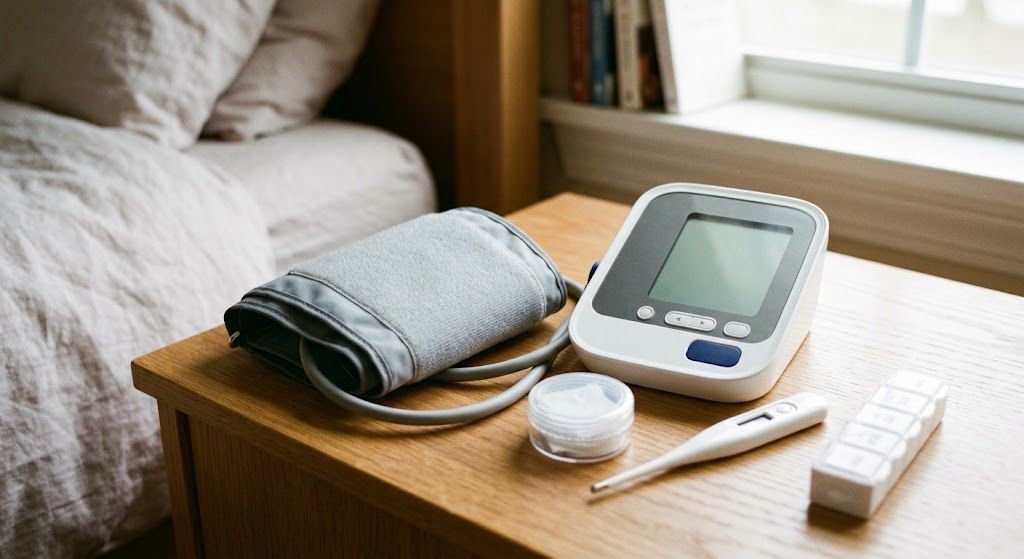
Chronic Condition Monitoring at Home and How To Do It Properly
Chronic Condition Monitoring at Home and How To Do It Properly
Reviewed by Otto R. Garcia MD Internist at Hermosa Medical and Diagnostic Center
Last updated: September 2026
Key takeaways
- Monitoring only works when a specific number is attached to a specific action.
- Blood pressure needs 7 days of readings before an appointment rather than daily forever.
- In heart failure a 3 pound gain in a day or 5 in a week means call the same day.
- An undersized blood pressure cuff can overestimate readings by 10 to 20 points.
- Medicare and many plans now cover remote patient monitoring for chronic conditions.
Start with what to measure and how often because that is the part most people get wrong. Measuring the wrong thing daily is worse than measuring the right thing weekly. It produces anxiety and a notebook nobody uses.
The table below is the whole system in one view. Three things have to be true for home monitoring to work. You measure the right thing. You measure it correctly. You know in advance which number triggers a phone call.
Home monitoring paired with internal medicine care changes outcomes when those three hold. Without the third one it produces data that nobody acts on.
What to measure by condition
|
Condition |
What to measure |
How often |
Call the clinic when |
Equipment cost |
|
High blood pressure |
Blood pressure |
7 day series before each appointment. Twice morning twice evening |
Average above your agreed target or readings frequently above 160 over 100 |
Validated upper arm cuff 40 to 100 dollars |
|
Diabetes on insulin |
Blood glucose or continuous glucose monitor |
Before meals bed driving and exercise |
Below 70 not responding to carbohydrate or any reading above 300 |
Meter and strips or CGM. Often covered |
|
Diabetes without insulin |
Paired glucose before and 2 hours after one meal |
A few times a week |
Consistently above 250 for more than a day |
Meter and strips. Often covered |
|
Heart failure |
Weight |
Every morning without exception |
Gain of 2 to 3 pounds in a day or 5 in a week |
Digital scale 20 to 50 dollars |
|
Asthma and COPD |
Peak flow |
During instability and after treatment changes |
Below 50 percent of personal best |
Peak flow meter 20 to 40 dollars |
|
Chronic kidney disease |
Blood pressure and weight |
As for hypertension plus weekly weight |
Reduced urine output persistent swelling increasing fatigue |
As above |
Not sure which numbers should trigger a call in your case? Ask for them in writing at your next visit and put the list on the refrigerator. Call 773 772 8876 or book an appointment online.
Why home monitoring changes outcomes
A clinic visit captures one moment while chronic disease happens across months. Home blood pressure readings predict cardiovascular outcomes better than clinic readings do. They also reveal two patterns a clinic visit cannot see. White coat hypertension where pressure is high only in the office and masked hypertension where it is normal in the office and high at home.
Masked hypertension is the dangerous one because it goes untreated. The office reading looks fine and nobody looks further.
For diabetes structured monitoring linked to a plan for acting on the results improves control. Unstructured checking without a response plan does not. That distinction is the difference between a useful habit and a source of worry.
For heart failure weight gain from fluid retention precedes hospital admission by days. Catching it early with a diuretic adjustment prevents the admission entirely.
The common thread across all four is that measurement matters only when a decision is attached to it.
Blood pressure and the errors that ruin readings
Technique errors routinely shift readings by 10 to 20 points which is enough to change a treatment decision wrongly. Eight rules cover it. Validated upper arm cuff. Correct cuff size. Five minutes seated first. Back supported feet flat legs uncrossed. Arm at heart level. Cuff on bare skin. Empty bladder. No caffeine exercise or smoking for 30 minutes.
Cuff size is the most common equipment error by a wide margin. A cuff too small for the arm overestimates pressure significantly. Measure your upper arm circumference once and buy accordingly rather than assuming the standard cuff fits.
Crossed legs raise readings. An unsupported arm raises readings. A full bladder raises readings meaningfully. Talking during measurement raises readings. None of these are trivia. Together they produce the difference between a diagnosis and a normal result.
Take two readings one minute apart and record both. Omron and Withings are two brands making validated upper arm devices. Wrist and finger monitors are less reliable and are not recommended for clinical decisions.
How often. A 7 day series before each appointment rather than indefinite daily checking. Two readings in the morning before medication and before breakfast and two in the evening. Discard the first day and average the rest. Daily monitoring forever produces anxiety and diminishing value once treatment is stable.
What the numbers mean. Home targets sit slightly lower than clinic targets. A home average at or above 130 over 80 generally indicates hypertension. Seek emergency care for a reading above 180 over 120 with chest pain breathlessness severe headache vision change weakness numbness or difficulty speaking. Our notes on high blood pressure symptoms cover what to watch for.
Diabetes monitoring by treatment type
Testing frequency is set by treatment and not by diagnosis. On multiple daily insulin injections or a pump check before each meal before bed before driving and before exercise. On basal insulin only a fasting morning reading most days is usually enough. On oral medication alone routine daily checking adds limited value for many people.
Paired testing teaches more than routine checking for people not on insulin. Test before a specific meal and again two hours after it a few times a week. That pair shows you what that meal actually does to your glucose which a single fasting number never reveals.
Continuous glucose monitoring is increasingly standard for people on insulin and is covered by many plans including Medicare for those who meet criteria. Dexcom and FreeStyle Libre are two systems in wide use. Users track time in range which is the percentage of readings between 70 and 180 with 70 percent or more a common goal.
Common general targets are 80 to 130 before meals and below 180 two hours after with hemoglobin A1c below 7 percent. Targets are individualized. Older adults and those with significant other conditions often carry looser targets deliberately because hypoglycemia is more dangerous than mildly raised glucose in that group.
Foot checks. Daily visual inspection of both feet including between the toes and the soles using a mirror. Diabetic foot ulcers begin small and painless because sensation is reduced. Any new wound that has not begun healing within 2 days warrants a call. Our diabetes management notes cover the rest of the routine.
Heart failure and the daily weight
Daily weight is the most valuable home measurement in heart failure and the most consistently skipped. Weigh at the same time each morning after urinating before eating and in similar clothing. Record it every single day. Call the clinic for a gain of 2 to 3 pounds in one day or 5 pounds in one week.
That gain is fluid and not fat. Nobody puts on three pounds of tissue overnight. It usually means a diuretic adjustment and catching it at three pounds is the difference between a phone call and an admission.
Track symptoms alongside weight. Increasing breathlessness. Needing more pillows to sleep. Waking breathless. Swelling of ankles feet or abdomen. Reduced exercise tolerance. A persistent cough particularly lying down.
Seek emergency care for severe breathlessness at rest chest pain fainting or a rapid irregular heartbeat with dizziness.
Sodium drives fluid retention directly. Most of it comes from processed food restaurant meals and bread rather than the salt shaker which means reading labels changes far more than removing the shaker from the table.
A typical case we see
A man in his sixties from Humboldt Park had heart failure and had been admitted twice in one year. Both admissions followed the same pattern. Gradual breathlessness across a week then an emergency visit.
He owned a scale. He weighed himself occasionally and had never been given a number that meant anything. Nobody had told him what gain to act on.
The change was not a new medication. It was a written instruction taped to the bathroom mirror. Weigh every morning. Call if you gain 3 pounds in a day or 5 in a week. He called twice over the following year. Both times a diuretic adjustment over the phone resolved it. He was not admitted again that year.
*Illustrative example. Composite of common presentations. Not a specific individual and not a testimonial. replace with a real anonymized case from clinic records.*
### Talk to someone about chronic condition monitoring
>
Walk ins are welcome at 2004 N Pulaski Rd in Chicago. No appointment needed.
>
Call 773 772 8876 or book an appointment online
See our Internal medicine services page for what the visit covers
*Hablamos español. Llame al 773 772 8876 para programar su cita.*
Building a system you will actually keep up
Six habits separate monitoring that lasts from monitoring that stops in three weeks. Choose fewer measurements. Attach each one to an existing habit. Use one log. Write the thresholds down. Review it at every appointment. Track medication adherence alongside the numbers.
Three measurements tracked consistently beat eight tracked sporadically. Pick the ones that change decisions.
Attach measurement to something you already do. Weigh after brushing your teeth. Take blood pressure while the morning coffee cools rather than while drinking it.
Use one log and bring it. A notebook works as well as an app provided it arrives at the appointment. Many devices export a report which saves transcription.
Write the thresholds on the refrigerator. For each measurement note the number that triggers a call and the number that triggers emergency care. This single step converts data into action and it is the step almost nobody takes.
Review at every appointment and ask which readings changed the plan. Monitoring that never influences a decision should be reduced or stopped rather than carried out of habit.
Include adherence. Missed doses explain more uncontrolled chronic disease than any other single factor and a weekly pill organizer improves it measurably.
Chicago winter and why numbers drift in January
Blood pressure rises in cold months. The pattern is consistent enough that a January reading series frequently looks worse than a July one in the same person on the same medication. Cold causes blood vessels to constrict which raises pressure directly.
Chicago winters extend that effect across four or five months. Outdoor activity collapses which removes one of the most reliable non drug interventions available. Diet shifts toward heavier sodium. Daylight shortens and sleep patterns change.
Two practical consequences. Do not panic at a January series that runs higher than your summer numbers and do not let a medication be increased on a single cold week without a proper series. And plan indoor activity in November rather than abandoning exercise until spring.
We see this every year across Hermosa Belmont Cragin and Humboldt Park. It is predictable which makes it manageable.
Remote patient monitoring programmes
Medicare and many commercial plans now cover remote patient monitoring for chronic conditions. Devices transmit readings automatically and a clinical team reviews them between visits. These programmes suit hypertension diabetes heart failure and COPD particularly well.
They typically require a minimum number of transmission days each month and include monthly clinical review time.
The value is straightforward. Readings get looked at before a problem becomes an admission rather than at the next appointment six weeks later. For someone managing three conditions at once that gap is where most deterioration happens unnoticed.
Ask whether your practice offers one. If several conditions are in play it is usually worth the enrollment.
What happens at your appointment
Expect 30 to 40 minutes for a chronic care review. Bring your home log your monitoring device and every medication bottle including over the counter products.
Check in. Photo identification insurance card and your medication list. Staff speak English Spanish and Arabic.
Bring the device itself. Your own cuff or meter gets checked against the clinic equipment. A device reading 15 points off explains a great deal and takes two minutes to find.
Technique check. You take a reading while the clinician watches. This finds cuff size errors arm position problems and timing mistakes that no amount of discussion would surface.
Log review. Trends across the last 3 months rather than any single reading. This is where the plan actually gets made.
Blood work. Drawn on site. Kidney function electrolytes hemoglobin A1c lipids and thyroid depending on the conditions in play.
Medication review. Every bottle checked against the record including anything started elsewhere. Nonsteroidal anti inflammatory drugs come up frequently here because they raise blood pressure and reduce kidney blood flow and people rarely think to mention them.
Written thresholds. You leave with the specific numbers that mean call and the numbers that mean emergency. On paper.
Pharmacy. Adjustments filled at the on site pharmacy before you leave.
What Medicaid and Medicare cover for chronic condition monitoring in Chicago
Coverage depends on whether a service is medically necessary or cosmetic and it varies by plan. The summary below reflects how Illinois Medicaid and Medicare generally treat these services. Confirm your own plan before the visit because benefits differ between managed care plans.
Generally covered
- Office visits for chronic disease management and follow up
- Laboratory testing including hemoglobin A1c kidney function and lipids
- Glucose meters test strips and lancets for people with diabetes
- Continuous glucose monitoring for those meeting plan criteria including many on insulin
- Medication on the plan formulary
- Remote patient monitoring under Medicare and many commercial plans
Generally not covered
- Blood pressure cuffs and digital scales in many plans which are classed as general use items
- Fitness trackers and consumer wellness devices
- Brand name medication where a formulary generic exists unless prior authorization is approved
Worth bundling into the same visit
- Annual wellness visit in the same trip
- Influenza and pneumococcal vaccination at the same appointment
- Foot examination and eye referral for people with diabetes
- Prescription pickup at the on site pharmacy
We accept Medicaid and Medicare. Call 773 772 8876 to confirm your plan before the visit. Coverage varies by plan so call to confirm rather than assuming.
Frequently asked questions
How often should I check my blood pressure at home?
Take a 7 day series before each appointment with two readings in the morning and two in the evening. Daily indefinite checking adds anxiety more than value once treatment is stable.
Do I need to check blood sugar if I am not on insulin?
Routine daily checking adds limited value on oral medication alone. Paired testing before and two hours after a specific meal a few times a week is far more informative.
What weight gain matters in heart failure?
Two to three pounds in one day or five pounds in one week. That is fluid retention rather than fat and it usually requires a diuretic adjustment.
Are wrist blood pressure monitors accurate?
They are less reliable than a validated upper arm cuff. Use an upper arm device and confirm the cuff size fits your arm because an undersized cuff can overestimate by 10 to 20 points.
When should I call the clinic versus go to the emergency room?
Call for readings outside your agreed range without severe symptoms. Go to the emergency room for chest pain severe breathlessness confusion fainting weakness numbness or difficulty speaking.
Does Medicare cover remote patient monitoring?
Medicare and many commercial plans cover remote patient monitoring for chronic conditions including hypertension diabetes heart failure and COPD subject to transmission day and review time requirements.
Does Medicaid cover a blood pressure monitor in Illinois?
Coverage for home blood pressure cuffs varies and many plans classify them as general use items that are not covered. Glucose meters and strips for diabetes are generally covered. Call 773 772 8876 to check yours.
Why are my blood pressure readings higher in winter?
Cold causes blood vessels to constrict which raises pressure directly. The seasonal rise is well recognized. Do not let a medication change be made on a single cold week without a full 7 day series.
About the reviewer
Otto R. Garcia MD | Internist | Hermosa Medical and Diagnostic Center
Dr Garcia is a board certified internal medicine specialist at Hermosa Medical Center. He cares for adults across the full range of chronic and acute conditions with a focus on long term disease management. He sees patients in English and Spanish.
Next step
If nobody has given you the exact numbers that should trigger a phone call ask for them in writing at your next visit. That single page prevents more admissions than any device does.
**Go to Internal medicine services** to see what we offer and how to book.
Visit Hermosa Medical and Diagnostic Center
Hermosa Medical and Diagnostic Center has served the Chicago West Side for 33 years. Primary care specialty care laboratory services imaging and an on site pharmacy sit in one building so most visits finish in one trip.
Address 2004 N Pulaski Rd Chicago IL 60639
Phone 773 772 8876
Hours Call 773 772 8876 to confirm current hours
Walk ins Welcome. No appointment needed.
Insurance Medicaid Medicare and most major plans accepted
Languages English Spanish and Arabic
We serve Hermosa Belmont Cragin Humboldt Park Logan Square and Austin.
*Hablamos español. Llame al 773 772 8876 para programar su cita. Se habla español.*
Getting here
We are at 2004 N Pulaski Rd in the Hermosa neighborhood just north of Armitage Ave. Street parking is available on Pulaski Rd and on the surrounding side streets. The CTA 53 Pulaski bus stops directly outside and the 73 Armitage bus runs east from the corner toward the Blue Line.
Embedded Google Map of 2004 N Pulaski Rd Chicago IL 60639. Open in Google Maps (the map embed code is in the markdown version of this file).
Sources
- American Heart Association | Monitoring Your Blood Pressure at Home
- Centers for Disease Control and Prevention | High Blood Pressure
- National Institute of Diabetes and Digestive and Kidney Diseases