


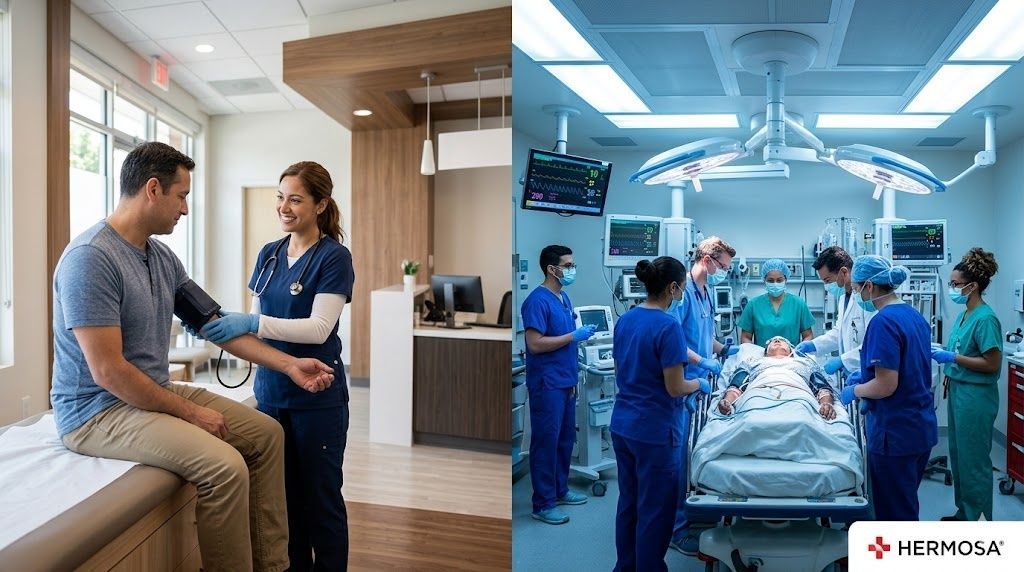
Urgent Care vs Emergency Room: How to Choose the Right Emergency Care
Urgent Care vs Emergency Room: How to Choose the Right Emergency Care
When something goes wrong with your health, the first question most people ask is: do I go to urgent care or the emergency room? It is not always easy to tell. The wrong choice can mean hours of waiting, a bill much larger than expected, or in serious cases, a delay in getting the help you actually need.
This guide walks you through the real difference between urgent care and the emergency room, when each one makes sense, and how to make the right call for yourself or your family without second-guessing every time.
What Is Urgent Care and What Does It Treat
Urgent care is a walk-in clinic that handles illnesses and injuries that need same-day attention but are not life-threatening. You do not need an appointment. You show up, get seen, and go home. Most urgent care centers are open during evenings and weekends, which makes them a practical option when your primary care physician is not available.
Urgent care services cover a wide range of medical conditions. Some of the most common reasons people visit include:
- Fever, cold, flu and sore throat
- Urinary tract infections and acute illness
- Minor cuts that may need stitches
- Sprains, strains and suspected minor fractures
- Ear infections and pink eye
- Skin rashes and mild allergic reactions
- STD testing and same-day screenings
- Basic diagnostic services including X-ray and labs
Urgent care is not just a walk-in clinic for simple problems. Many centers are equipped to handle a real range of sudden illness and non-emergencies that cannot wait for a scheduled appointment.
What Is an Emergency Room and When Do You Go There
The emergency room is part of a hospital and it operates 24 hours a day. It is staffed by emergency medicine physicians, specialists, and nurse practitioners who are trained to handle life-threatening and limb-threatening conditions. The emergency department has surgical teams, advanced imaging, cardiac equipment, and everything needed to manage a serious medical emergency.
You should call 911 or go to the nearest emergency room right away if you or someone with you has:
- Chest pain with shortness of breath or jaw pain
- Stroke symptoms including sudden weakness or slurred speech
- Uncontrolled bleeding or deep traumatic injuries
- Loss of consciousness or seizures
- Severe allergic reaction with throat swelling
- High fever in a newborn under 3 months
- Suspected overdose or poisoning
- Serious illness or injury that is getting worse fast
These are not situations where you wait. The emergency department is built for exactly this level of care and no urgent care center or walk-in clinic can replace it in a true medical emergency.
Urgent Care vs Emergency Room: The Key Differences
A lot of people feel unsure where to go because both options accept walk-in patients and neither requires you to schedule ahead of time. The difference between urgent care and the emergency room comes down to how serious your condition is and what kind of treatment you need.
| Factor | Urgent Care | Emergency Room |
|---|---|---|
| Appointment needed | No | No |
| Hours | Extended hours | Open 24 hours a day |
| Average wait time | 15 to 45 minutes | 2 to 6 hours or more |
| Cost without insurance | $100 to $200 | $1,500 to $3,000 or more |
| Conditions treated | Non-life-threatening | Life-threatening and serious |
| On-site imaging | X-ray, basic labs | Full radiology suite |
| Staffed by | MDs, PAs, NPs | ER physicians and specialists |
When you look at ER vs urgent care wait times, the gap is significant. Emergency rooms triage based on the severity of each case. If your condition is not life-threatening you may wait several hours before being seen, even if you arrived early. Urgent care centers or walk-in clinics move much faster for the kinds of illnesses and injuries they are designed to treat.
Is Urgent Care Cheaper Than the ER
Yes. The cost difference between urgent care vs ER is one of the biggest reasons to choose the right setting from the start. A typical urgent care visit without insurance runs between $100 and $200. An emergency room visit for the same non-emergency condition can cost $1,500 to over $3,000 once facility fees, lab work, and physician fees are added together.
Even with insurance, hospital emergency rooms usually carry a much higher copay or deductible than an urgent care center. For anyone on Medicaid, Medicare, or a standard insurance plan, the out-of-pocket savings from choosing urgent care for a non-emergency can be hundreds of dollars.
Hermosa Medical Center accepts most insurance plans along with Medicaid, Medicare, and cash payments. That makes it one of the most accessible urgent care options in Chicago for children and adults regardless of coverage type.
Should I Go to Urgent Care or the ER: A Symptom Guide
This is the question most people are really asking. The answer depends on the type of illness or injury and whether it puts your life or a limb at risk.
Go to Urgent Care For
- Fever without other severe symptoms (in children and adults over 3 months)
- Nausea, vomiting, or diarrhea that is uncomfortable but not severe
- Minor cuts that may need stitches
- Sprains and minor fractures with no visible deformity
- Urinary tract infection symptoms
- Flu, cold, strep throat, and sinus infections
- Eye irritation or pink eye
- Mild asthma flare-up in a stable patient
- STD screenings and confidential testing
- Allergic reactions without throat swelling or breathing trouble
Go to the ER For
- Chest pain that may signal a heart attack
- Stroke symptoms that appeared suddenly
- Severe difficulty breathing
- Uncontrolled or heavy bleeding
- Major trauma from a car accident or serious fall
- Sudden severe headache unlike anything before
- High fever with neck stiffness or confusion
- Broken bones with numbness, visible deformity, or loss of circulation
- Overdose, poisoning, or a mental health crisis with safety concerns
If you are sick or injured and not sure whether your condition is serious enough for the ER, it is always safer to go. You can never be wrong for choosing care in a situation that could be life-threatening.
Urgent Care for Chest Pain: What You Should Know
This topic comes up often and it is one of the most important. Urgent care for chest pain is not the right choice when that pain could be cardiac. Urgent care centers are not equipped to handle a heart attack. They do not have the cardiac catheterization labs, surgical teams, or emergency medicine specialists that a hospital has.
If chest pain comes with shortness of breath, sweating, arm or jaw pain, or a feeling of pressure, call 911 and go to the emergency room. Do not drive yourself.
That said, not all chest pain is a heart attack. Muscle strain, acid reflux, and cartilage inflammation can all cause discomfort in the chest area. If you have already been evaluated and your doctor knows the cause, a follow-up with a cardiologist is the right next step. Hermosa Medical Center has Dr. Eliyazar Gaddam, MD on staff for cardiac evaluations and ongoing heart health care.
Urgent Care vs Hospital: Understanding the Level of Care
Urgent care and a hospital emergency room are not the same thing and they were never designed to be. A hospital offers inpatient admission, surgical suites, intensive care units, and specialists across every field of medicine. An urgent care center is an outpatient setting. If your condition gets worse while you are there, the staff will stabilize you and send you to the nearest emergency facility.
The difference between urgent care and a hospital becomes clear when you think about what you actually need. For a broken bone that may need surgery, go to the ER. For a broken bone that looks minor and needs an X-ray, urgent care is often the right choice and will save you time and money compared to waiting at a hospital emergency department.
For anything that is ongoing, recurring, or complex, a primary care provider or internal medicine physician is the best long-term option. At Hermosa Medical Center you can access both urgent care and primary care in the same building which removes the need to go anywhere else for follow-up.
ER vs Urgent Care Wait Times and What That Means for You
When you are sick or in pain, waiting is the last thing you want to do. ER vs urgent care wait times are not even close in most situations. Emergency rooms see hundreds of patients and they prioritize based on severity. If your issue is not life-threatening you will wait, sometimes for hours, in a room full of people who may be dealing with serious medical emergencies.
Urgent care centers run on a much tighter schedule. Most patients are seen within 15 to 45 minutes. For after-hours care on evenings and weekends, an urgent care clinic is usually faster and more comfortable for non-emergency conditions than any hospital emergency room.
At Hermosa Medical Center, walk-in patients are seen promptly with no appointment needed. On-site allergy and immunotherapy services, diagnostics, and pharmacy are all available in one visit so you can get in, get treated, and get back to your day.
Common Mistakes People Make When Seeking Care
A lot of unnecessary emergency room bills come from a simple mismatch between the medical need and the care setting. Here are some of the most common mistakes:
- Going to the ER for a UTI, cold, or minor sprain because it felt faster when urgent care would have been both quicker and cheaper
- Going to urgent care for chest pain when it should have been a 911 call
- Waiting too long to seek urgent care for an infection that could have been treated early
- Not knowing that urgent care centers often have on-site MRI and imaging so you avoid a separate referral
- Assuming that the emergency room is always covered better by insurance when urgent care copays are almost always lower
- Skipping primary care entirely when a condition has been going on for weeks and needs a real care plan
Why Choose Hermosa Medical Center for Urgent Care in Chicago
Hermosa Medical Center at 2004 N Pulaski Rd, Chicago, IL 60639 is a multi-specialty medical center that offers urgent care services alongside a full range of specialized care options. You do not have to visit multiple locations to get the help you need.
What makes Hermosa different from a standard urgent care clinic:
- Walk-in urgent care with no appointment needed Monday through Saturday from 9:00 AM to 5:00 PM
- On-site Open MRI, X-ray, ultrasound, Doppler, and EKG for same-day diagnostic services
- Board-certified physicians including specialists in cardiology, gynecology, internal medicine, and psychiatry
- An on-site pharmacy so prescriptions are filled before you leave
- Serves the Chicago community in English, Arabic, and Spanish
- Accepts Medicaid, Medicare, most insurance plans, and cash
Benefits of Choosing Urgent Care Over the ER When Appropriate
- Faster visits: Most urgent care visits are done in under an hour
- Lower cost: You will cost less out of pocket compared to any hospital emergency room for the same non-emergency condition
- No appointment needed: Services are available on a walk-in basis whenever you need care
- Less exposure: Fewer critically ill patients in the waiting area compared to an emergency department
- Convenience: Extended hours including evenings and weekends make after-hours care easier to access
- Complete care at Hermosa: You can see a specialist, fill a prescription, and get imaging all in one visit
Real Patient Experiences at Hermosa Medical Center
A parent brought in their child on a Saturday afternoon with a high fever and a sore throat. They had been worried about a long ER wait but walked into Hermosa instead. Within 90 minutes the child had been seen, diagnosed with strep throat, and the prescription was filled at the on-site pharmacy before they left the building.
A patient came in after rolling their ankle during a soccer game on the weekend. On-site X-ray confirmed no fracture. The ankle was wrapped and the patient left with care instructions and paid an urgent care copay instead of a hospital bill.
Another patient had been experiencing recurring discomfort in their chest for several days. The team at Hermosa evaluated the symptoms, ruled out a cardiac emergency, and referred the patient directly to Dr. Gaddam in cardiology for follow-up without the patient needing to go anywhere else.
Frequently Asked Questions
When should I go to urgent care instead of the emergency room?
Go to urgent care for non-life-threatening conditions like fever, minor injuries, infections, and flu symptoms. If your condition involves chest pain, stroke symptoms, severe bleeding, or loss of consciousness, go to the ER or call 911.
Is urgent care cheaper than the emergency room?
Yes. An urgent care visit typically costs between $100 and $200 without insurance. An ER visit for the same non-emergency condition can run from $1,500 to over $3,000. Most insurance plans also charge a much lower copay for urgent care than for emergency room visits.
How long is the wait at urgent care compared to the ER?
Urgent care centers usually see patients within 15 to 45 minutes. Emergency rooms prioritize life-threatening cases so non-emergency patients can wait 2 to 6 hours or longer depending on how busy the department is.
Can urgent care treat a broken bone?
Urgent care can evaluate and treat minor fractures in areas like fingers, toes, wrists, and feet using on-site X-ray. Complex fractures, open fractures, or injuries with nerve damage should be treated at an emergency room.
Should I go to urgent care or the ER for chest pain?
Chest pain should always be taken seriously. If it comes with shortness of breath, arm or jaw pain, sweating, or nausea call 911 and go to the ER. Mild discomfort from a known non-cardiac cause may be evaluated at urgent care but when there is any doubt the ER is the right choice.
Does Hermosa Medical Center accept walk-in patients?
Yes. Hermosa Medical Center welcomes walk-in patients for urgent care at 2004 N Pulaski Rd, Chicago, IL 60639 during operating hours from 9:00 AM to 5:00 PM. You can also book an appointment online or call 773-772-8876.
Final Thoughts
The choice between urgent care vs emergency room is not complicated once you know what each one is built for. Life-threatening and limb-threatening conditions belong in the emergency department. Everything else, from a sudden illness to a minor fracture to an infection that cannot wait, is exactly what urgent care centers are built to handle.
Choosing the right level of care can save you time and money and in some cases it can get you better treatment faster. If you are in Chicago and you need same-day care without the ER experience, Hermosa Medical Center is open for walk-ins and ready to help. Call 773-772-8876 or visit us at 2004 N Pulaski Rd to get the care you need today.