

Thyroid Ultrasound in Chicago: Nodules, Follow-Up Scans and What Results Mean
Thyroid Ultrasound in Chicago: Nodules, Follow-Up Scans and What Results Mean
Your doctor says you need a thyroid ultrasound and suddenly you're on your phone at midnight reading worst-case scenarios. Here's the thing most of those late-night searches won't tell you: thyroid nodules are incredibly common. They show up on ultrasound in as many as two out of three adults. And the vast majority of them (over 90%) are completely benign.
That doesn't mean you should ignore the scan. It means the scan is doing exactly what it's supposed to do: catching things early so they can be monitored, evaluated and handled properly before they ever become a problem.
A thyroid ultrasound is a painless and radiation-free imaging test that uses sound waves to produce real-time pictures of your thyroid gland. At Hermosa Medical Center in Chicago, we provide on-site thyroid ultrasound in Chicago with same-day scheduling and a care team that speaks English, Arabic and Spanish. Our clinic is located at 2004 N Pulaski Rd, Chicago, IL 60639. A single location where your imaging, lab work and follow-up care happen under one roof.
This guide walks you through everything: what the scan shows, how nodules are classified, when a biopsy is actually needed and what your results mean in plain language.
What Does a Thyroid Ultrasound Show?
A thyroid ultrasound gives your doctor a detailed structural view of the thyroid gland. That's the butterfly-shaped organ sitting at the front of your neck just below your Adam's apple. The scan evaluates the gland's size, shape, position and internal texture. It also images the surrounding structures in the neck including lymph nodes and blood vessels.
But here's something important that catches a lot of patients off guard: ultrasound shows structure, not function. It tells your doctor what the thyroid looks like. It can't tell you how well the thyroid is working. A gland that looks perfectly normal on ultrasound can still be producing too much or too little hormone. And a thyroid full of nodules can be functioning just fine.
What a Thyroid Ultrasound Evaluates
|
Structure / Finding |
What Ultrasound Shows |
Clinical Significance |
|
Thyroid gland size |
Overall dimensions of both lobes and isthmus |
Enlarged gland may indicate goiter, Hashimoto's or Graves' disease |
|
Thyroid nodules |
Solid, fluid-filled or mixed growths within the gland |
Found in up to 67% of adults. Over 90% are benign |
|
Gland texture |
Smooth and uniform vs heterogeneous (patchy) |
Heterogeneous texture suggests Hashimoto thyroiditis or other inflammation |
|
Echogenicity |
How bright or dark the tissue appears |
Hypoechoic (darker) tissue can indicate inflammation or suspicious nodules |
|
Blood flow |
Doppler imaging shows vascularity |
Increased blood flow may indicate Graves' disease or suspicious nodules |
|
Lymph nodes |
Size, shape and internal structure of neck nodes |
Abnormal nodes may suggest thyroid disease spread |
|
Surrounding structures |
Trachea, carotid arteries, jugular veins |
Ensures no compression or displacement from thyroid masses |
Thyroid Ultrasound vs Blood Tests: What Each One Tells You
|
Feature |
Thyroid Ultrasound |
Thyroid Blood Tests |
|
What it measures |
Physical structure of the gland |
Chemical function of the gland |
|
Key findings |
Nodules, cysts, goiter, inflammation and lymph nodes |
TSH, Free T4, Free T3 and thyroid antibodies |
|
Can detect nodules? |
Yes, down to 2 to 3 mm |
No |
|
Can detect hormone problems? |
No |
Yes |
|
Can detect Hashimoto's? |
Shows characteristic texture changes |
Shows TPO antibodies confirming autoimmune cause |
|
When ordered |
Lump felt on exam, abnormal blood tests, symptoms or family history |
Screening, symptom evaluation or monitoring treatment |
|
Radiation |
None |
Not applicable |
That's why thyroid ultrasound is almost always paired with blood tests. The ultrasound shows what's there physically. The blood work shows what's happening chemically. Together they give the full picture.
Why Would Your Doctor Order a Thyroid Ultrasound?
There are several common reasons and not all of them mean something is wrong. Your doctor might order a thyroid ultrasound if:
-
They felt a lump during a neck exam and need to see what it actually is
-
Your thyroid blood tests came back abnormal (elevated or suppressed TSH, abnormal T4 or positive thyroid antibodies)
-
You have symptoms that point to thyroid problems like difficulty swallowing, throat pressure, unexplained hoarseness, visible neck swelling or rapid weight changes
-
You have a family history of thyroid cancer and need baseline imaging
-
You had radiation exposure to the head or neck from medical treatment or environmental sources
-
You're being monitored for a previously found nodule that needs periodic tracking
I've noticed that patients are often surprised when the ultrasound is ordered after a normal blood test. But remember: a normal TSH doesn't mean the gland's structure is normal. And structural findings on ultrasound don't necessarily mean your thyroid function is impaired.
How to Prepare for a Thyroid Ultrasound
This is one of the easiest imaging tests to prepare for. There's almost nothing you need to do.
Step-by-Step Preparation
-
Eat and drink normally. No fasting required. No full bladder. No dietary restrictions of any kind.
-
Take your regular medications as usual. Including thyroid medications if you're already on them.
-
Wear loose clothing with easy neck access. A V-neck or button-down shirt works well. You won't need to change into a gown.
-
Remove necklaces and jewelry around your neck. Take them off before arriving or at check-in.
-
Arrive 10 to 15 minutes early. Complete any paperwork before your scan time.
-
Bring your doctor's order and insurance card. A physician's order is required for the scan.
That's it. No prep at all compared to an abdominal or pelvic ultrasound. You just show up.
What Happens During a Thyroid Ultrasound?
The procedure is about as straightforward as imaging gets. Here's the step-by-step process.
Step-by-Step: During Your Thyroid Ultrasound
-
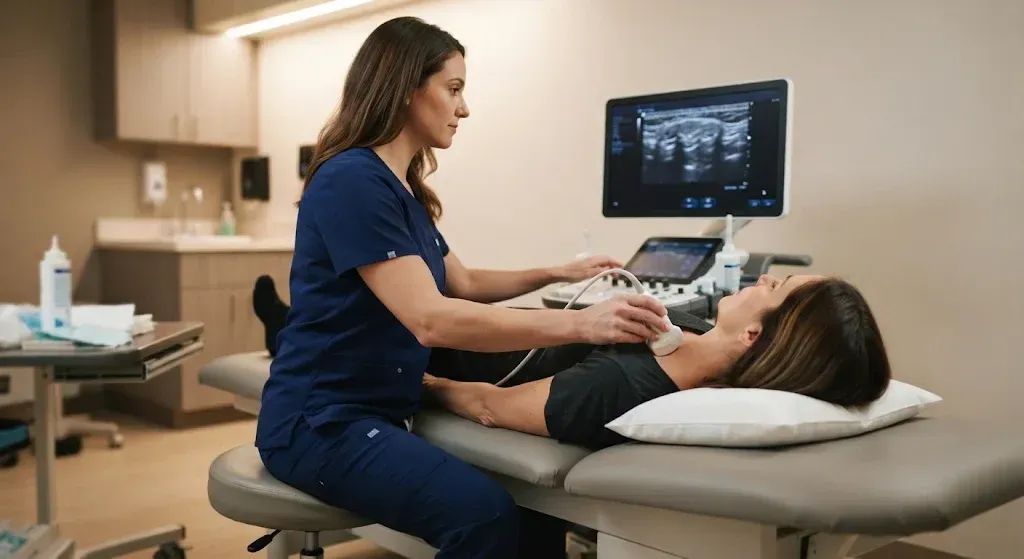
Position yourself on the exam table. You'll lie on your back with a small pillow or rolled towel under your shoulders. This extends your neck slightly and gives the sonographer better access to the thyroid.
-
Gel is applied to your neck. The sonographer applies warm gel to the front and sides of your neck. The gel helps conduct sound waves and prevents air gaps between the transducer and your skin.
-
The sonographer scans your thyroid. A small handheld device called a transducer is placed against your neck and moved slowly across the skin. You'll feel light pressure but no pain.
-
You may be asked to reposition. The sonographer might ask you to turn your head, swallow or hold your breath briefly while they capture specific images.
-
Both lobes and the isthmus are scanned. The sonographer captures images of the entire thyroid gland from multiple angles.
-
Lymph nodes are checked. The surrounding neck area is also scanned for any enlarged or abnormal lymph nodes.
-
Gel is wiped off and you're done. No recovery time. No restrictions. You can eat, drive, exercise and take your medications normally.
The whole scan takes about 15 to 30 minutes. The images are then reviewed by a radiologist who generates a detailed report. That report goes to your ordering physician within 24 to 48 hours.
Understanding Thyroid Nodules: Why They Form and What They Mean
Thyroid nodules are areas of abnormal growth within the thyroid gland. They can be solid, filled with fluid or a mix of both. Some are so small they're only visible on ultrasound. Others grow large enough to feel or even see from the outside.
The truth is, nobody knows exactly why thyroid nodules form in most cases. They're associated with iodine deficiency (less common in the U.S. where salt is iodized), family history, age and female sex. But for a lot of patients there's no identifiable trigger. The nodule just showed up.
And that's usually fine. Most thyroid nodules cause no symptoms, don't affect thyroid function and don't need treatment. They sit there doing nothing. The only reason they were found is that someone looked with an ultrasound.
What matters isn't that you have a nodule. It's what the nodule looks like. And that's where the classification system comes in.
TI-RADS: How Thyroid Nodules Are Scored and Classified
When a radiologist sees a thyroid nodule on ultrasound, they evaluate five specific features and assign a standardized score using ACR TI-RADS (Thyroid Imaging Reporting and Data System) developed by the American College of Radiology.
TI-RADS Scoring Features
|
Feature |
What It Measures |
Points Range |
|
Composition |
Is the nodule solid, cystic or mixed? |
0 to 2 points |
|
Echogenicity |
How bright or dark compared to surrounding tissue? |
0 to 3 points |
|
Shape |
Wider than tall or taller than wide? |
0 to 3 points |
|
Margins |
Smooth and well-defined or irregular and jagged? |
0 to 3 points |
|
Echogenic foci |
Bright spots inside (possible calcifications)? |
0 to 3 points |
Each feature is assigned a point value. The points are added up. The total determines the nodule's TI-RADS level.
TI-RADS Classification Levels
|
TI-RADS Level |
Suspicion Level |
Biopsy Threshold |
Follow-Up Schedule |
Cancer Risk |
|
TR1 |
Benign |
No biopsy at any size |
None needed |
Essentially zero |
|
TR2 |
Not suspicious |
No biopsy at any size |
None needed |
Less than 2% |
|
TR3 |
Mildly suspicious |
Biopsy at 2.5 cm or larger |
At 1, 3 and 5 years (if 1.5 cm+) |
About 5% |
|
TR4 |
Moderately suspicious |
Biopsy at 1.5 cm or larger |
At 1, 2, 3 and 5 years (if 1.0 cm+) |
5 to 20% |
|
TR5 |
Highly suspicious |
Biopsy at 1.0 cm or larger |
Annual for up to 5 years (if 0.5 cm+) |
Over 20% |
And here's the part that most patients find reassuring: nodules smaller than 5 millimeters don't require follow-up even if they score as TR5, because the likelihood of clinically significant malignancy at that size is extremely low. If a nodule shows no change in size over a 5-year surveillance period, it's generally considered benign in behavior and no further follow-up is needed.
The TI-RADS system exists specifically to prevent unnecessary biopsies while making sure truly suspicious nodules don't slip through.
When Is a Thyroid Biopsy Needed?
A fine needle aspiration biopsy (FNA) is the next step when a nodule meets certain size and suspicion criteria based on its TI-RADS score.
Step-by-Step: What Happens During a Thyroid Biopsy (FNA)
-
Positioning. You lie on your back with your neck slightly extended, similar to the ultrasound position.
-
Ultrasound guidance. The radiologist uses ultrasound to locate the nodule and guide the needle precisely.
-
Local numbing (optional). Some providers apply a numbing agent to the skin. Others proceed without it since the needle is very thin.
-
Needle insertion. A thin needle is inserted through the skin into the nodule. Most patients describe this as feeling like a blood draw in the neck. Brief pressure and a pinch.
-
Cell collection. The needle collects a small sample of cells from inside the nodule. This may be repeated two to three times to get an adequate sample.
-
Bandage applied. A small bandage covers the insertion site. No stitches needed.
-
Resume normal activities. The procedure takes about 10 to 15 minutes. You can return to your normal routine the same day.
Not every nodule needs a biopsy. The TI-RADS system intentionally sets size thresholds to avoid biopsying small and low-risk nodules that are almost certainly benign. If your doctor recommends a biopsy, it's because your nodule crossed a specific threshold, not because cancer is likely.
What Your Thyroid Ultrasound Results Mean
When you get your results, you'll see a radiologist's report describing the thyroid gland and any findings. Here's how to read the key terms.
Understanding Your Results
|
Result |
What It Means |
Typical Next Steps |
|
Normal thyroid |
Gland is normal in size, shape and texture. No nodules or inflammation |
Nothing further needed unless blood work suggests otherwise |
|
Thyroid nodule(s) found |
One or more growths identified with TI-RADS scoring |
Follow-up monitoring, biopsy or no action based on score and size |
|
Goiter (diffuse) |
Entire gland is enlarged without distinct nodules |
Blood tests to check function. Possible medication |
|
Goiter (nodular) |
Gland enlarged due to multiple nodules |
Individual nodule assessment with TI-RADS scoring |
|
Hashimoto thyroiditis |
Heterogeneous texture, hypoechoic and possibly lobulated gland |
Blood tests for TPO antibodies. Thyroid hormone monitoring |
|
Suspicious lymph nodes |
Enlarged or abnormally shaped nodes near the thyroid |
Further evaluation. May indicate thyroid disease spread |
If your results are unclear or raise questions, your doctor may recommend additional imaging such as an MRI scan or referral to an endocrinologist for specialized evaluation.
Thyroid Ultrasound Cost in Chicago
Cost shouldn't be the reason you skip a scan your doctor ordered. Here's what thyroid ultrasound typically costs in the Chicago area.
Thyroid Ultrasound Cost Comparison
|
Setting |
Estimated Cost (Without Insurance) |
|
Multi-specialty clinic (like Hermosa Medical Center) |
$100 to $300 |
|
Freestanding imaging center |
$150 to $400 |
|
Hospital outpatient department |
$400 to $900+ |
|
Emergency room |
$800 to $1,500+ |
What You'll Pay With Insurance
|
Insurance Situation |
Typical Out-of-Pocket Cost |
|
Insurance with met deductible |
$0 to $50 copay |
|
Insurance with unmet deductible |
Full cost until deductible is met |
|
Medicaid |
$0 in most cases |
|
Medicare |
20% coinsurance after Part B deductible |
|
No insurance (cash pay) |
$100 to $400 at a clinic |
Hermosa Medical Center accepts Medicaid, Medicare, most insurance plans and cash payments. Call 773-772-8876 to ask about current pricing before your appointment.
When to Talk to Your Doctor About a Thyroid Ultrasound
You don't need to wait for something to feel wrong. Talk to your primary care in Chicago doctor or your internal medicine in Chicago provider if you notice any of the following:
-
A visible lump or swelling in the front of your neck
-
Pressure or tightness in your throat that doesn't go away
-
Difficulty swallowing or a sensation that something is stuck
-
A hoarse voice that persists without a cold or other explanation
-
Abnormal thyroid blood test results
-
A family history of thyroid cancer or thyroid disease
If you don't have a regular doctor, Hermosa Medical Center can evaluate your symptoms, order blood work and imaging, and coordinate any specialist referrals. All from one location. For symptoms that feel urgent, our urgent care in Chicago team sees walk-in patients during regular hours.
How to Book Your Thyroid Ultrasound at Hermosa Medical Center
Step-by-Step Booking Process
-
Get your doctor's order. A physician's order is required for a diagnostic thyroid ultrasound.
-
See our primary care or internal medicine team if needed. Don't have a doctor? Our primary care or internal medicine team can evaluate your symptoms and order the scan during the same visit.
-
Call or book online. Call 773-772-8876 or visit hermosamedicalcenter.com/appointment. Same-day appointments are often available.
-
Confirm your insurance. We accept Medicaid, Medicare, most insurance plans and cash. Call ahead to verify coverage.
-
Show up. No fasting. No full bladder. No special prep. Wear comfortable clothing with easy neck access.
-
Get your results. Your ordering physician receives the radiologist's report within 24 to 48 hours and will contact you to discuss findings and next steps.
Frequently Asked Questions About Thyroid Ultrasound
What does a thyroid ultrasound show?
A thyroid ultrasound shows the size, shape and internal structure of the thyroid gland. It detects nodules, cysts, solid masses, goiter, signs of inflammation like Hashimoto thyroiditis and abnormal lymph nodes in the neck. It shows structure, not function. Thyroid hormone levels require a separate blood test.
How do I prepare for a thyroid ultrasound?
No special preparation is needed. You can eat and drink normally, take your regular medications and go about your day as usual. Wear loose clothing with easy neck access and remove necklaces or jewelry before the exam.
Is a thyroid ultrasound painful?
No. The sonographer applies warm gel to your neck and gently moves a handheld transducer across the skin. You may feel mild pressure but the procedure involves no needles, no radiation and no incisions. Most patients describe it as completely comfortable.
How long does a thyroid ultrasound take?
Typically 15 to 30 minutes. If nodules are found and need detailed measurement, the exam may take slightly longer. There's no recovery time afterward. You can resume all normal activities immediately.
What is TI-RADS and how are thyroid nodules classified?
TI-RADS is a standardized scoring system from the American College of Radiology that classifies thyroid nodules based on five ultrasound features: composition, echogenicity, shape, margins and echogenic foci. Each feature earns points. The total score determines a TI-RADS level from TR1 (benign) to TR5 (highly suspicious), which guides whether to recommend monitoring, biopsy or no further action.
When does a thyroid nodule need a biopsy?
Biopsy depends on TI-RADS level and nodule size. TR3 nodules: biopsy at 2.5 cm or larger. TR4 nodules: biopsy at 1.5 cm or larger. TR5 nodules: biopsy at 1.0 cm or larger. TR1 and TR2 nodules don't need biopsy at any size. These thresholds are designed to catch suspicious nodules while avoiding unnecessary procedures on low-risk ones.
Are most thyroid nodules cancerous?
No. Over 90% of thyroid nodules are benign. They're extremely common and detectable by ultrasound in up to 67% of adults. Most are small, cause no symptoms and need only monitoring. The TI-RADS scoring system helps identify which nodules deserve closer attention.
How often should thyroid nodules be monitored?
TR3 nodules: follow-up at 1, 3 and 5 years. TR4 nodules: follow-up at 1, 2, 3 and 5 years. TR5 nodules: annual follow-up for up to 5 years. If a nodule shows no change over a 5-year period, it's generally considered stable and no further follow-up is required.
Can a thyroid ultrasound detect cancer?
Ultrasound can identify features that raise suspicion for cancer including irregular margins, taller-than-wide shape, microcalcifications, solid hypoechoic composition and abnormal lymph nodes. But ultrasound alone can't confirm cancer. A fine needle aspiration biopsy is needed for a definitive diagnosis.
Can a thyroid ultrasound detect Hashimoto's thyroiditis?
Yes. Hashimoto thyroiditis has a characteristic ultrasound pattern: heterogeneous (uneven) texture, decreased echogenicity and sometimes gland enlargement. These findings combined with positive TPO antibodies on blood work strongly suggest the diagnosis.
What is the difference between a thyroid ultrasound and thyroid blood tests?
The ultrasound shows physical structure including gland size, nodules and inflammation. Blood tests (TSH, T4, T3 and antibodies) measure thyroid function. A structurally normal gland can produce abnormal hormone levels and a gland full of nodules can function perfectly. Both tests provide different and complementary information.
What does it mean if my thyroid nodule is hypoechoic?
A hypoechoic nodule appears darker than surrounding thyroid tissue on ultrasound. This feature adds points to the TI-RADS score. Many hypoechoic nodules are still benign but the finding is considered more significant when combined with other suspicious features like irregular margins or microcalcifications.
How much does a thyroid ultrasound cost in Chicago?
At a freestanding clinic or multi-specialty center, a thyroid ultrasound typically costs $100 to $400 without insurance. Hospital-based centers charge more due to facility fees. With insurance, copays usually range from $0 to $50. Hermosa Medical Center accepts Medicaid, Medicare, most plans and cash.
Do I need a referral for a thyroid ultrasound?
Yes, a physician's order is required. If you don't have a doctor, Hermosa Medical Center can evaluate your symptoms and order the scan during the same visit through our primary care or internal medicine teams.
What happens after a thyroid ultrasound finds a nodule?
The radiologist scores each nodule using TI-RADS. Depending on the score and size, your doctor may recommend periodic monitoring with repeat ultrasound, a fine needle aspiration biopsy, thyroid blood tests or referral to an endocrinologist. Most nodules require only monitoring.
What is a fine needle aspiration biopsy of the thyroid?
FNA is a procedure where a thin needle is guided by ultrasound into a thyroid nodule to collect a cell sample. The sample is examined under a microscope to determine if the cells are benign, suspicious or malignant. It takes about 10 to 15 minutes and feels similar to a blood draw.
Where can I get a thyroid ultrasound in Chicago?
Hermosa Medical Center offers on-site thyroid ultrasound with same-day availability at 2004 N Pulaski Rd, Chicago, IL 60639. Call 773-772-8876 or book online at hermosamedicalcenter.com/appointment.
Schedule Your Thyroid Ultrasound at Hermosa Medical Center
Whether you've been putting off a scan your doctor ordered, noticed something in your neck that wasn't there before, or just want answers about a nodule that's been on your mind, we're here. Hermosa Medical Center offers on-site thyroid ultrasound with same-day scheduling, a bilingual team and acceptance of Medicaid, Medicare and most insurance plans.
We're located at 2004 N Pulaski Rd, Chicago, IL 60639. Open Monday through Friday, 9:00 AM to 5:00 PM. We accept Medicaid, Medicare, most insurance plans and cash. Our staff speaks English, Arabic and Spanish.
Call 773-772-8876 or book your appointment online.