

Pelvic Ultrasound: What It Shows, When You Need One and What to Expect
Pelvic Ultrasound: What It Shows, When You Need One and What to Expect
A pelvic ultrasound is one of the most frequently ordered diagnostic imaging tests in women's health. It's also one of the most misunderstood. A lot of patients walk into the imaging room not entirely sure what the scan is looking for, why they need a full bladder, or what the difference is between the two types of pelvic ultrasound their doctor mentioned on the phone.
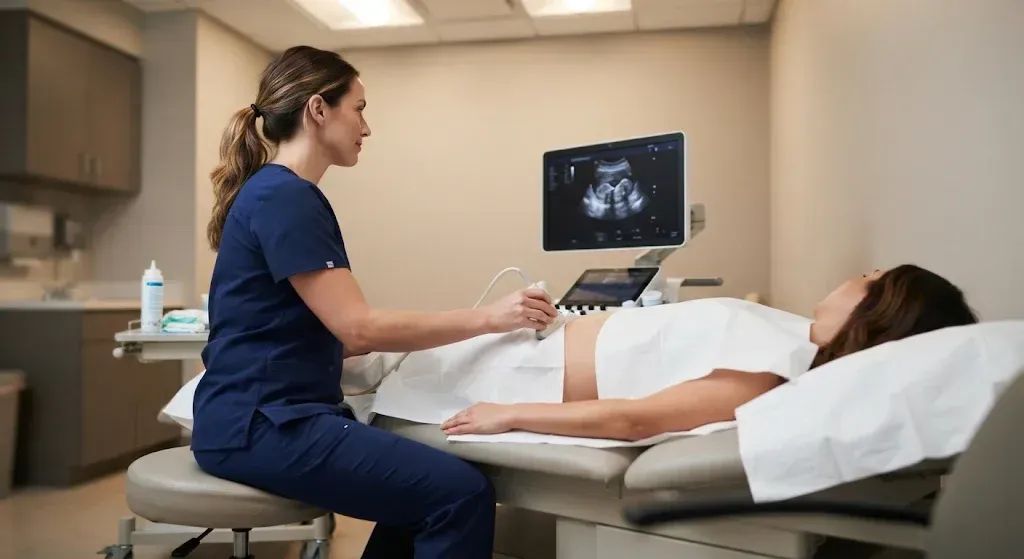
Here's the short version: a pelvic ultrasound uses sound waves to produce real-time images of the organs inside your pelvis. No radiation. No injections. No surgery. It's how your doctor checks for things like ovarian cysts, uterine fibroids, abnormal bleeding, pelvic pain and early pregnancy. All without a single incision.
At Hermosa Medical Center in Chicago, we offer on-site pelvic ultrasound in Chicago with same-day scheduling and a care team that speaks English, Arabic and Spanish. We're located at 2004 N Pulaski Rd, Chicago, IL 60639. Whether your gynecologist ordered this scan or you're trying to figure out what's causing symptoms that won't go away, this guide covers everything you need to know before you walk through the door.
What Does a Pelvic Ultrasound Show?
A pelvic ultrasound gives your doctor a detailed look at the organs and structures in your lower abdomen. The images are captured in real time. That means your doctor isn't looking at a frozen snapshot. They're seeing the actual shape, size, texture and blood flow of your organs as they are right now.
Because ultrasound uses sound waves instead of X-rays, there's zero radiation exposure. It's safe for pregnant women, children and patients who need repeat imaging.
Organs and Structures Evaluated by Pelvic Ultrasound
|
Organ / Structure |
What It Does |
What Ultrasound Evaluates |
|
Uterus |
Houses and nourishes a developing pregnancy |
Size, shape, position, fibroids, polyps, adenomyosis and structural abnormalities |
|
Ovaries |
Produce eggs and hormones |
Cysts, solid masses, signs of PCOS and ovarian torsion |
|
Endometrium |
Inner lining of the uterus that sheds during menstruation |
Thickness, polyps, hyperplasia and signs of endometrial cancer |
|
Fallopian Tubes |
Transport eggs from ovaries to uterus |
Dilation, fluid collection (hydrosalpinx) and ectopic pregnancy |
|
Cervix |
Lower portion of uterus connecting to vagina |
Length (important in pregnancy), masses and structural changes |
|
Bladder |
Stores urine |
Wall thickening, masses and stones |
|
Prostate (men) |
Produces fluid that nourishes sperm |
Enlargement, nodules and structural changes |
I find that most patients don't realize how much information a single 30-minute scan can produce about organs they can't see or feel from the outside.
Common Conditions a Pelvic Ultrasound Can Detect
The list of things a pelvic ultrasound can identify is broader than most patients expect. Here's a breakdown of the most common findings and what they mean.
Conditions Detected by Pelvic Ultrasound
|
Condition |
What It Is |
What Ultrasound Shows |
How Common |
|
Ovarian Cysts |
Fluid-filled sacs on or inside the ovary |
Size, location, simple vs complex structure and blood flow |
Very common. Most resolve on their own |
|
Uterine Fibroids |
Non-cancerous growths in the uterine wall |
Number, size and exact location (subserosal, intramural or submucosal) |
Up to 80% of women by age 50 |
|
Endometrial Polyps |
Growths on the inner lining of the uterus |
Thickened lining and irregularities (sonohysterogram adds clarity) |
Common cause of irregular bleeding |
|
Ectopic Pregnancy |
Fertilized egg implants outside the uterus |
Empty uterus with positive pregnancy test and possible tubal mass |
Medical emergency requiring immediate care |
|
Pelvic Inflammatory Disease (PID) |
Infection of uterus, tubes or ovaries |
Fluid in pelvis, thickened fallopian tubes and tubo-ovarian abscesses |
Often caused by STI bacteria |
|
Endometriosis |
Endometrial tissue growing outside the uterus |
Endometriomas ("chocolate cysts") on ovaries |
Normal scan doesn't rule it out |
|
Ovarian or Uterine Cancer |
Abnormal cell growth in reproductive organs |
Suspicious masses with irregular shape, blood flow and mixed components |
Ultrasound is usually the first test |
|
Adenomyosis |
Endometrial tissue grows into uterine muscle wall |
Enlarged asymmetric uterus with thickened wall |
Common cause of heavy painful periods |
Here's the thing about endometriosis: ultrasound can spot the endometriomas (those characteristic ovarian cysts filled with old blood), but it can't detect every form of the disease. Small implants on the pelvic lining aren't visible on standard imaging. So a normal ultrasound doesn't rule it out.
Transabdominal vs Transvaginal Ultrasound: What's the Difference?
Most pelvic ultrasound appointments involve two types of scans done one after the other during the same visit. They aren't interchangeable. Each one does something the other can't.
Comparison: Transabdominal vs Transvaginal Ultrasound
|
Feature |
Transabdominal |
Transvaginal |
|
How It Works |
Transducer glides across lower abdomen |
Slim probe inserted into vagina |
|
Bladder Requirement |
Full bladder required |
Empty bladder required |
|
Image Type |
Wide-angle overview of entire pelvis |
High-resolution close-up images |
|
Best For |
Large masses, overall organ position and bladder evaluation |
Endometrium detail, small cysts, early pregnancy and IUD checks |
|
Comfort Level |
Mild pressure from full bladder |
Slight pressure similar to a tampon |
|
Duration |
10 to 15 minutes |
5 to 10 minutes |
|
Body Habitus |
May be limited in larger patients |
Not affected by body size |
|
Radiation |
None |
None |
Why Doctors Often Order Both
A comprehensive pelvic ultrasound typically starts with the transabdominal scan (with a full bladder) and then moves to the transvaginal scan (after you empty your bladder). The combination gives your doctor both the big picture and the fine detail. Wide-field context from the abdominal approach and high-resolution close-ups from the vaginal approach. Together they provide the most complete and accurate assessment.
Most patients find the transvaginal scan more comfortable than they expected. The probe is slim and insertion is gentle. If you've used a tampon, the sensation is similar.
How to Prepare for a Pelvic Ultrasound
Preparation depends on which type of scan you're having. In most cases you're having both. Here's how to get ready.
Step-by-Step Preparation
-
Empty your bladder 90 minutes before your appointment. This gives you a clean starting point for the water-drinking timeline.
-
Drink 32 ounces of water starting one hour before your appointment. That's roughly four glasses. Drink steadily over 15 to 20 minutes rather than chugging it all at once.
-
Do not urinate until after the transabdominal scan is complete. A full bladder acts as an acoustic window that pushes bowel loops aside and lifts the uterus into clearer view.
-
Arrive 15 minutes early. Handle paperwork while your bladder is doing its job. This prevents uncomfortable waiting.
-
Wear loose and comfortable clothing. You'll undress from the waist down and put on a gown. Remove any jewelry around your waist or hips.
-
Take your regular medications as usual. No fasting or dietary restrictions are needed.
-
Let your sonographer know about any latex allergies. The transvaginal probe sheath may contain latex and alternatives are available.
Preparation Quick Reference
|
Preparation Item |
Transabdominal Scan |
Transvaginal Scan |
|
Bladder |
Full (32 oz water, 1 hour before) |
Empty (use bathroom before scan) |
|
Clothing |
Waist-down access needed |
Waist-down gown required |
|
Fasting |
Not required |
Not required |
|
Medications |
Take as usual |
Take as usual |
|
Latex Note |
Not applicable |
Tell sonographer if allergic |
|
Consent |
You can decline |
You can decline |
Timing matters here. If you drink too early, you'll be uncomfortably full or you'll give in and use the bathroom before the scan. If you drink too late, your bladder won't be full enough and the sonographer may ask you to wait and drink more.
What Happens During a Pelvic Ultrasound?
The entire exam typically takes 20 to 30 minutes. Here's what happens step by step.
Step-by-Step: During Your Pelvic Ultrasound
-
Check in and change. You'll check in at the front desk and change into a gown. The sonographer will confirm your identity and review the reason for your scan.
-
Lie on the exam table. You'll lie on your back. For the transabdominal portion, warm gel is applied to your lower abdomen.
-
Transabdominal scan begins. The sonographer glides the transducer across your skin and captures images of your uterus, ovaries, bladder and surrounding structures. You may feel mild pressure.
-
Repositioning as needed. You might be asked to shift your position or hold your breath briefly while the technician gets a particular angle.
-
Bathroom break. Once the abdominal portion is done, you'll use the bathroom and empty your bladder completely.
-
Transvaginal scan begins. You'll return and position yourself on the table with your knees slightly bent. The sonographer gently inserts the slim transvaginal probe. Most patients describe this as tolerable and brief.
-
Close-up imaging. The probe captures detailed images of the uterus, ovaries and endometrium from much closer range.
-
All done. The gel is wiped off and you get dressed. No recovery period. No driving restrictions. No side effects. You can eat, exercise and go about your day normally.
And that's the part most people miss about pelvic ultrasound: the whole thing is remarkably undramatic compared to what patients build it up to be in their heads.
When Should You Ask Your Doctor About a Pelvic Ultrasound?
There's no reason to sit with symptoms that could be easily explained or ruled out with a quick non-invasive scan. Talk to your doctor if you're experiencing any of the following:
-
Persistent pelvic pain that isn't explained by your period
-
Abnormal vaginal bleeding including periods heavier than usual, bleeding between cycles or bleeding after menopause
-
Irregular periods or cycles that have changed in length, frequency or flow
-
Painful or heavy periods that interfere with your daily life
-
Difficulty getting pregnant after six to twelve months of trying
-
A feeling of pressure or fullness in the lower abdomen
-
Pain during intercourse that's new or worsening
-
Urinary symptoms like frequent urination or difficulty emptying the bladder
Your doctor may also order a pelvic ultrasound to follow up on an abnormal pelvic exam, to check IUD placement, to monitor a known cyst or fibroid over time, or to evaluate early pregnancy.
If you don't currently have a primary care doctor or gynecologist, Hermosa Medical Center's primary care in Chicago team or our gynecology in Chicago can evaluate your symptoms, order the appropriate scan and coordinate any specialist referrals. All from one location. For symptoms that feel urgent, our urgent care in Chicago team sees walk-in patients during regular hours.
What Happens After Your Pelvic Ultrasound?
After the scan, a board-certified radiologist reviews the images and generates a detailed report. That report goes to your ordering physician within 24 to 48 hours. Your doctor will then contact you to go over the findings.
Understanding Your Results
|
Result Category |
What It Means |
Typical Next Steps |
|
Normal findings |
All organs appear healthy in size, shape and structure |
Reassurance. Often the end of the workup for mild symptoms |
|
Simple ovarian cyst |
Fluid-filled cyst with no concerning features |
Repeat scan in 6 to 8 weeks to confirm resolution |
|
Uterine fibroids |
Non-cancerous growths identified by size and location |
Treatment discussion based on symptoms. Options range from monitoring to medication to surgery |
|
Endometrial thickening |
Lining thicker than expected for cycle phase |
Further evaluation with sonohysterogram or biopsy |
|
Suspicious mass |
Irregular shape, mixed components or abnormal blood flow |
Specialist referral, additional imaging (MRI) or biopsy |
|
Ectopic pregnancy |
No gestational sac in uterus with positive pregnancy test |
Immediate medical intervention required |
A normal scan doesn't always mean nothing is going on. Some conditions like small endometriosis implants or early-stage pathology aren't visible on standard ultrasound. If your symptoms persist, your doctor may order additional imaging such as an MRI, blood work or a referral for further evaluation.
At Hermosa Medical Center, we coordinate follow-up seamlessly. Our on-site MRI and X-ray imaging in Chicago means you don't need to travel to a separate facility for advanced imaging. And our internal medicine in Chicago team manages chronic conditions and specialist referrals when needed.
Pelvic Ultrasound Cost in Chicago
Cost is one of those things that keeps people from scheduling a scan they actually need. Here's what pelvic ultrasound typically costs in the Chicago area.
Pelvic Ultrasound Cost Comparison
|
Setting |
Estimated Cost (Without Insurance) |
|
Multi-specialty clinic (like Hermosa Medical Center) |
$200 to $400 |
|
Freestanding imaging center |
$250 to $500 |
|
Hospital outpatient department |
$500 to $1,200+ |
|
Emergency room |
$1,000 to $2,500+ |
What You'll Pay With Insurance
|
Insurance Situation |
Typical Out-of-Pocket Cost |
|
Insurance with met deductible |
$0 to $50 copay |
|
Insurance with unmet deductible |
Full cost until deductible is met |
|
Medicaid |
$0 in most cases |
|
Medicare |
20% coinsurance after Part B deductible |
|
No insurance (cash pay) |
$200 to $500 at a clinic |
Hermosa Medical Center accepts Medicaid, Medicare, most insurance plans and cash payments. If you're paying out of pocket, call us at 773-772-8876 to ask about current pricing before your appointment.
Pelvic Ultrasound in Men
While pelvic ultrasound is most commonly associated with women's health, men have pelvic ultrasounds too. In men the scan evaluates the bladder for wall thickening, masses or stones. It checks the prostate gland for enlargement, nodules or structural changes. And it evaluates the seminal vesicles.
A doctor might order a pelvic ultrasound for a man who has difficulty urinating, frequent or urgent urination, pelvic pain, blood in the urine, elevated PSA levels on blood work, or suspected bladder issues. Depending on the clinical question, men may have a transabdominal ultrasound, a transrectal ultrasound or both.
The preparation for men is similar to the transabdominal approach for women. A full bladder is typically required to provide a clear acoustic window to the bladder and prostate.
How to Book Your Pelvic Ultrasound at Hermosa Medical Center
Getting your scan scheduled is straightforward. Here's the process from start to finish.
Step-by-Step Booking Process
-
Get your doctor's order. A physician's order is required for a diagnostic pelvic ultrasound. If you don't have one, we can help.
-
See our primary care or gynecology team if needed. Don't have a doctor? Our primary care or gynecology team can evaluate your symptoms and order the scan during the same visit.
-
Call or book online. Call 773-772-8876 or visit hermosamedicalcenter.com/appointment. Same-day appointments are often available.
-
Confirm your insurance. We accept Medicaid, Medicare, most insurance plans and cash. Call ahead to verify coverage and get an estimate of your costs.
-
Prepare for your scan. Follow the preparation steps above. Drink 32 ounces of water one hour before. Wear comfortable clothing.
-
Arrive 15 minutes early. Complete paperwork and check in with the front desk.
-
Get your results. Your ordering physician will receive the radiologist's report within 24 to 48 hours and contact you to discuss findings and next steps.
Frequently Asked Questions About Pelvic Ultrasound
What does a pelvic ultrasound show?
A pelvic ultrasound shows the uterus, ovaries, fallopian tubes, cervix, endometrium and bladder in women. In men it shows the bladder, prostate and seminal vesicles. It can identify ovarian cysts, uterine fibroids, endometrial polyps, ectopic pregnancy, pelvic inflammatory disease, structural abnormalities, fluid in the pelvis and signs of cancer.
Do I need a full bladder for a pelvic ultrasound?
Yes, for the transabdominal portion. Drink about 32 ounces of water one hour before your appointment and avoid urinating until after that part of the scan. A full bladder acts as an acoustic window that pushes bowel loops aside and lifts the uterus into clearer view. For the transvaginal portion, you'll empty your bladder before it begins.
What is the difference between a transabdominal and transvaginal ultrasound?
A transabdominal ultrasound scans through the lower abdomen using a full bladder and gives a wide overview of the pelvic structures. A transvaginal ultrasound uses a slim internal probe inserted into the vagina with an empty bladder and produces much more detailed close-up images. Most complete pelvic exams include both approaches done during the same appointment.
Is a pelvic ultrasound painful?
No, for most patients. The transabdominal scan may cause mild discomfort from the full bladder and the pressure of the transducer on your skin. The transvaginal scan involves gentle insertion of a probe about the size of a tampon. Most women describe it as brief and tolerable. Patients with conditions like endometriosis or pelvic adhesions may experience slightly more sensitivity.
How long does a pelvic ultrasound take?
A typical pelvic ultrasound takes 20 to 30 minutes. When both transabdominal and transvaginal scans are performed, the appointment may run a bit longer. There's no recovery time afterward. You can drive, eat and resume normal activities immediately.
Can a pelvic ultrasound detect ovarian cysts?
Yes. Pelvic ultrasound is the primary imaging tool for detecting ovarian cysts. It determines the cyst's size, whether it's simple (fluid-filled) or complex (containing solid areas) and whether it shows blood flow. This information helps your doctor decide if the cyst needs monitoring, treatment or further imaging.
Can a pelvic ultrasound detect fibroids?
Yes. Ultrasound detects uterine fibroids and maps their size, number and location. Whether they're on the outer wall (subserosal), within the muscle (intramural) or pushing into the uterine cavity (submucosal). Location matters because it determines whether fibroids are causing your symptoms and which treatments are options.
Can a pelvic ultrasound detect endometriosis?
Partially. Ultrasound can detect endometriomas, the "chocolate cysts" that form on the ovaries when endometrial tissue bleeds into the ovarian space. But it can't reliably detect all forms of endometriosis, particularly small implants on the pelvic peritoneum. A normal ultrasound does not rule out endometriosis.
Can a pelvic ultrasound detect cancer?
A pelvic ultrasound can identify suspicious masses or growths in the ovaries, uterus or surrounding structures based on their appearance, internal structure and blood flow. While it raises the suspicion for cancer, a biopsy or surgical evaluation is needed for a definitive diagnosis. Ultrasound is usually the first step.
Why would a doctor order a pelvic ultrasound?
Doctors order pelvic ultrasounds for pelvic pain, abnormal vaginal bleeding, irregular or heavy periods, difficulty conceiving, suspected cysts or fibroids, abnormal findings during a pelvic exam, IUD placement checks, early pregnancy evaluation and investigation of urinary symptoms. It's often the first imaging test used before more advanced studies.
How much does a pelvic ultrasound cost in Chicago?
At a freestanding clinic or multi-specialty center, a pelvic ultrasound typically costs $200 to $500 without insurance. Hospital-based outpatient imaging charges more due to facility fees. With insurance, copays usually range from $0 to $50. Hermosa Medical Center accepts Medicaid, Medicare, most plans and cash.
Can men get a pelvic ultrasound?
Yes. In men pelvic ultrasound evaluates the bladder, prostate gland and seminal vesicles. Doctors may order it for urinary difficulties, pelvic pain, elevated PSA or suspected prostate enlargement. Men may have a transabdominal or transrectal approach depending on the clinical question.
Do I need a referral for a pelvic ultrasound?
Yes, a physician's order is required for a diagnostic pelvic ultrasound. If you don't have a doctor, Hermosa Medical Center can evaluate you through our primary care, gynecology or urgent care teams and order the scan during the same visit.
How soon do I get pelvic ultrasound results?
Results are typically available within 24 to 48 hours after a radiologist reviews the images. Your ordering physician will contact you to discuss the findings and any follow-up recommendations.
Can a pelvic ultrasound detect pregnancy?
Yes. Pelvic ultrasound confirms pregnancy, estimates gestational age, checks fetal viability and detects ectopic pregnancy. Transvaginal ultrasound is the preferred approach in early pregnancy because it provides more detailed imaging at that stage than transabdominal scanning.
What should I wear to a pelvic ultrasound?
Wear loose and comfortable clothing. You'll undress from the waist down and change into a gown, especially if a transvaginal scan is performed. Remove jewelry around your waist and hips before the exam.
Where can I get a pelvic ultrasound in Chicago?
Hermosa Medical Center offers on-site pelvic ultrasound with same-day availability at 2004 N Pulaski Rd, Chicago, IL 60639. Call 773-772-8876 or book online at hermosamedicalcenter.com/appointment.
Schedule Your Pelvic Ultrasound at Hermosa Medical Center
Whether you're dealing with pelvic pain that won't let up, periods that have changed in ways you can't explain, or a doctor's order you haven't gotten around to filling, we can help. Hermosa Medical Center offers affordable on-site pelvic ultrasound with same-day scheduling, a bilingual care team and acceptance of Medicaid, Medicare and most insurance plans.
We're located at 2004 N Pulaski Rd, Chicago, IL 60639. Open Monday through Friday, 9:00 AM to 5:00 PM. We accept Medicaid, Medicare, most insurance plans and cash. Our staff speaks English, Arabic and Spanish.
Call 773-772-8876 or book your appointment online.