

Open MRI vs Closed MRI: How to Choose the Right Scan for You
Open MRI vs Closed MRI: How to Choose the Right Scan for You
A patient sits in the waiting room holding an MRI order and staring at two words she does not fully understand. Open or closed. The doctor did not explain much beyond that and now she is guessing. This happens more than most people admit. An MRI order shows up after a fall or a stubborn back pain or a heart concern and suddenly the patient has to make sense of machines they have never used before.
Here is the part most people miss. The choice between open and closed is not random and it is not just about comfort. It comes down to what part of the body needs a picture and how clear that picture has to be. Some patients need a stronger magnet for fine detail. Others simply cannot handle a tight tube and need a different setup that still gets the job done.
This article walks through what each machine actually does and how to know which one fits your situation. By the end you will understand the real tradeoffs and you will know how to book the right scan close to home in Chicago.
What Open MRI and Closed MRI Actually Mean
Both machines do the same basic job. They use a strong magnetic field and radio waves to build detailed images of organs bones and soft tissue without any radiation involved. The difference sits in the shape of the machine and the strength of the magnet inside it.
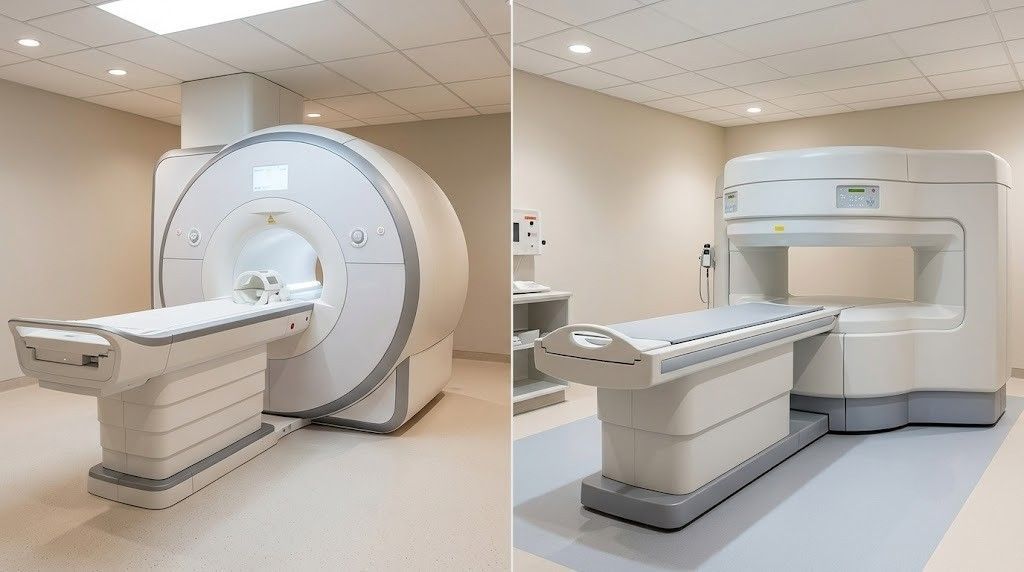
A closed MRI is the tube shaped scanner most people picture when they hear the word MRI. An open MRI trades that tube for a design with more open sides or no sides at all which gives patients more room and more visibility during the scan.
How a Closed MRI Works
A closed MRI machine is built like a long cylinder and the patient lies on a table that slides into the center of it. The magnet wraps completely around the body which is part of why the images come out so sharp. Most closed machines run at a field strength of 1.5T and some run higher which allows for very fine detail on small structures like ligaments nerves and blood vessels.
The tradeoff is space. Once the table moves in the walls sit close to the body and some patients feel boxed in almost right away. The scan also comes with a steady banging or thumping noise while the magnet cycles through different sequences.
How an Open MRI Works
An open MRI machine skips the full tube. Instead the magnets sit above and below the patient with open air on the sides so the patient can see out and does not feel enclosed the same way. A wide bore MRI is a related option. It keeps the tube shape but widens the opening to around 60cm which gives more breathing room than a standard bore without going fully open.
Open machines tend to run at a lower magnetic field strength than a traditional closed system. That does not mean the scan is useless. It means the images work well for many exams and may not be the first pick for the most detail heavy cases.
Differences Between Open and Closed MRI
The two machines are not competing versions of the same thing. They are different tools built for different priorities and the table below breaks down where each one stands.
| Factor | Closed MRI | Open MRI |
|---|---|---|
| Magnet strength | Typically 1.5T or higher | Typically lower field strength |
| Image detail | Very high for fine structures | Good for most standard scans |
| Space | Narrow tube | Open sides or wide bore |
| Scan time | Often faster | Can take longer |
| Noise | Loud banging throughout | Noticeably quieter |
| Best for | Brain spine joints fine detail | Claustrophobia larger patients general imaging |
Magnet Strength and Image Quality
Field strength is measured in Tesla and it directly affects how sharp the final image looks. A 1.5T closed machine can pick up small tears or subtle changes in tissue that a lower strength open machine might miss. For a torn ligament in the knee or a small lesion in the brain that extra clarity actually matters.
That said not every scan needs that level of detail. A general joint scan or a follow up image often comes out perfectly diagnostic on an open system. The right pick depends on what the doctor is actually looking for.
Scan Time
Closed MRI machines usually finish faster because the stronger magnet captures data more efficiently. A standard closed scan might run 30 to 45 minutes depending on the body part. Open MRI scans can run longer since the lower field strength needs more time to build the same level of image data.
For patients with anxiety about staying still that extra time can be a real factor and it is worth discussing with the technologist before the scan starts.
Patient Comfort and Space
This is where open MRI earns its reputation. Patients who are claustrophobic patients often describe the closed tube as the hardest part of the whole appointment and not the scan itself. An open design or a wide bore MRI gives more visual space and for a lot of people that changes the entire experience from stressful to manageable.
Larger patients also benefit here. A traditional closed MRI has a fairly fixed table size and weight limit and an open system can often accommodate a wider range of body types more comfortably.
Noise Level
Every MRI machine makes noise. It comes from the magnetic coils rapidly switching on and off which creates that familiar loud banging sound. Closed machines tend to be louder because the sound reflects off the tube walls right next to the ears. Open machines are not silent but the sound does not bounce back the same way which makes the whole thing feel less intense.
Most centers offer earplugs or headphones for either machine so noise alone should not be the deciding factor.
Which One Is Better for Claustrophobia
Straightforward answer. For patients who are claustrophobic an open MRI or a wide bore MRI is usually the more comfortable choice because it removes the feeling of being sealed inside a narrow tube while still producing images your doctor can use for diagnosis.
That does not mean closed MRI is off the table for anxious patients. Plenty of people manage a closed scan just fine with the right prep and the right mindset going in.
Signs You Might Need an Open MRI
A few signals tend to show up before the appointment even starts. Panic at the thought of small spaces. A history of feeling trapped in elevators or crowded rooms. Difficulty lying flat and still for extended periods. Larger body size that would feel cramped in a standard tube.
If any of that sounds familiar it is worth mentioning to the ordering doctor or the imaging staff ahead of time so they can steer toward the setup that will actually work for the appointment instead of one that gets cut short halfway through.
Ways to Manage Anxiety During a Closed MRI
Even with a closed scan there are real ways to make it easier. Deep slow breathing during the table slide in helps more than people expect. Closing the eyes before entering the tube instead of watching the walls close in can prevent panic before it starts.
A few other things help too. Asking for a mirror that reflects the open room behind you. Requesting music through the headphones. Letting the technologist know you may need a brief pause partway through. None of these are signs of weakness and every imaging team has seen it before.
For patients whose anxiety runs deeper than typical nerves a conversation with the Psychiatry team beforehand can help build a plan for the day of the scan.
Does Open MRI Sacrifice Accuracy
Direct answer for anyone short on time. A modern open MRI does not sacrifice accuracy for most common exams. It produces diagnostic quality images for joints spine and general soft tissue. The accuracy gap only shows up in cases that need extremely fine detail such as certain brain or small nerve studies where a higher field closed system still holds an edge.
That gap is smaller than it used to be. Open MRI technology has improved a lot over the past several years and for the majority of everyday orders the difference between the two is not something a patient would notice in the outcome.
When a Closed MRI Still Wins for Certain Scans
There are specific situations where the stronger magnetic field of a closed system genuinely changes the outcome. Detailed brain imaging. Small nerve or vascular studies. Certain cardiac imaging that needs very precise timing and clarity. In these cases the doctor will usually recommend closed MRI directly and it is worth trusting that call since it comes down to what the images need to show rather than personal preference.
What Each MRI Type Works Best For
Doctors do not pick a machine at random. The choice usually maps pretty closely to the body part and the level of detail the diagnosis requires.
Best Uses for Closed MRI
Closed MRI tends to be the pick for brain imaging spine studies small joint detail and any scan where the smallest structures need to show up clearly. Cardiology referrals for cardiac imaging often lean closed as well because of the precision needed.
Best Uses for Open MRI
Open MRI covers a lot of general imaging needs well. Larger joints. Follow up scans where the diagnosis is already narrowed down. Patients with claustrophobia or larger body size where comfort directly affects whether the scan can even be completed. Primary Care and Internal Medicine referrals for general diagnostic workups often work just fine on an open system.
Cost and Insurance for MRI in Chicago
Cost varies by facility and by the type of scan being ordered rather than by open versus closed alone. Some patients assume open MRI costs less across the board and that is not always true. What matters more is where you get it done and what your insurance plan covers for that location.
Getting an MRI done somewhere that already knows your insurance details and can confirm coverage before the appointment saves a lot of back and forth. That is one advantage of staying with a center you already trust for other care needs.
Insurance Plans Accepted at Hermosa
Hermosa Medical Center accepts Medicaid Medicare BCBS Aetna Cigna Tricare Wellcare and cash which covers a wide range of patients across Chicago without forcing anyone into a separate facility just for imaging.
What to Expect During Your MRI Appointment
Knowing the flow of the appointment ahead of time takes a lot of the guesswork out of the day.
- Confirm your referral and bring any prior imaging results if you have them
- Remove metal items including jewelry watches and anything with a magnetic strip
- Change into a gown if the technologist requests it
- Lie on the table and get positioned for the specific body part being scanned
- Stay still while the machine captures images which can take anywhere from 15 to 45 minutes depending on the scan
- Step off the table once the technologist confirms the images are complete
Before Your Scan
Tell the staff about any metal implants pacemakers or medical devices before the appointment since these can affect whether an MRI is even safe to perform. Mention any past reaction to contrast dye if the scan requires it. Wearing comfortable clothing without metal snaps or zippers makes the whole process smoother.
During the Scan
Staying still is the single biggest factor in getting a clear image the first time. Movement blurs the picture the same way a camera blurs a moving subject and that can mean repeating parts of the scan. The technologist stays in contact through a speaker the entire time and most facilities offer a call button for anything urgent.
After the Scan
There is no recovery time needed for a standard MRI. Patients can drive themselves home and return to normal activity right away unless sedation was used for the appointment. Results typically go back to the ordering doctor within a few business days depending on the complexity of the read.
How to Decide Which MRI Is Right for You
A few honest questions make this decision a lot easier than it feels going in.
- What body part is being scanned and how much fine detail does the diagnosis need
- Do you have a history of claustrophobia or anxiety in tight spaces
- What is your body size relative to a standard closed MRI table
- Did your doctor specify a machine type on the referral or leave it open
- How soon do you need results and does scan time factor into that timeline
Walking through these with the ordering doctor or the imaging staff before booking usually points to a clear answer instead of a guess.
Why Choose Hermosa Medical Center for Your MRI
Hermosa Medical Center has served Chicago for more than 33 years and that kind of history means the team has handled just about every version of this decision before. What makes a real difference for patients is not just having an MRI machine on site but having Primary Care Internal Medicine Cardiology and Urgent Care all working under the same roof so imaging results connect directly back to the doctor managing your care instead of getting lost between separate offices.
On Site MRI and Imaging in Chicago
Hermosa offers on site MRI and X Ray imaging so patients do not have to drive across the city or wait weeks for an outside referral to open up. Everything from the order to the scan to the follow up conversation happens in one place.
Experienced Team and Same Day Availability
Walk in convenience matters when a doctor orders imaging and a patient wants it handled quickly rather than sitting on a calendar for two weeks. The team at Hermosa works to get patients scheduled fast and explains the process clearly before anyone steps into either machine.
Schedule Your MRI at Hermosa Medical Center
If you have an MRI order in hand or you are still working through symptoms with your doctor the team at Hermosa Medical Center can help you figure out which scan fits your situation and get you booked without the runaround. Walk in or call 773 772 8876 to schedule at 2004 N Pulaski Rd Chicago IL 60639 open daily from 9 AM to 5 PM.
Frequently Asked Questions
Is a closed MRI open on both ends?
Yes. A standard closed MRI is a long tube that is open at both ends. You lie on a padded table that slides into the center of the tube. Your head or feet may sit near an opening depending on the body part being scanned. Air and light flow through the tube the whole time.
What does a closed MRI machine look like?
A closed MRI looks like a large ring shaped machine with a narrow tunnel through the middle. A padded table slides you into the tunnel. The opening is about two feet wide and the inside is lit and ventilated. Open MRI machines have a wider and more open design for patients who feel closed in.
Is an open MRI as accurate as a closed MRI?
For most common scans yes. Open MRI produces clear diagnostic images for joints spine and general soft tissue. The accuracy difference only shows up in cases needing very fine detail such as certain brain or nerve studies where a stronger magnet has an edge.
Can I request an open MRI if I am claustrophobic?
In most cases yes. Talk to your doctor or the imaging staff ahead of time so they can confirm an open or wide bore MRI will still capture what your diagnosis needs while keeping you more comfortable during the scan.
How long does an open MRI take compared to a closed MRI?
Closed MRI scans often run 30 to 45 minutes because the stronger magnet captures data faster. Open MRI scans can take a bit longer due to the lower field strength needing more time to build the same image quality.
Does insurance cover open MRI the same as closed MRI?
Insurance coverage usually depends on the diagnosis and the facility rather than the machine type itself. Hermosa Medical Center accepts Medicaid Medicare BCBS Aetna Cigna Tricare Wellcare and cash for imaging services.
What body parts are best scanned with a closed MRI?
Closed MRI tends to work best for brain imaging spine studies and small joint detail where a stronger magnetic field picks up fine structures more clearly than a lower strength system.
Can overweight patients use an open MRI?
Open MRI machines often accommodate a wider range of body types than a standard closed tube since there is no fixed narrow opening limiting table space and positioning.
Is an open MRI noisier or quieter than a closed MRI?
Open MRI tends to feel quieter overall. Closed MRI machines echo the magnetic coil noise inside the tube close to the ears which makes the banging sound feel louder even though both machines produce similar sounds during scanning.
Do I need a referral to get an MRI at Hermosa Medical Center?
Most MRI scans require a doctor referral for insurance purposes. Patients without one can be evaluated on site by the Primary Care or Internal Medicine team to determine if imaging is medically necessary.
How do I know if my doctor ordered an open or closed MRI?
Check the imaging order for the machine type or ask the referring doctor directly. If the order does not specify a type the imaging staff at Hermosa can help determine which system fits the diagnosis.
How soon can I get an MRI appointment in Chicago?
Hermosa Medical Center offers walk in evaluation and works to schedule imaging quickly rather than making patients wait weeks for an outside facility to open up availability.
Share:

Written by