

Diagnostic Ultrasound Near Me: Which Scan Your Doctor Ordered and Why
Diagnostic Ultrasound Near Me: Which Scan Your Doctor Ordered and Why
You got the referral. Maybe it says "abdominal ultrasound" or "pelvic sonogram" or something with "Doppler" in the name. And now you're sitting there wondering what exactly your doctor ordered, whether you need to fast or drink water, and how long it's going to take. That's a pretty normal place to be.
A diagnostic ultrasound is one of the most commonly ordered imaging tests in medicine, and for good reason. It's painless, radiation-free, and gives your doctor real-time images of what's happening inside your body. At Hermosa Medical Center in Chicago, we offer on-site diagnostic ultrasound with same-day scheduling, a care team fluent in English, Arabic and Spanish, and acceptance of Medicaid, Medicare and most insurance plans. We're located at 2004 N Pulaski Rd, Chicago, IL 60639.
But "diagnostic ultrasound" isn't one test. It's a category. And which scan you're getting determines what your doctor is looking for, how you need to prepare and what your results might mean. This guide breaks it all down by scan type so you know exactly what you're walking into.
What Is a Diagnostic Ultrasound?
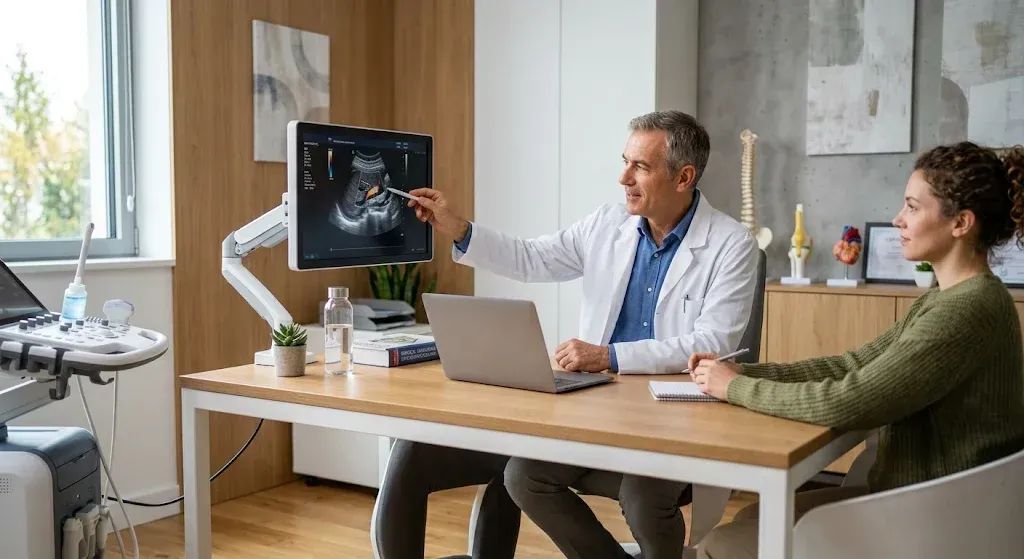
Diagnostic ultrasound uses high-frequency sound waves to create pictures of your internal organs, tissues, blood vessels and other structures. A handheld device called a transducer sends sound waves into your body. Those waves bounce off your organs and return to the transducer, which converts the echoes into images on a screen.
Here's what makes ultrasound different from other imaging: it happens in real time. While an X-ray or CT gives you a frozen snapshot, ultrasound shows movement as it happens. Blood flowing through a vessel. A heart valve opening and closing. A fetus moving. That real-time capability is one of the reasons doctors reach for it first in so many clinical situations.
It also uses zero radiation. No X-rays, no ionizing energy, no cumulative dose to track. That makes it the go-to choice for pregnant patients, children and anyone who needs repeated imaging over time.
And it's quick. Most scans take 15 to 45 minutes, require no anesthesia, no IV contrast and have no recovery period. You walk in, get scanned and leave.
Types of Diagnostic Ultrasound: Complete Comparison
Not all ultrasounds are the same. The type of scan your doctor orders depends on your symptoms, your medical history and which part of your body needs evaluation.
Diagnostic Ultrasound Types at a Glance
|
Scan Type |
What It Evaluates |
Common Reasons Ordered |
Preparation Required |
Duration |
|
Abdominal |
Liver, gallbladder, pancreas, spleen, kidneys, aorta |
Upper abdominal pain, nausea, jaundice, abnormal liver tests, suspected gallstones |
Fast 6 to 8 hours. Water usually OK |
20 to 30 min |
|
Pelvic (Transabdominal) |
Uterus, ovaries, bladder, prostate |
Pelvic pain, irregular periods, suspected cysts or fibroids, abnormal bleeding |
Full bladder (32 oz water 1 hour before) |
20 to 30 min |
|
Pelvic (Transvaginal) |
Uterus, ovaries, cervix (close-up view) |
Same as above plus fertility evaluation and early pregnancy |
Empty bladder |
15 to 20 min |
|
Thyroid |
Thyroid gland, neck lymph nodes |
Neck lump, abnormal thyroid blood tests, nodule monitoring, difficulty swallowing |
None. Remove necklaces |
15 to 30 min |
|
Vascular / Doppler |
Arteries, veins, blood flow |
Leg swelling, blood clot risk, carotid artery screening, varicose veins |
Most need none. Some abdominal vascular studies require fasting |
30 to 45 min |
|
Musculoskeletal |
Joints, tendons, muscles, ligaments, nerves |
Rotator cuff tears, tendinitis, carpal tunnel, plantar fasciitis, soft tissue masses |
None |
15 to 30 min |
|
Obstetric |
Fetus, placenta, amniotic fluid, uterus |
Pregnancy monitoring, due date, fetal anatomy, growth checks |
First trimester may need full bladder. Later scans typically don't |
20 to 45 min |
|
Echocardiogram |
Heart chambers, valves, walls, pumping function |
Shortness of breath, chest pain, heart murmur, heart failure monitoring |
None for standard transthoracic |
30 to 45 min |
Conditions Each Scan Type Can Detect
|
Scan Type |
Key Conditions Detected |
|
Abdominal |
Gallstones, bile duct obstruction, fatty liver, cirrhosis, kidney stones, hydronephrosis, pancreatitis, abdominal aortic aneurysm, spleen enlargement |
|
Pelvic |
Ovarian cysts, uterine fibroids, endometriosis signs, ectopic pregnancy, pelvic masses, bladder abnormalities, prostate enlargement |
|
Thyroid |
Thyroid nodules, goiter, Hashimoto thyroiditis, Graves' disease features, suspicious lymph nodes, thyroid cancer features |
|
Vascular / Doppler |
Deep vein thrombosis (DVT), carotid artery stenosis, peripheral artery disease, abdominal aortic aneurysm, varicose veins, renal artery stenosis |
|
Musculoskeletal |
Rotator cuff tears, tendinitis, bursitis, carpal tunnel syndrome, plantar fasciitis, ganglion cysts, muscle tears, Baker's cysts |
|
Obstetric |
Fetal heart activity, gestational age, fetal anomalies, placenta position, amniotic fluid levels, multiple pregnancy, growth restriction |
|
Echocardiogram |
Valve disease, heart failure, cardiomyopathy, pericardial effusion, congenital heart defects, wall motion abnormalities |
Ultrasound vs MRI vs CT Scan: When to Use Each
This is a question I hear a lot. If MRI shows more detail and CT is faster, why start with ultrasound? The answer depends on what your doctor is trying to find and how quickly they need information. Each tool has strengths. None of them is universally "better."
Imaging Comparison: Ultrasound vs MRI vs CT
|
Feature |
Ultrasound |
MRI |
CT Scan |
|
How it works |
Sound waves |
Magnetic fields and radio waves |
X-ray technology |
|
Radiation |
None |
None |
Yes (ionizing radiation) |
|
Real-time imaging |
Yes |
No |
No |
|
Scan time |
15 to 45 minutes |
20 to 60 minutes |
5 to 15 minutes |
|
Cost without insurance |
$100 to $500 |
$500 to $3,000+ |
$500 to $3,000+ |
|
Best for |
Soft organs, blood vessels, pregnancy, thyroid, guided procedures |
Brain, spine, joints, complex tumors, nerve compression |
Emergency imaging, bone, lungs, kidney stones, trauma |
|
Safe during pregnancy |
Yes |
Generally avoided in first trimester |
No (radiation risk) |
|
Safe for children |
Yes |
Yes (may need sedation) |
Used cautiously (radiation dose) |
|
Limitations |
Can't see through bone or air well |
Expensive, slow, not widely available for same-day |
Radiation exposure, less soft tissue detail |
When Doctors Choose Each Imaging Type
|
Clinical Situation |
First-Line Imaging |
Why |
|
Gallbladder pain or suspected gallstones |
Ultrasound |
Highest accuracy for gallstones, no radiation, fast |
|
Pregnancy monitoring |
Ultrasound |
Only safe real-time option, no radiation |
|
Thyroid nodule evaluation |
Ultrasound |
Best for nodule characterization and TI-RADS scoring |
|
Blood vessel evaluation |
Ultrasound (Doppler) |
Real-time blood flow assessment, no radiation |
|
Emergency abdominal pain |
CT scan |
Fast, comprehensive, rules out life-threatening conditions |
|
Kidney stones |
CT scan |
Highest accuracy, fast, shows stone size and location |
|
Brain or spinal cord conditions |
MRI |
Best soft tissue contrast for neurological structures |
|
Joint or ligament injuries |
MRI |
Detailed views of cartilage, ligaments and tendons |
|
Trauma or car accident |
CT scan |
Speed is critical, shows fractures and internal bleeding |
|
Breast mass evaluation |
Ultrasound |
No radiation, distinguishes solid from cystic masses |
So when your doctor orders an ultrasound, they're saying: this is the right tool for what I'm looking for right now. It's safe and it'll give me the information I need to decide what comes next. If findings are inconclusive, they can step up to CT or MRI.
For situations that do require advanced imaging, Hermosa Medical Center offers on-site MRI and X-ray imaging in Chicago so you don't need to go to a separate facility.
Preparation Quick Reference by Scan Type
This is the part most patients want bookmarked. Preparation varies by scan type, and getting it right matters. Incomplete preparation can affect image quality and may result in needing to reschedule.
Ultrasound Preparation Requirements
|
Scan Type |
Fasting |
Bladder |
Clothing |
Other |
|
Abdominal |
Yes, 6 to 8 hours |
Not required |
Loose top, easy abdomen access |
No gum, candy or tobacco during fast. Water usually OK |
|
Pelvic (Transabdominal) |
No |
Full (32 oz water, 1 hour before) |
Loose pants or skirt |
Don't empty bladder until after scan |
|
Pelvic (Transvaginal) |
No |
Empty |
Comfortable clothing |
If both scans ordered, transabdominal done first with full bladder |
|
Renal (Kidney) |
Some facilities require it |
Moderately full |
Loose top |
Follow your provider's specific instructions |
|
Thyroid |
No |
Not required |
V-neck or button-down shirt |
Remove necklaces and jewelry |
|
Vascular / Doppler |
Some abdominal vascular studies require it |
Not required |
Easy access to scan area |
Varies by vessel being studied |
|
Musculoskeletal |
No |
Not required |
Access to the joint or area |
No restrictions |
|
Echocardiogram |
No |
Not required |
Loose top, easy chest access |
Standard transthoracic only |
|
Obstetric (1st trimester) |
No |
May need full bladder |
Loose clothing |
Follow your OB's instructions |
|
Obstetric (2nd/3rd trimester) |
No |
Not required |
Loose clothing |
No special prep |
When in doubt, call the imaging facility before your appointment. Better to confirm preparation requirements than to show up and learn you needed to fast.
What Happens During a Diagnostic Ultrasound
The procedure is essentially the same across most scan types. Here's exactly what to expect.
Step-by-Step: During Your Diagnostic Ultrasound
-
Check in and confirm your order. You'll verify your identity, insurance and the physician's order at the front desk.
-
Change if needed. Depending on the scan, you may be asked to change into a gown. For thyroid and some vascular scans you can keep your own clothing on.
-
Position yourself on the exam table. You'll lie on your back in most cases. Sometimes on your side depending on what's being scanned.
-
Gel is applied to the scan area. The sonographer applies warm gel to the skin over the area of interest. The gel conducts sound waves and prevents air gaps between the transducer and your skin.
-
The sonographer scans the area. A small handheld transducer is placed against your skin and moved slowly with gentle pressure. You'll see images appearing on the screen in real time.
-
You may be asked to adjust. Hold your breath briefly, change position, roll to one side or swallow so the sonographer can capture specific views.
-
Multiple areas may be scanned. For abdominal studies, the sonographer moves through each organ systematically. For vascular studies, multiple vessels are evaluated.
-
Gel is wiped off and you're done. No recovery time. No restrictions. You can eat, drive, exercise and take your regular medications immediately.
For most people the scan feels like nothing. Mild pressure. Maybe slight coolness from the gel. That's it.
The images are reviewed by a radiologist who generates a written report. That report goes to your ordering physician within 24 to 48 hours. Your doctor contacts you to discuss findings and determine whether any follow-up is needed.
What Your Results Might Say and What Comes Next
After the radiologist reviews your images, the report goes to your ordering doctor. Here's what the most common outcomes look like.
Understanding Your Ultrasound Results
|
Result Category |
What It Means |
Typical Next Steps |
|
Normal findings |
Organs and structures appear normal in size, shape and texture. No masses, fluid collections or abnormalities |
Nothing further needed unless blood work suggests otherwise |
|
Incidental findings |
Something found that wasn't causing your symptoms (small cyst, simple nodule, minor anatomic variant) |
Periodic monitoring or notation in your chart. Vast majority are benign |
|
Findings explaining symptoms |
Gallstones causing pain, ovarian cyst behind pelvic pressure, blood clot causing leg swelling |
Treatment plan: medication, surgery, further imaging or specialist referral |
|
Findings needing further evaluation |
Something that doesn't look clearly benign but can't be fully characterized by ultrasound alone |
CT scan, MRI or biopsy for more information |
|
Urgent findings |
Active bleeding, large blood clot, critical vessel narrowing, ectopic pregnancy |
Immediate physician notification and same-day treatment or referral |
If your results suggest further imaging is needed, Hermosa Medical Center offers on-site MRI and X-ray imaging so follow-up can often be scheduled the same week.
Diagnostic Ultrasound Cost in Chicago
Costs depend on the type of scan, the facility and your insurance status. Here's what to expect.
Cost by Setting
|
Setting |
Estimated Cost (Without Insurance) |
|
Multi-specialty clinic (like Hermosa Medical Center) |
$100 to $500 |
|
Freestanding imaging center |
$150 to $600 |
|
Hospital outpatient department |
$400 to $1,200+ |
|
Emergency room |
$800 to $2,000+ |
Cost by Scan Type (Clinic Setting, Without Insurance)
|
Scan Type |
Typical Cost Range |
|
Thyroid ultrasound |
$100 to $300 |
|
Abdominal ultrasound |
$150 to $400 |
|
Pelvic ultrasound |
$150 to $400 |
|
Vascular / Doppler |
$200 to $500 |
|
Musculoskeletal |
$150 to $400 |
|
Echocardiogram |
$200 to $500 |
|
Obstetric |
$200 to $500 |
What You'll Pay With Insurance
|
Insurance Situation |
Typical Out-of-Pocket Cost |
|
Insurance with met deductible |
$0 to $50 copay |
|
Insurance with unmet deductible |
Full cost until deductible is met |
|
Medicaid |
$0 in most cases |
|
Medicare |
20% coinsurance after Part B deductible |
|
No insurance (cash pay) |
$100 to $500 at a clinic |
Hermosa Medical Center accepts Medicaid, Medicare, most insurance plans and cash. If you're paying out of pocket, ask about pricing when you schedule. Freestanding clinics like ours are almost always less expensive than hospital-based imaging.
When to Talk to Your Doctor About Getting an Ultrasound
You don't always need to wait for your doctor to suggest it. If you're experiencing any of these symptoms, it's worth bringing up at your next visit or scheduling one specifically to discuss it:
-
Persistent abdominal pain, especially in the upper right side where the gallbladder sits
-
Pelvic pain, pressure or abnormal bleeding
-
A lump in your neck, breast or anywhere under the skin that you can feel but can't explain
-
Leg swelling, especially if it's only on one side (this can be a sign of a blood clot)
-
Symptoms of thyroid problems like unexplained weight changes, fatigue or difficulty swallowing
-
Abnormal blood test results pointing to liver, kidney or thyroid issues
-
Shortness of breath or chest pain that may need heart imaging
-
Joint pain, swelling or limited range of motion that isn't improving
Your primary care doctor in Chicago or internal medicine provider can evaluate your symptoms, determine which scan you need and order it during the same visit. At Hermosa Medical Center, on-site imaging means you don't need a referral to a separate facility. For women's health concerns, our gynecology team can also order and coordinate pelvic and obstetric imaging.
How to Book Your Diagnostic Ultrasound at Hermosa Medical Center
Step-by-Step Booking Process
-
Get your doctor's order. A physician's order is required for all diagnostic ultrasound scans.
-
See our primary care or internal medicine team if needed. Don't have a regular doctor? Our team can evaluate your symptoms and order the appropriate scan during the same visit.
-
Call or book online. Call 773-772-8876 or visit hermosamedicalcenter.com/appointment. Same-day appointments are often available.
-
Confirm your insurance. We accept Medicaid, Medicare, most insurance plans and cash. Call ahead to verify coverage and get pricing information.
-
Follow your preparation instructions. Check the preparation table above for your specific scan type. If you're unsure, call when booking and our scheduling team will walk you through it.
-
Arrive 10 to 15 minutes early. Complete any paperwork before your scan time. Bring your insurance card, photo ID and doctor's order.
-
Get your results. Your ordering physician receives the radiologist's report within 24 to 48 hours and will contact you to discuss findings and next steps.
Frequently Asked Questions About Diagnostic Ultrasound
What is a diagnostic ultrasound?
A diagnostic ultrasound is a non-invasive imaging test that uses sound waves to create real-time pictures of organs, tissues and blood vessels inside your body. It involves no radiation and is one of the most commonly ordered imaging studies in medicine. Doctors use it to investigate symptoms, monitor known conditions and guide certain procedures.
What types of diagnostic ultrasound are there?
The most common types include abdominal (liver, gallbladder, kidneys, pancreas, spleen), pelvic (uterus, ovaries, bladder, prostate), thyroid, vascular or Doppler (arteries and veins), musculoskeletal (joints, tendons, muscles), obstetric (pregnancy), echocardiogram (heart) and breast ultrasound. Each scan targets different structures and answers different clinical questions.
How do I prepare for a diagnostic ultrasound?
It depends on the scan. Abdominal ultrasound usually requires 6 to 8 hours of fasting. Pelvic ultrasound may require a full bladder. Thyroid, vascular, musculoskeletal and echocardiogram scans require no special preparation. Always confirm with your scheduling team.
Do I need a doctor's referral for a diagnostic ultrasound?
Yes. Diagnostic ultrasound requires a physician's order. If you don't have a regular doctor, Hermosa Medical Center can evaluate you and order the appropriate scan during the same visit.
How long does a diagnostic ultrasound take?
Most scans take 15 to 45 minutes. A thyroid scan may be done in 15 to 20 minutes. A complete abdominal or vascular study can take 30 to 45 minutes. There's no recovery period. You leave immediately afterward.
Is a diagnostic ultrasound painful?
No. External ultrasound involves no needles and no radiation. You'll feel mild pressure from the transducer and coolness from the gel, but that's it. Internal ultrasounds like transvaginal scans may cause slight discomfort but aren't painful for most patients.
What is the difference between ultrasound and MRI?
Ultrasound uses sound waves to produce real-time images. MRI uses magnetic fields and radio waves for highly detailed soft tissue images. Ultrasound is faster, cheaper and radiation-free. MRI provides greater detail for brain, spine, joint and complex soft tissue evaluation. They answer different questions and are often complementary.
What is the difference between ultrasound and CT scan?
Ultrasound uses sound waves with no radiation. CT uses X-ray technology and involves ionizing radiation. CT is faster for emergency situations and better for bone, lung and deep abdominal imaging. Ultrasound is preferred for pregnancy, children, blood vessel evaluation and situations requiring repeated imaging.
When would my doctor order an ultrasound instead of an MRI or CT?
Doctors typically choose ultrasound first for gallbladder, liver, kidney, thyroid, pelvic and blood vessel evaluation. It's also the default during pregnancy and for pediatric patients. If ultrasound doesn't fully answer the question, your doctor steps up to CT or MRI as needed.
How quickly will I get my ultrasound results?
A radiologist reviews the images and sends a report to your doctor, usually within 24 to 48 hours. In urgent cases, preliminary results may be communicated sooner. Your doctor will contact you to discuss the findings.
Can an ultrasound detect cancer?
Ultrasound can identify masses, nodules and other suspicious findings that raise concern for cancer. But it can't confirm a cancer diagnosis on its own. If something suspicious is found, the next step is usually a biopsy or additional imaging.
What can a diagnostic ultrasound detect?
Gallstones, kidney stones, liver disease, thyroid nodules, ovarian cysts, fibroids, blood clots, arterial narrowing, abdominal aortic aneurysm, appendicitis, tendon tears, breast masses and pregnancy-related findings. What it detects depends on which area is scanned.
Is ultrasound safe during pregnancy?
Yes. Ultrasound is the safest imaging method during pregnancy because it uses no radiation. It's the standard tool for monitoring fetal development, establishing due dates and evaluating the placenta and amniotic fluid.
How much does a diagnostic ultrasound cost in Chicago?
At a clinic or multi-specialty center, expect $100 to $500 without insurance depending on the scan type. Hospital outpatient centers charge more. With insurance, copays are usually $0 to $50. Hermosa Medical Center accepts Medicaid, Medicare, most plans and cash.
Can I get a same-day ultrasound in Chicago?
Yes. Hermosa Medical Center offers same-day diagnostic ultrasound appointments. Call 773-772-8876 or book online at hermosamedicalcenter.com/appointment.
What should I wear to an ultrasound appointment?
Loose, comfortable clothing that allows easy access to the area being scanned. You may be asked to change into a gown. Remove necklaces and jewelry from the area being imaged.
Where can I get a diagnostic ultrasound near me in Chicago?
Hermosa Medical Center provides on-site diagnostic ultrasound including abdominal, pelvic, thyroid, vascular, musculoskeletal and obstetric scans at 2004 N Pulaski Rd, Chicago, IL 60639. Same-day appointments available. Call 773-772-8876 or visit hermosamedicalcenter.com/appointment.
Schedule Your Diagnostic Ultrasound at Hermosa Medical Center
Whether your doctor already ordered a scan or you're looking for a provider who can evaluate your symptoms and order the right imaging in one visit, we're here. Hermosa Medical Center offers on-site diagnostic ultrasound with same-day scheduling, a bilingual care team and acceptance of Medicaid, Medicare and most insurance plans.
We're located at 2004 N Pulaski Rd, Chicago, IL 60639. Open Monday through Friday, 9:00 AM to 5:00 PM. We accept Medicaid, Medicare, most insurance plans and cash. Our staff speaks English, Arabic and Spanish.
Call 773-772-8876 or book your appointment online.