

Abdominal Ultrasound in Chicago: What It Can Detect and How to Prepare
Abdominal Ultrasound in Chicago: What It Can Detect and How to Prepare
An abdominal ultrasound is one of the most common diagnostic imaging tests ordered in medicine and for good reason. It's safe. It's painless. And it gives your doctor a detailed look at what's going on inside your abdomen without any radiation. No needles. No dye injections. Just sound waves and a clear picture.
At Hermosa Medical Center in Chicago we offer on-site abdominal ultrasound in Chicago as part of our diagnostic imaging services. We're located at 2004 N Pulaski Rd Chicago IL 60639 and same-day appointments are available depending on scheduling. If you've been told you need an abdominal ultrasound or you're wondering whether one might help explain your symptoms here's everything you need to know about what the test does and what it finds and how to get ready for it.
What Is an Abdominal Ultrasound?
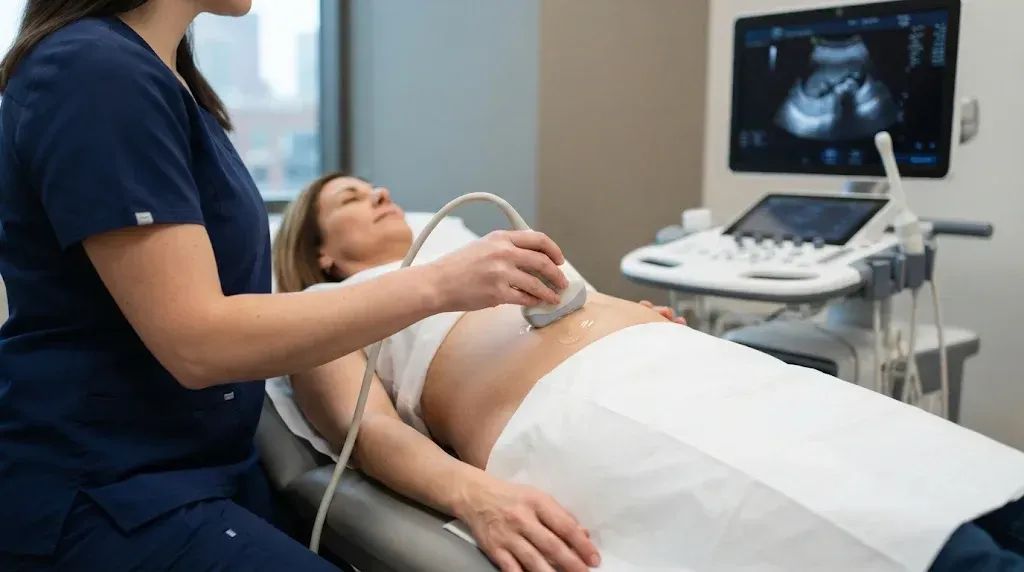
An abdominal ultrasound uses high-frequency sound waves to produce real-time images of the organs and structures in your upper abdomen. A technician called a sonographer places a small handheld device called a transducer against your skin and moves it across your belly. The sound waves bounce off your internal organs to create images on a screen.
It's the same basic technology used in pregnancy scans but instead of looking at a baby it's looking at your liver and gallbladder and kidneys and other abdominal organs. The images are captured in real time which means your doctor can see the actual shape and size and texture of your organs as they appear right now.
Here's the thing that makes abdominal ultrasound particularly valuable: it involves absolutely no ionizing radiation. That matters if you need repeat imaging or if you're pregnant or if you're getting a scan for a child. According to Harvard Health ultrasound poses no documented health risks even when performed multiple times.
What Organs Does an Abdominal Ultrasound Check?
An abdominal ultrasound examines the major organs in your upper belly. Depending on the clinical reason for the scan your doctor may request a complete abdominal ultrasound (which covers all the organs below) or a focused study on a specific area.
Organs Examined During an Abdominal Ultrasound
|
Organ |
What It Does |
What Ultrasound Evaluates |
|
Liver |
Filters toxins and produces bile |
Size, shape, texture, fat content, masses, cysts, signs of cirrhosis |
|
Gallbladder |
Stores bile for fat digestion |
Gallstones, wall thickening, inflammation, bile duct dilation |
|
Kidneys |
Filter waste and produce urine |
Size, stones, cysts, tumors, hydronephrosis (swelling from blocked urine flow) |
|
Pancreas |
Produces digestive enzymes and insulin |
Cysts, tumors, signs of pancreatitis, ductal dilation |
|
Spleen |
Filters blood and supports immune function |
Enlargement (splenomegaly), rupture, structural abnormalities |
|
Abdominal Aorta |
Largest artery delivering blood to lower body |
Diameter measurement, aneurysm detection, wall integrity |
|
Bile Ducts |
Carry bile from liver to small intestine |
Dilation, blockage, stones within the ducts |
I've always thought it's remarkable how much information a single 30-minute scan can provide about organs that would otherwise be invisible without surgery.
Common Conditions an Abdominal Ultrasound Can Detect
The list of conditions an abdominal ultrasound can identify is longer than most people expect. Here's what your doctor may be looking for.
Conditions Detected by Organ
|
Organ/Area |
Conditions Detected |
Key Indicators on Ultrasound |
|
Gallbladder |
Gallstones, cholecystitis, polyps |
Shadowing stones, wall thickening over 3mm, pericholecystic fluid |
|
Liver |
Fatty liver (NAFLD), cirrhosis, tumors, cysts |
Increased echogenicity (brightness), shrunken irregular surface, focal masses |
|
Kidneys |
Stones, hydronephrosis, cysts, tumors, chronic kidney disease |
Echogenic foci with shadowing, dilated collecting system, cortical thinning |
|
Pancreas |
Pancreatitis, cysts, pseudocysts, tumors |
Enlarged gland, ductal dilation, hypoechoic masses |
|
Spleen |
Splenomegaly, infarction |
Length exceeding 12-13cm, wedge-shaped lesions |
|
Abdominal Aorta |
Aneurysm |
Diameter exceeding 3cm (aneurysm), over 5.5cm (surgical evaluation) |
|
Peritoneal Cavity |
Ascites (fluid buildup) |
Free fluid between organs indicating liver disease or heart failure or cancer |
|
Bile Ducts |
Obstruction, choledocholithiasis |
Common bile duct diameter exceeding 6mm, visible stones |
Gallstones and cholecystitis are among the most common findings. The scan can show stones inside the gallbladder and inflammation of the gallbladder wall and blocked bile ducts that may require surgical intervention.
Fatty liver disease has become increasingly common and ultrasound is often the first test to detect it. The liver appears brighter than normal on ultrasound when fat has accumulated. That's a finding that can prompt lifestyle changes before permanent damage sets in.
Kidney stones and hydronephrosis show up when stones block urine flow. For very small stones CT may be more sensitive but ultrasound avoids radiation and is often the starting point.
Abdominal aortic aneurysm is a potentially life-threatening condition that often has no symptoms until it ruptures. Ultrasound is the primary screening tool for this. A bulge exceeding 3cm is considered an aneurysm and findings above 5.5cm typically require surgical evaluation.
How to Prepare for an Abdominal Ultrasound
Preparation for an abdominal ultrasound is straightforward but it does matter. Following the instructions correctly makes the difference between clear diagnostic images and images that are too cloudy to interpret.
Preparation Requirements
|
Preparation Step |
Requirement |
Why It Matters |
|
Fasting |
8 to 12 hours before exam |
Reduces intestinal gas and keeps gallbladder distended |
|
Water intake |
Small sips only during fasting |
Large amounts can distort imaging |
|
Medications |
Take with minimal water (most cases) |
Diabetic patients should consult their doctor about timing adjustments |
|
Clothing |
Loose and comfortable |
Easy access to abdomen is needed |
|
Arrival time |
15 minutes early |
Allows time for paperwork and insurance verification |
|
Items to bring |
Insurance card, photo ID, physician referral |
Required for check-in and billing |
Step-by-Step: How to Prepare for Your Abdominal Ultrasound
-
Schedule a morning appointment. This makes fasting easier since most of your fasting window happens while you sleep. Call Hermosa Medical Center at 773-772-8876 or visit hermosamedicalcenter.com/appointment to book.
-
Stop eating 8 to 12 hours before your scan. No food and no beverages other than small sips of water. An empty stomach reduces intestinal gas and keeps the gallbladder distended for better imaging. When you eat the gallbladder contracts to release bile and a contracted gallbladder is much harder to evaluate.
-
Take your regular medications with minimal water. Most daily medications can be taken on the morning of your scan with a small sip of water. If you're diabetic and on insulin or oral glucose-lowering medications talk to your prescribing doctor first about adjusting the timing or dose to avoid low blood sugar during the fasting window.
-
Wear loose comfortable clothing. Choose clothes that allow easy access to your abdomen. You may be asked to change into a gown. Remove any jewelry or accessories around your waist before the exam.
-
Gather your documents. Bring your insurance card and a photo ID and the physician's referral or order for the scan.
-
Arrive 15 minutes early. Give yourself time to complete paperwork and verify insurance before your scheduled scan time.
What Happens If You Eat Before Your Scan
Eating before an abdominal ultrasound can cause the gallbladder to contract and the intestines to fill with gas. Both of those things significantly reduce image quality. If you accidentally eat before your exam call your imaging facility right away. The appointment may need to be rescheduled for accurate results.
What Happens During an Abdominal Ultrasound
The scan itself is quick and painless. Here's what to expect from start to finish.
Step-by-Step: During Your Abdominal Ultrasound
-
You'll lie on your back on a padded examination table. The room will be dimly lit so the sonographer can see the monitor clearly.
-
The sonographer applies a warm water-based gel to your abdomen. The gel eliminates air pockets between the transducer and your skin which improves sound wave transmission.
-
The transducer is pressed gently against your skin. The sonographer moves it across different areas of your abdomen. You'll see images appear on the monitor in real time though they won't look like an anatomy textbook.
-
You may be asked to hold your breath for a few seconds. This moves the diaphragm out of the way and gives the sonographer a clearer view of the liver and upper abdominal structures.
-
You may be asked to roll onto your side. This helps the technician get a better angle on the kidneys or spleen.
-
The radiologist may request additional views. If something needs a closer look the sonographer will capture extra images of that area.
-
The gel is wiped off and you're done. The whole process typically takes 20 to 30 minutes. You can eat immediately afterward. There's no recovery time and no restrictions on driving and no side effects.
Abdominal Ultrasound vs. CT Scan: Which Is Better?
This is a question patients ask constantly and the honest answer is that it depends on what your doctor is looking for. Ultrasound and CT aren't competitors. They're complementary tools that do different things well.
Abdominal Ultrasound vs. CT Scan Comparison
|
Feature |
Abdominal Ultrasound |
CT Scan |
|
Radiation |
None (uses sound waves) |
Yes (uses X-rays) |
|
Best for |
Gallstones, liver evaluation, kidneys, aorta screening |
Bowel problems, appendicitis, trauma, cancer staging |
|
Safe for pregnancy |
Yes |
No (radiation risk to fetus) |
|
Safe for children |
Yes |
Used when necessary but radiation is a concern |
|
Real-time imaging |
Yes (can watch blood flow and organ movement) |
No (static cross-sectional images) |
|
Cost (Chicago area) |
$150 to $400 at clinic |
$500 to $3,000+ depending on facility |
|
Contrast dye needed |
No |
Often yes (IV contrast) |
|
Scan duration |
20 to 30 minutes |
5 to 15 minutes |
|
Limitations |
Gas and body habitus can obstruct view |
Radiation exposure, higher cost, contrast allergy risk |
When Ultrasound Is the Better Choice
Ultrasound is the first-line imaging test for gallbladder problems including gallstones and cholecystitis. It's also the preferred initial study for evaluating the liver and kidneys and abdominal aorta. For pregnant women and children and patients who need repeat imaging ultrasound is the clear choice because it involves zero radiation.
It's also less expensive. An abdominal ultrasound at a clinic like Hermosa Medical Center costs significantly less than a CT scan and it doesn't carry the facility fees that hospitals add to CT pricing.
And there's one advantage that doesn't get enough attention: ultrasound shows real-time movement. Your doctor can watch blood flow through vessels and observe organ motion and even guide a needle during a biopsy or fluid drainage.
When CT Is the Better Choice
CT scans produce more detailed cross-sectional images and are better at visualizing the bowel and detecting appendicitis and evaluating complex abdominal trauma and identifying bowel obstructions and staging cancers. When a patient arrives at the emergency room with acute severe abdominal pain CT is often the test of choice because of its speed and comprehensive anatomical detail.
The Practical Bottom Line
In many cases your doctor will start with an ultrasound and escalate to CT only if the ultrasound doesn't provide a definitive answer. That's the smart approach. You get the information you need while minimizing radiation exposure and cost. If a CT scan or MRI is needed after your ultrasound Hermosa Medical Center offers on-site MRI and X-ray imaging in Chicago so you don't have to go to a separate facility.
Cost of Abdominal Ultrasound in Chicago
|
Setting |
Self-Pay Cost Range |
Notes |
|
Multi-specialty clinic (like Hermosa) |
$150 to $400 |
No facility fees. Radiologist reading often included |
|
Hospital outpatient department |
$400 to $900+ |
Facility fees add $200 to $500+ to the total |
|
With insurance (copay) |
$0 to $50 |
After deductible is met |
|
Medicaid |
$0 to minimal copay |
Most diagnostic ultrasounds fully covered |
|
Medicare Part B (deductible met) |
20% coinsurance |
Medicare pays 80% of approved amount |
Hermosa Medical Center accepts Medicaid and Medicare and most private insurance plans and cash. Call 773-772-8876 to ask about current pricing and verify your insurance coverage before your appointment.
When Should You Ask Your Doctor About an Abdominal Ultrasound?
Don't wait for pain to become unbearable before bringing it up. An abdominal ultrasound is non-invasive and low-risk and affordable. There's no reason to put it off if your symptoms suggest something might be going on.
Symptoms That Should Prompt an Ultrasound Discussion
-
Persistent pain in the upper right abdomen especially after eating fatty foods (classic gallbladder territory)
-
Unexplained nausea and bloating or loss of appetite that doesn't resolve on its own
-
A feeling of fullness or a palpable mass in the upper abdomen
-
Abnormal liver function tests on blood work
-
Jaundice (yellowing of the skin or eyes)
-
Flank pain or blood in the urine which can point to kidney stones or other kidney problems
-
Family history of abdominal aortic aneurysm especially if you're over 65
-
Unexplained weight loss combined with abdominal discomfort
If you don't currently have a primary care doctor Hermosa Medical Center's primary care in Chicago team can evaluate your symptoms and order the appropriate ultrasound and coordinate any follow-up care all from one location. For urgent symptoms like sudden severe abdominal pain our urgent care in Chicago team can see you on a walk-in basis.
What Happens After Your Abdominal Ultrasound?
After the scan a board-certified radiologist reviews the images and creates a detailed report. That report is sent to your ordering physician within 24 to 48 hours. Your doctor will then call you or schedule a follow-up appointment to discuss the results.
Understanding Your Results
|
Result Category |
What It Means |
Typical Next Steps |
|
Normal |
No significant abnormalities detected |
Routine follow-up. Symptoms may require different testing |
|
Benign finding |
Simple cyst, minor fatty liver, small stable nodule |
Monitoring over time. Repeat ultrasound in 6 to 12 months |
|
Indeterminate |
Finding needs further evaluation to characterize |
CT scan or MRI or blood work for clarification |
|
Abnormal/Concerning |
Suspicious mass, significant aneurysm, obstructed bile duct |
Specialist referral, biopsy, or surgical consultation |
A normal ultrasound is great news but it doesn't always mean the end of the workup. In some cases a normal ultrasound with persistent symptoms may prompt your doctor to order a CT scan or MRI or additional lab work to investigate further.
At Hermosa Medical Center our cardiologist in Chicago can evaluate aortic aneurysm findings while our primary care team coordinates follow-up for liver and kidney and gallbladder issues. And if your doctor wants to compare ultrasound findings with more advanced imaging our on-site MRI and X-ray imaging in Chicago means you don't need to go to a separate facility.
How to Book Your Abdominal Ultrasound
Step-by-Step: Booking at Hermosa Medical Center
-
Get a physician's order. Most diagnostic abdominal ultrasounds require a doctor's order or referral.
-
Don't have a doctor? Visit Hermosa first. Our primary care in Chicago team or urgent care in Chicago team can evaluate your symptoms and order the scan during the same visit.
-
Call to schedule. Call 773-772-8876 or visit hermosamedicalcenter.com/appointment. Let the scheduling team know you need an abdominal ultrasound and they'll confirm your appointment time and provide preparation instructions.
-
Verify your insurance. Call the number on the back of your insurance card or check your plan's portal to confirm that Hermosa Medical Center is in-network and that the scan is covered. If you're on Medicaid or Medicare our team can verify coverage when you call.
-
Prepare the night before. Stop eating 8 to 12 hours before your scheduled scan. Set clothes out that allow easy access to your abdomen.
-
Arrive 15 minutes early. Bring your insurance card and photo ID and referral paperwork.
-
Complete your scan and resume normal activities. The exam takes 20 to 30 minutes. You can eat and drive and go about your day immediately afterward.
Frequently Asked Questions About Abdominal Ultrasound
What does an abdominal ultrasound detect?
An abdominal ultrasound detects conditions affecting the liver and gallbladder and kidneys and pancreas and spleen and abdominal aorta. Common findings include gallstones and kidney stones and fatty liver disease and liver tumors and cysts and fluid buildup in the abdomen and aortic aneurysms and blocked bile ducts.
Do I need to fast before an abdominal ultrasound?
Yes. Most abdominal ultrasounds require fasting for 8 to 12 hours before the exam. Fasting keeps the stomach empty and reduces intestinal gas and ensures the gallbladder remains distended for clearer imaging. Schedule a morning appointment and fast overnight for the easiest preparation.
What organs does an abdominal ultrasound check?
An abdominal ultrasound examines the liver and gallbladder and bile ducts and kidneys and pancreas and spleen and abdominal aorta. Depending on the clinical indication it may also evaluate the bladder and surrounding structures in the upper abdomen.
How long does an abdominal ultrasound take?
A typical abdominal ultrasound takes 20 to 30 minutes. If the radiologist needs additional views of specific areas the scan may take slightly longer. There's no recovery time needed after the exam.
Is an abdominal ultrasound painful?
No. For most patients an abdominal ultrasound is completely painless. You may feel mild pressure from the transducer moving across your abdomen. If your abdomen is already tender due to an existing condition or injury the pressure may cause slight discomfort.
Can an abdominal ultrasound detect cancer?
An abdominal ultrasound can identify suspicious masses or tumors in the liver and kidneys and pancreas and other abdominal organs. However a biopsy or additional imaging such as a CT scan or MRI is typically needed to confirm whether a growth is cancerous.
What is the difference between an abdominal ultrasound and a CT scan?
Ultrasound uses sound waves and involves no radiation. CT scans use X-rays to create detailed cross-sectional images. Ultrasound is the preferred first-line test for gallbladder and liver and kidney evaluation. CT is better for bowel problems and appendicitis and complex trauma and detailed cancer staging. In many cases ultrasound is done first with CT reserved for cases where more detail is needed.
Can I drink water before an abdominal ultrasound?
Small sips of water are usually permitted during the fasting period. Avoid drinking large amounts. If you take daily medications take them with a minimal amount of water. Patients with diabetes should consult their doctor about adjusting medications during the fasting window.
What happens if I eat before my abdominal ultrasound?
Eating before the exam can cause the gallbladder to contract and intestines to fill with gas. Both of those things significantly reduce image quality. If you accidentally eat before your scan call your imaging facility. The appointment may need to be rescheduled for accurate results.
How much does an abdominal ultrasound cost in Chicago?
At a freestanding clinic or multi-specialty medical center an abdominal ultrasound typically costs $150 to $400 without insurance. Hospital outpatient departments charge more due to facility fees. With insurance copays usually range from $0 to $50. Hermosa Medical Center accepts Medicaid and Medicare and most plans and cash.
Can an abdominal ultrasound detect gallstones?
Yes. Ultrasound is considered the gold standard for detecting gallstones. It can also identify gallbladder inflammation (cholecystitis) and thickened gallbladder walls and enlarged bile ducts. All of those may require treatment.
Can an abdominal ultrasound detect kidney stones?
Yes though not all stones are visible on ultrasound. It reliably detects larger stones and can identify hydronephrosis which is swelling of the kidney caused by blocked urine flow. For very small stones CT is often more sensitive.
Do I need a doctor's referral for an abdominal ultrasound?
Yes. A physician's order is required for a diagnostic abdominal ultrasound. If you don't have a primary care provider Hermosa Medical Center can evaluate you through our primary care or urgent care team and order the scan during the same visit.
How quickly do I get abdominal ultrasound results?
Results are typically available within 24 to 48 hours after a radiologist reviews the images. Your ordering physician will contact you to discuss findings and any next steps.
Can an abdominal ultrasound detect liver problems?
Yes. Abdominal ultrasound can identify fatty liver disease and cirrhosis and liver tumors and cysts and changes in liver size or texture. It's often the first imaging test ordered when liver disease is suspected based on symptoms or abnormal blood work.
Where can I get an abdominal ultrasound in Chicago?
Hermosa Medical Center provides on-site abdominal ultrasound at 2004 N Pulaski Rd Chicago IL 60639. Same-day scheduling is available. Call 773-772-8876 or book online at hermosamedicalcenter.com/appointment.
What should I wear to an abdominal ultrasound?
Wear loose comfortable clothing that provides easy access to your abdomen. You may be asked to change into a gown. Remove jewelry around your midsection before the exam. No special clothing is required.
Schedule Your Abdominal Ultrasound at Hermosa Medical Center
Whether your doctor ordered the scan or you're dealing with symptoms that haven't been explained yet we can help. Hermosa Medical Center offers affordable on-site abdominal ultrasound with same-day scheduling and Medicaid and Medicare acceptance and a care team that speaks your language.
We're located at 2004 N Pulaski Rd, Chicago, IL 60639. Open Monday through Friday, 9:00 AM to 5:00 PM. We accept Medicaid, Medicare, most insurance plans, and cash. Our staff speaks English, Arabic, and Spanish.
Call 773-772-8876 or book your appointment online.