


Heavy and Abnormal Periods and What Treatment Looks Like
Heavy and Abnormal Periods and What Treatment Looks Like
Reviewed by Maria M. Munoz MD Gynecologist at Hermosa Medical and Diagnostic Center
Last updated: September 2026
Key takeaways
- The most common mistake is assuming heavy bleeding is normal because a relative had it too.
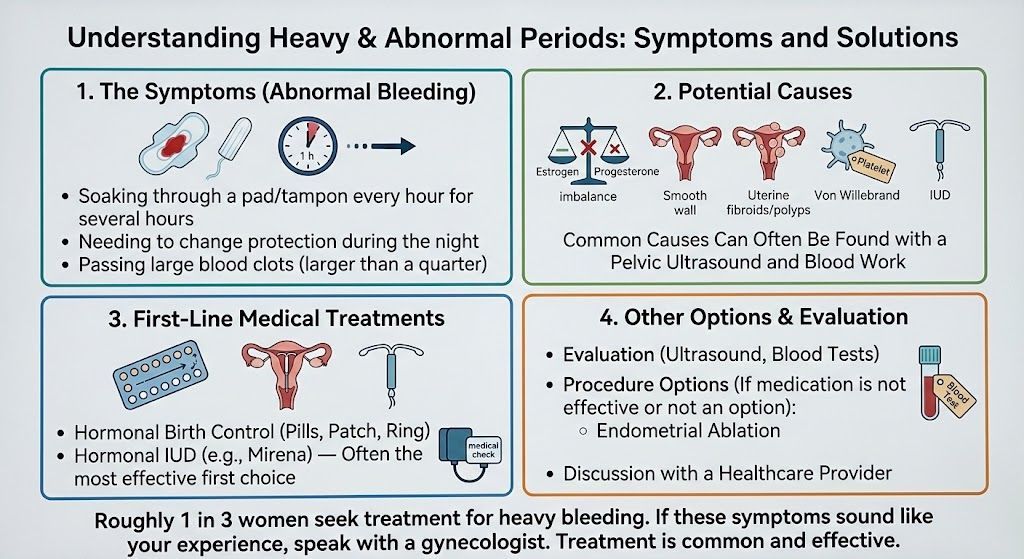
- Soaking a pad or tampon every hour for several hours meets the clinical definition of heavy.
- Roughly 1 in 3 women seeks treatment for heavy bleeding at some point.
- 8 causes account for nearly all of it and most are found with an ultrasound and blood work.
- First line treatment is a hormonal IUD. Most treatment avoids surgery entirely.
The most common mistake with heavy periods is inheriting an assumption rather than a diagnosis.
A mother or a sister describes the same experience. Everybody in the family bleeds like this. So it must be normal. Ten or fifteen years pass and the exhaustion gets blamed on work or age or motherhood.
Sometimes the family pattern is real and it is not normality. Von Willebrand disease is the commonest inherited bleeding disorder and it causes heavy periods from the very first one onward. It runs in families which is exactly why the family pattern is so persuasive and so misleading.
Heavy bleeding is common and treatable by a gynecologist in Chicago. Common is not the same as normal and it is not something to simply absorb.
Treatment options compared
|
Option |
Type |
Time to result |
How long it lasts |
Best for |
Downside |
|
Levonorgestrel IUD |
Medical. In office insertion |
3 to 6 months |
5 to 8 years per device |
First line for heavy bleeding. Also gives contraception |
Irregular spotting in the first 3 to 6 months |
|
Tranexamic acid |
Medical. Bleeding days only |
First cycle |
Only while taken |
Anyone wanting to keep ovulating or trying to conceive |
Does nothing to cycle regularity |
|
Combined oral contraceptive |
Medical. Daily |
1 to 3 cycles |
Only while taken |
Heavy plus irregular cycles plus cramping |
Not suitable for smokers over 35 or certain migraine histories |
|
Progestin only options |
Medical |
1 to 3 cycles |
Only while taken |
When estrogen is contraindicated |
Irregular spotting common |
|
Hysteroscopic polyp or fibroid removal |
Day procedure. No incision |
Next cycle |
Often permanent for that lesion |
Polyps and fibroids inside the cavity |
New fibroids can develop later |
|
Endometrial ablation |
Day procedure |
1 to 3 cycles |
Years |
Heavy bleeding when childbearing is complete |
Not contraception. Pregnancy afterwards is dangerous |
|
Uterine artery embolization |
Interventional radiology |
3 to 6 months |
Years |
Fibroids with uterus preservation |
Not first choice if future pregnancy is planned |
|
Myomectomy |
Surgery |
Next cycle |
Until new fibroids form |
Fibroids with future pregnancy planned |
Surgical recovery |
|
Hysterectomy |
Surgery |
Immediate |
Permanent |
When other options have failed or are unsuitable |
Permanent and ends fertility |
Been told heavy periods run in your family? A blood count and a ferritin level take one draw and settle whether you are anemic. Call 773 772 8876 or book an appointment online.
What counts as abnormal
Bleeding is heavy if you soak a pad or tampon every hour for several consecutive hours pass clots larger than a quarter bleed longer than 7 or 8 days need both a tampon and a pad at once or wake at night to change. A normal cycle runs 24 to 38 days. Any bleeding at all after menopause is abnormal.
Other markers of abnormal bleeding. Bleeding between periods. Bleeding after sex. Cycles shorter than 24 days or longer than 38.
Symptoms of anemia belong on this list too. Fatigue breathlessness pale skin dizziness and unusual cravings for ice all point at iron deficiency from chronic blood loss.
That last point deserves emphasis because it is where most of the avoidable harm sits. Chronic heavy bleeding causes iron deficiency anemia gradually and quietly. People attribute the resulting exhaustion to stress or age or parenting for years when the cause is blood loss that is entirely treatable.
The eight causes that account for nearly all of it
Eight categories cover nearly every case of abnormal uterine bleeding. Fibroids adenomyosis polyps ovulatory dysfunction endometrial causes bleeding disorders medication effects and malignancy. Gynecology uses a structured classification for exactly this reason because the cause determines which treatment works.
Fibroids. Benign muscular growths in the uterine wall. Extremely common. Frequency is higher in Black women with earlier onset and larger fibroids on average. Fibroids pressing into the uterine cavity cause the heaviest bleeding.
Adenomyosis. Uterine lining tissue growing into the muscular wall. Causes heavy bleeding with significant cramping and an enlarged tender uterus. Frequently underdiagnosed.
Polyps. Small benign growths on the lining. Cause bleeding between periods and after sex. Usually straightforward to remove.
Ovulatory dysfunction. When ovulation does not happen regularly the lining builds unopposed and sheds unpredictably. Polycystic ovary syndrome thyroid disease high prolactin perimenopause significant weight change and extreme exercise all cause it. Our guide to PCOS symptoms and treatment covers one of the commonest.
Endometrial causes. Problems with the lining itself including hyperplasia which is thickening that can occasionally progress toward cancer.
Bleeding disorders. Von Willebrand disease is the commonest and a significant cause of heavy periods from the first period onward. Underdiagnosed and worth testing when the history fits.
Medication effects. Copper intrauterine devices commonly increase bleeding. Blood thinners increase it. Some hormonal contraceptives cause irregular spotting particularly in the first months.
Malignancy. Uncommon but important. Endometrial cancer is why any postmenopausal bleeding requires evaluation and why persistent abnormal bleeding over 45 gets a lining biopsy.
What the evaluation involves
A thorough workup is efficient and mostly non invasive. Expect a history a pelvic examination a pregnancy test blood work and a pelvic ultrasound. Most cases are resolved by those five steps in one or two visits. A lining biopsy is added when age or risk factors warrant it.
History. Cycle pattern duration flow volume clot size pain bleeding tendencies elsewhere such as nosebleeds or easy bruising family history medication use and pregnancy history. Bring a record of your last three cycles.
Pregnancy test. Always first in anyone of reproductive age regardless of what the history suggests.
Blood work. Complete blood count for anemia ferritin for iron stores thyroid function and prolactin where ovulatory dysfunction is suspected. Coagulation studies and von Willebrand testing when the history points that way particularly with heavy bleeding since the very first period.
Pelvic ultrasound. The primary imaging test. Identifies fibroids measures lining thickness and assesses the ovaries. Transvaginal imaging gives better detail than abdominal and is done in the same visit here.
Saline infusion sonohysterography. Fluid instilled during ultrasound outlines polyps and submucosal fibroids that plain ultrasound misses.
Endometrial biopsy. An office procedure sampling the lining. Recommended for abnormal bleeding over 45 and in younger patients with risk factors including obesity polycystic ovary syndrome and prolonged unopposed estrogen exposure.
MRI. Used for fibroid mapping before a procedure or when adenomyosis is suspected. Available on site at our imaging centre.
Medical treatment which handles most cases
Most heavy bleeding is treated without surgery. A levonorgestrel intrauterine device is first line in most guidelines and reduces blood loss substantially. Tranexamic acid combined contraceptives progestins and anti inflammatory drugs cover the rest. Iron replacement runs alongside whichever option is chosen.
Levonorgestrel intrauterine device. Mirena and Liletta are two brand names in this category. Reduces blood loss substantially and many users stop bleeding altogether within a year. Lasts 5 to 8 years depending on the device and provides contraception at the same time. Inserted in the office in a few minutes.
Combined oral contraceptives. Regulate cycles reduce flow and reduce cramping. Not suitable for everyone including smokers over 35 and those with certain migraine or clotting histories.
Progestin only options. Oral progestins the injection and the implant. Useful when estrogen is contraindicated.
Tranexamic acid. Sold under the brand name Lysteda among others. Taken only on heavy bleeding days. Reduces blood loss meaningfully and leaves the cycle itself alone which makes it an excellent option for anyone still trying to conceive.
Nonsteroidal anti inflammatory drugs. Taken during bleeding days these reduce both flow and cramping modestly. Inexpensive and available everywhere.
Iron replacement. Essential when anemia or low ferritin is present. Treating the bleeding without replacing iron leaves the exhaustion in place for months afterward and is the commonest reason people say treatment did not help.
Procedural treatment and when it applies
Procedures apply when medical treatment fails when a structural cause needs removing or when childbearing is complete. Options run from a day procedure with no incision through to hysterectomy. The right choice depends heavily on whether future pregnancy is planned.
Hysteroscopic polypectomy or myomectomy. Removal of polyps or submucosal fibroids through the cervix with no abdominal incision. Day procedure with fast recovery.
Endometrial ablation. Destroys the uterine lining. Effective when childbearing is complete. It is not contraception and pregnancy afterwards is dangerous so reliable contraception is required.
Uterine artery embolization. Shrinks fibroids by cutting their blood supply. Preserves the uterus with shorter recovery than surgery.
Myomectomy. Surgical fibroid removal preserving the uterus. The option when future pregnancy is planned.
Hysterectomy. Definitive and permanent. Reserved for cases where other treatments have failed or are unsuitable. It is a reasonable choice and it should be a considered one rather than a default arrived at through exhaustion.
A typical case we see
A woman in her late thirties from Hermosa had bled heavily since her teens. She had been told it ran in the family. She was tired constantly and had been treated for low mood twice over the previous decade.
Blood work showed a hemoglobin at the low end and a ferritin level that was substantially depleted. Ultrasound found two small fibroids that did not fully explain the volume. Her history included frequent nosebleeds and easy bruising which had never been connected to her periods by anyone.
Coagulation testing returned a bleeding disorder diagnosis. Treatment combined tranexamic acid on bleeding days with iron replacement. The exhaustion she had carried for fifteen years resolved over about four months.
*Illustrative example. Composite of common presentations. Not a specific individual and not a testimonial. replace with a real anonymized case from clinic records.*
### Talk to someone about heavy or abnormal bleeding
>
Walk ins are welcome at 2004 N Pulaski Rd in Chicago. No appointment needed.
>
Call 773 772 8876 or book an appointment online
See our Gynecology services page for what the visit covers
*Hablamos español. Llame al 773 772 8876 para programar su cita.*
When to seek care urgently
Go to an emergency department for bleeding that soaks through a pad every hour for 2 or more consecutive hours for dizziness fainting or breathlessness for a rapid heartbeat with heavy bleeding for severe abdominal pain with bleeding or for any heavy bleeding during a known pregnancy.
Make a prompt appointment for any bleeding after menopause for persistent bleeding between periods for bleeding after sex for cycles that suddenly change pattern or for symptoms of anemia.
Postmenopausal bleeding deserves separate emphasis. It is the single most important symptom in gynecology because it is the presenting sign of endometrial cancer in a meaningful proportion of cases. It always requires evaluation and it should never be written off as a last period arriving late.
Managing it while you wait for treatment to work
Four things help in the interval between diagnosis and full effect. Track cycles properly. Address iron actively. Time anti inflammatory drugs before bleeding starts rather than after. Use heat for cramping because the evidence for it is better than most people assume.
Track with an app or a calendar noting flow days protection changes per day clot size and pain level. This turns a vague description into data a clinician can act on and it makes the next appointment shorter and more useful.
Iron rich foods help and supplementation is usually required. Vitamin C improves absorption. Tea coffee and calcium taken at the same time reduce it so separate them by an hour.
Start anti inflammatory drugs a day before bleeding is expected rather than after cramping begins. Prevention works better than rescue here.
Heat genuinely helps cramping. Trials of heat application show effects comparable with some analgesics which makes a hot water bottle a reasonable first line rather than a folk remedy.
What happens at your appointment
Expect 30 to 45 minutes for a first gynecology visit. Bring a record of your last three cycles if you have one because it shortens the visit considerably and improves the plan.
Check in. Photo identification insurance card and your medication list including any blood thinners and supplements. Staff speak English Spanish and Arabic and a female provider is available.
History. Cycle pattern flow volume clot size pain bleeding elsewhere family history and pregnancy history. This is the longest part of the visit and it is where most of the diagnosis happens.
Pregnancy test. Routine for anyone of reproductive age.
Pelvic examination. Brief. Identifies an enlarged uterus visible polyps and cervical causes. You can ask for a chaperone and one is offered regardless.
Pelvic ultrasound. Done on site in the same visit rather than booked for another day. Transvaginal imaging gives the detail needed to see fibroids and measure lining thickness.
Blood draw. Complete blood count ferritin thyroid function and coagulation studies where the history warrants them. Drawn on site.
Endometrial biopsy. Added in the same visit when age or risk factors indicate it. It takes a few minutes and causes cramping similar to a strong period pain.
The plan. Discussed before you leave with the options ranked and the reasoning explained. Prescriptions filled at the on site pharmacy.
What Medicaid and Medicare cover for heavy and abnormal periods in Chicago
Coverage depends on whether a service is medically necessary or cosmetic and it varies by plan. The summary below reflects how Illinois Medicaid and Medicare generally treat these services. Confirm your own plan before the visit because benefits differ between managed care plans.
Generally covered
- Gynecology office visits for evaluation of abnormal bleeding
- Pelvic ultrasound and laboratory testing when medically indicated
- Endometrial biopsy performed in the office
- Contraception including intrauterine device insertion which is a covered benefit without cost sharing under most plans
- Medical treatment on the plan formulary including tranexamic acid and hormonal options
- Iron supplementation when anemia is documented
Generally not covered
- Cosmetic procedures unrelated to the bleeding
- Brand name medication where a formulary generic exists unless prior authorization is approved
- Some fertility services which fall under separate benefit rules
Worth bundling into the same visit
- Annual well woman visit in the same trip
- Cervical cancer screening if you are due one
- Blood pressure weight and thyroid screening at the same draw
- Contraception counselling and prescription at the same appointment
We accept Medicaid and Medicare. Call 773 772 8876 to confirm your plan before the visit. Coverage varies by plan so call to confirm rather than assuming.
Frequently asked questions
What is considered a heavy period?
Soaking a pad or tampon every hour for several hours passing clots larger than a quarter bleeding longer than 7 days needing double protection or waking at night to change.
What causes heavy menstrual bleeding?
Fibroids adenomyosis polyps ovulatory dysfunction including PCOS and thyroid disease endometrial causes inherited bleeding disorders copper intrauterine devices and blood thinners.
Can heavy periods be treated without surgery?
Yes in most cases. A levonorgestrel intrauterine device is first line. Tranexamic acid combined contraceptives progestins and anti inflammatory drugs are further non surgical options.
Is bleeding after menopause ever normal?
No. Any postmenopausal bleeding requires evaluation because it can be the presenting sign of endometrial cancer.
Are heavy periods dangerous?
They commonly cause iron deficiency anemia which produces fatigue breathlessness and poor concentration. The underlying cause sometimes needs prompt treatment which makes evaluation worthwhile.
When should an endometrial biopsy be done?
Generally for abnormal bleeding over 45 and in younger patients with risk factors such as obesity polycystic ovary syndrome or prolonged unopposed estrogen exposure.
Does a hormonal IUD stop periods completely?
It reduces bleeding substantially in most users and many stop bleeding entirely within a year. Irregular spotting is common in the first 3 to 6 months and then settles.
Does Medicaid cover IUD insertion in Illinois?
Contraception including intrauterine device insertion is a covered benefit without cost sharing under most Illinois Medicaid plans. Call 773 772 8876 to confirm yours before the visit.
About the reviewer
Maria M. Munoz MD | Gynecologist | Hermosa Medical and Diagnostic Center
Dr Munoz provides comprehensive care for women of all ages with a focus on prenatal and postnatal care cancer screenings and family planning. She sees patients in English and Spanish.
Next step
If you have never had a blood count and a ferritin level checked start there. One draw tells you whether the exhaustion has a measurable cause and it changes the whole conversation.
Go to Gynecology services to see what we offer and how to book.
Visit Hermosa Medical and Diagnostic Center
Hermosa Medical and Diagnostic Center has served the Chicago West Side for 33 years. Primary care specialty care laboratory services imaging and an on site pharmacy sit in one building so most visits finish in one trip.
Address 2004 N Pulaski Rd Chicago IL 60639
Phone 773 772 8876
Hours Call 773 772 8876 to confirm current hours
Walk ins Welcome. No appointment needed.
Insurance Medicaid Medicare and most major plans accepted
Languages English Spanish and Arabic
We serve Hermosa Belmont Cragin Humboldt Park Logan Square and Austin.
Hablamos español. Llame al 773 772 8876 para programar su cita. Se habla español.
Getting here
We are at 2004 N Pulaski Rd in the Hermosa neighborhood just north of Armitage Ave. Street parking is available on Pulaski Rd and on the surrounding side streets. The CTA 53 Pulaski bus stops directly outside and the 73 Armitage bus runs east from the corner toward the Blue Line.
Embedded Google Map of 2004 N Pulaski Rd Chicago IL 60639. Open in Google Maps (the map embed code is in the markdown version of this file).
Sources
- American College of Obstetricians and Gynecologists | Heavy Menstrual Bleeding
- Centers for Disease Control and Prevention | Bleeding Disorders in Women